World
G7 leaders seek to refocus Trump on Ukraine as war enters 5th year
With the Iran conflict dominating global attention, European allies pressed the US President to sustain support for Kyiv and increase pressure on Russia
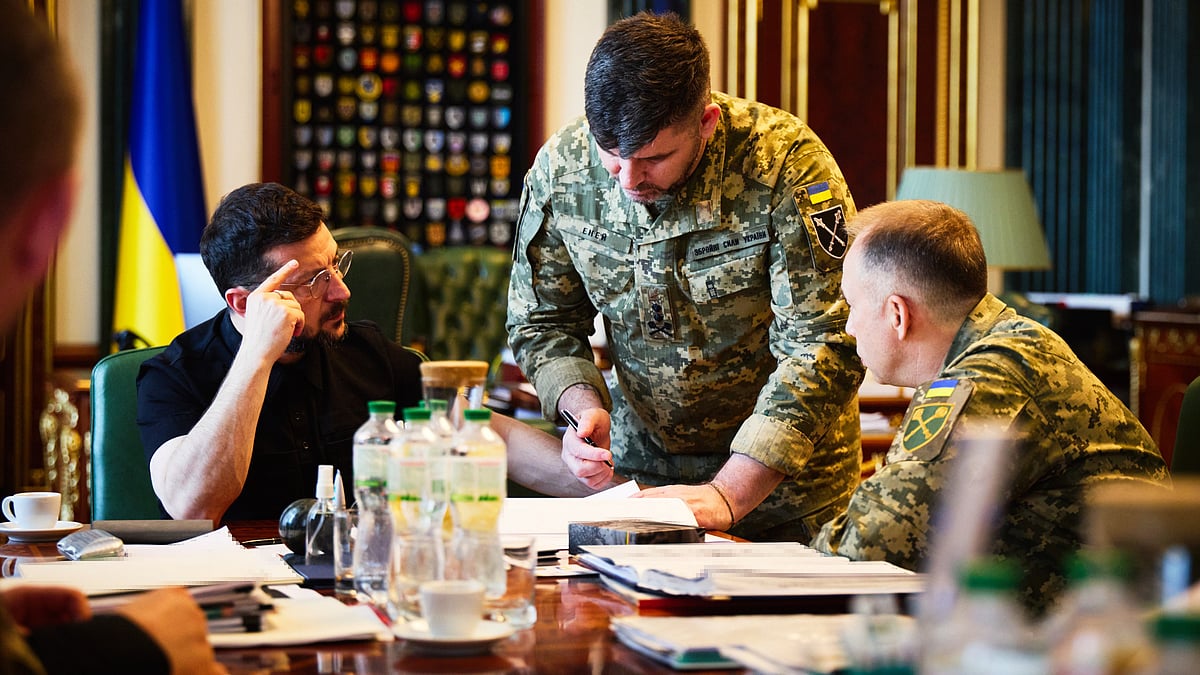
Leaders of the Group of Seven (G7) nations on Tuesday sought to push the war in Ukraine back to the forefront of US President Donald Trump's agenda, as Russia's invasion entered its fifth year and diplomatic efforts to end the conflict remained stalled.
The Ukraine discussions took place against the backdrop of a newly announced US-Iran peace agreement, which has dominated international attention in recent weeks and overshadowed the conflict in Eastern Europe.
French President Emmanuel Macron said he would urge Trump to maintain support for Ukraine and intensify pressure on Russia in an effort to secure a peace settlement.
As the Trump administration has scaled back assistance to Kyiv, France and its European allies have emerged as Ukraine's largest providers of military and financial support.
Ukrainian President Volodymyr Zelenskyy joined G7 leaders for a working session on Tuesday morning. According to the French presidency, the discussion lasted around 75 minutes.
Trump later said he would hold a one-on-one meeting with Zelenskyy and signalled that Ukraine would once again become a key focus for his administration.
“I want to focus on Ukraine now,” Trump said, adding that Iran would soon be “back in the rearview mirror”.
Describing the war as “ridiculous”, Trump said he would do whatever possible to help end the conflict.
Fresh Russian attacks underscore urgency
The discussions came hours after Russia launched hundreds of drones and dozens of missiles against major Ukrainian cities, killing at least 11 people and damaging a prominent religious site in Kyiv.
The attacks followed separate telephone conversations that Trump held with Zelenskyy and Russian President Vladimir Putin on Sunday, suggesting that Washington continues to pursue diplomatic channels despite limited progress.
During his 2024 presidential campaign, Trump repeatedly claimed he could end the war within 24 hours of returning to office, but has since acknowledged the complexity of achieving a settlement.
Ukraine also formally launched negotiations for membership of the European Union on Monday, beginning a process expected to require years of political and institutional reforms.
Kyiv views EU membership as a key long-term security guarantee. Ukrainian leaders continue to seek NATO membership as well, though the Trump administration has ruled out that possibility while the war remains ongoing.
New sanctions on Russia
Meanwhile, the United Kingdom announced a fresh package of sanctions targeting Russia's so-called “shadow fleet” used to transport oil and gas and evade Western sanctions.
The measures include restrictions on vessels linked to Russia's Arctic LNG 2 project. British authorities also recently seized a vessel associated with the shadow fleet in the English Channel.
The sanctions are part of broader Western efforts to tighten economic pressure on Moscow as the conflict drags on.
Iran deal looms over summit
The recently announced US-Iran ceasefire agreement featured prominently in discussions at the summit.
Trump held bilateral talks with Qatar's Emir Sheikh Tamim bin Hamad Al Thani and is also scheduled to meet UAE President Mohammed bin Zayed Al Nahyan. Both leaders were invited to the summit by Macron amid ongoing efforts to stabilise the Middle East.
G7 leaders are expected to discuss the implementation of the US-Iran agreement and the reopening of the Strait of Hormuz, whose blockade had disrupted global energy markets.
In recent months, Trump has clashed with several European leaders, including Macron, British Prime Minister Keir Starmer, German Chancellor Friedrich Merz and Italian Prime Minister Giorgia Meloni, over his decision to launch military action against Iran without prior consultation.
Despite those disagreements, European governments are keen to see tensions ease in the Gulf region, particularly because of the impact of energy prices on their economies.
“I think a lot of great things are going to happen in the Middle East right now,” Trump said, pointing to falling oil prices and rising stock markets.
Macron said France and its allies were prepared to move quickly to help restore maritime security in the Strait of Hormuz and support the resumption of normal shipping operations.
The G7 comprises France, the United States, Canada, Germany, Italy, Japan and the United Kingdom. Guest countries attending parts of this year's summit include India, Brazil, Kenya and South Korea.
Join our official telegram channel (@nationalherald) and stay updated with the latest headlines