World
NASA sends 2026 World Cup ball ‘Trionda’ to space for microgravity tests
NASA-backed experiment examins how a football's internal mass affects its motion, stability and spin
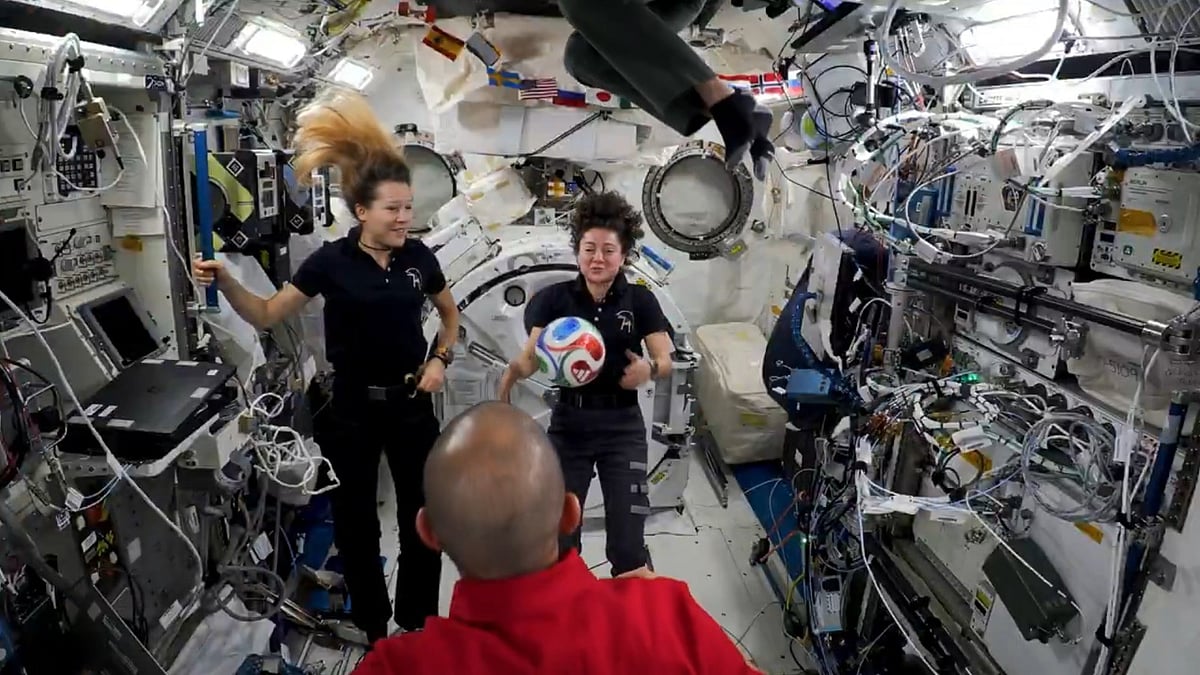
Before it graces the grandest stage in world football, the official match ball of the 2026 FIFA World Cup has already embarked on a journey few footballs can dream of — a mission beyond Earth.
In a remarkable fusion of space science and sports engineering, the FIFA World Cup 2026 official match ball, Trionda, was sent to the International Space Station (ISS), where astronauts used the unique conditions of microgravity to study one of football's most crucial yet often overlooked characteristics: balance.
The experiment, highlighted by NASA, sought to demonstrate how the internal distribution of mass influences a football's motion, stability and spin — factors that can determine whether a perfectly struck shot swerves gloriously into the top corner or veers unpredictably off course.
"The official FIFA World Cup ball went to space. Soccer balls need to move predictably, so sports engineers carefully measure and optimise their centre of mass and balance," NASA said in a social media post.
A football laboratory in orbit
The research builds on a groundbreaking study conducted aboard the ISS in partnership with the ISS National Laboratory in 2019.
Using the station's microgravity environment as a floating laboratory, researchers examined how subtle variations in a football's internal mass affect its flight characteristics, rotation and overall stability.
The findings offered valuable insights into the impact of embedded technologies such as motion sensors, which have become increasingly important in modern football.
According to NASA, the latest ISS crew recreated the earlier experiment using the newly unveiled Trionda ball to illustrate the difference between well-balanced and poorly balanced footballs.
"The findings from these experiments have improved our understanding of how embedded tech, like match-ball sensors, can influence ball performance during play," NASA said.
The agency added that helping improve the world's most popular sport is yet another example of how research conducted aboard the ISS finds practical applications back on Earth.
The science behind the beautiful game
The demonstration underscores a fascinating truth: the same laws of physics that govern spacecraft manoeuvres and astronaut movements also dictate the flight of a football.
By observing how footballs spin and drift in weightlessness, engineers gain a clearer understanding of how balance affects performance under normal playing conditions.
The knowledge is especially relevant as footballs become increasingly sophisticated, incorporating advanced tracking technology that provides real-time data to players, coaches and match officials.
Meet ‘Trionda’
The name Trionda — derived from Spanish and meaning "three waves" — is a tribute to the three nations jointly hosting the 2026 FIFA World Cup: the United States, Canada and Mexico.
The ball's striking design features bold red, green and blue colours representing the host countries, while a revolutionary four-panel construction replaces traditional panel layouts.
Its fluid geometry creates a distinctive triangular centre, symbolising the historic partnership between the three nations staging football's biggest tournament.
The surface is adorned with national motifs, including Canada's maple leaf, Mexico's eagle and a star representing the United States. Gold accents honour the iconic FIFA World Cup Trophy.
Built for precision
Beyond aesthetics, Trionda represents a significant leap in football technology.
Its four-panel design incorporates deep seams engineered to generate consistent aerodynamic drag, enhancing stability during flight and helping ensure predictable movement through the air.
Embossed surface details improve grip and control, particularly in wet or humid conditions, allowing players to strike and dribble with greater confidence.
At the heart of the ball lies its most advanced feature: a cutting-edge 500Hz motion sensor chip.
The connected-ball technology captures precise data on every touch, movement and trajectory in real time, transmitting information directly to the Video Assistant Referee (VAR) system. The technology is expected to play a crucial role in decision-making, including offside reviews and other key match incidents.
A World Cup ball with a cosmic beginning
Long before the opening whistle blows in 2026, Trionda has already completed a journey unlike any of its predecessors.
From orbiting Earth alongside astronauts to eventually soaring across football stadiums packed with fans, the ball's path reflects the increasingly close relationship between science, technology and sport.
For now, the beautiful game has quite literally reached for the stars — and found that even in space, football and physics remain inseparable companions.
With IANS inputs
Join our official telegram channel (@nationalherald) and stay updated with the latest headlines