POLITICS
A welcome in Dhaka, a hold-up in Delhi
India's new high commissioner to Bangladesh may have crossed the border seamlessly, but the same treatment isn't available to all
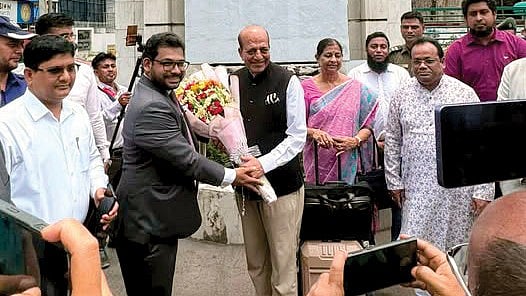
Dinesh Trivedi’s decision to travel to Dhaka from Kolkata by road — instead of taking the customary 45-minute flight — was welcomed by all. On 12 June, India’s high commissioner to Bangladesh walked across the international border at Petrapole-Benapole and drove across the Padma bridge to reach Dhaka. The favourable optics around Trivedi’s travel, given how delicately poised India-Bangladesh relations currently are, were not lost on South Asia watchers.
In Dhaka, Trivedi recounted his journey with enthusiasm: “Upon entering Bangladesh, I did not feel like a foreigner. India and Bangladesh are strong democracies. Whatever we do, we have to do it together. We cannot be powerful in isolation.”
Imagine the enormous economic possibilities if the 160 crore people of both countries combine resources, he gushed.
On the face of it, there was nothing amiss about his remarks — diplomats and ambassadors are, after all, meant to project bonhomie and bilateral possibilities. Even more so if the two countries have a shared legacy. That his remarks turned into a diplomatic flashpoint exposes the underlying anxieties of this bilateral relationship.
Shafiqur Rahman, ameer of Bangladesh’s largest opposition party, the Jamaat-e-Islami (JeI), and its secretary-general Mia Golam Porwar were the first to react. JeI issued formal statements, demanding an immediate clarification from Dhaka on what Trivedi meant by India and Bangladesh “becoming one”. His remarks, they said, were inimical to Bangladesh’s sovereignty and territorial integrity.
Mir Ahmad Bin Quasem, foreign affairs advisor to Rahman, told National Herald, “The confusion arose after certain media outlets circulated clickbait photo cards and misleading headlines that subsequently went viral. The leader of the opposition in Bangladesh has called for a clarification to avoid further confusion.”
****
While Trivedi spoke of ‘togetherness’ and Rahman demanded a clarification, a different drama was unfolding in Delhi. On 14 June, Dr Zahed Ur Rahman (policy, strategy and information advisor to the prime minister of Bangladesh) landed in Delhi, leading his country’s delegation to the 28th meeting of the Indian Ocean Rim Association’s committee of senior officials.
Dr Rahman — who holds ministerial status and was travelling on a regular Bangladeshi passport with a SAARC visa rather than a diplomatic passport — was stopped by immigration officers at Indira Gandhi International Airport and questioned for two-and-a-half hours. According to media reports quoting official sources, his name was flagged on an immigration blacklist linked to critical comments on India aired on his YouTube channel Zahed’s Take.
Despite advance diplomatic notifications from the Bangladesh high commission to India’s ministry of external affairs, immigration clearance was initially stalled.
Eventually, higher authorities cleared his entry while — and this is bizarre — asking him to reconsider. Justifiably irked, Dr Rahman refused to enter India, collected his passport and returned to Dhaka via Colombo.
Following the incident, Bangladesh’s ministry of foreign affairs summoned India’s deputy high commissioner Pawan Badhe to register a formal protest, expressing Dhaka’s “deep disappointment” and strong displeasure. Bangladesh’s foreign minister Khalilur Rahman publicly called the incident “unexpected and regrettable”.
While Trivedi’s journey to Dhaka was a photo-op of seamless cross-border movement, thousands of people remain stranded in the no-man’s land along the India-Bangladesh border. Women, children and the elderly have been huddled under trees for days and nights on end, with no shelter or toilet facilities, subsisting on the meagre food and water provided by the local administration or volunteers.
India has branded them illegal Bangladeshi migrants and ordered the Border Security Force (BSF) to ‘push’ them into Bangladesh. The Border Guards Bangladesh (BGB) have refused to let them in, citing deviation from standard operating procedures that require verification of identity by Bangladeshi authorities.
The ‘push them back’ policy has led to diplomatic friction and was discussed at the 57th meeting of the director generals of both the BSF and BGB in New Delhi on8 June. In a departure from tradition, there was no joint press conference or media briefing at the conclusion of the talks. Instead, the two forces issued separate statements, a cautious diplomatic strategy to prevent sensitive bilateral disagreements from spilling over into public discussions or media rhetoric.
India appears to have adopted a segmented approach. Multiple agencies are involved, with each one playing its designated role. “We simply hand over people to the BSF. They will explain what they do with them,” a senior police officer involved in the process told National Herald. Repeated attempts to get a response from the BSF or from Bangladeshi diplomatic missions in Kolkata and New Delhi were unsuccessful.
Caught in this tug-of-war are families rendered homeless and stateless. Local residents and NGO workers active in the area say hundreds of such migrants have vanished overnight, unable to withstand the hardship, the exposure and the uncertainties of this administrative limbo.
A social media post by documentary filmmaker Dwaipayan Banerjee captures the border situation rather poignantly: 'For marginalised Bengali-speaking Muslim domestic workers, construction labourers and waste-pickers, the line between undocumented economic migrant and domestic citizen has been blurred. The frontier has ceased to be a legal boundary. It is now an informal, one-way exit valve for an administration treating citizenship like a seasonal clearance drive.'
Sourabh Sen is a Kolkata-based independent writer and commentator on politics, human rights and foreign affairs. More of his writing here
Join our official telegram channel (@nationalherald) and stay updated with the latest headlines