Sports
How Mehdi Taremi’s Iran is battling odds on and off the pitch
US visa rules didn’t allow the team night’s rest after a gruelling opener; same routine to follow for Sunday’s game vs Belgium
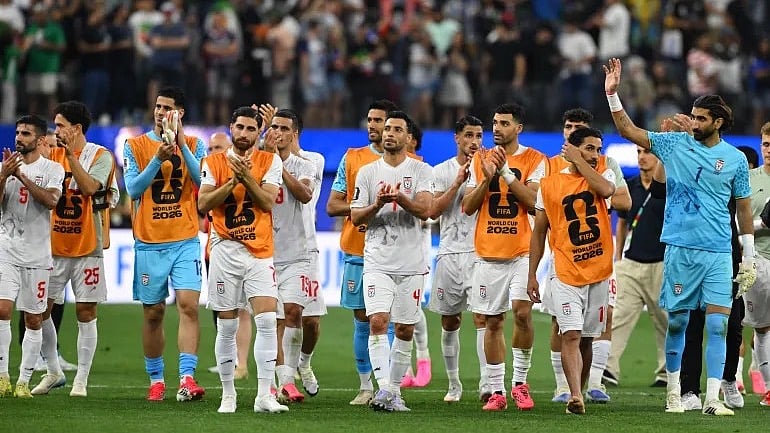
Imagine taking a four-hour international flight into a hostile country only a day before an important FIFA World Cup game — because of rigid visa restrictions. Iran has been asked to do it again ahead of its second group game against Belgium on Sunday, 21 June, so what if much-needed time for acclimatisation is compromised in the bargain?
The 2026 World Cup is certainly not a fair playing field for Team Melli, as Iran football team is known, but it has been handling the situation with immense fortitude and dignity so far. ‘’Of course, we don’t have the same beautiful experience we always talk about,” team captain Mehdi Taremi said after the team arrived in Los Angeles last Sunday (14 June) from its base camp in Tijuana, Mexico.
It was just a day before Iran's campaign opener against New Zealand on Monday — a match which ended in a 2-2 draw — and the team had to leave within hours of the match ending, which deprived it of a night’s recovery at the team hotel. Unthinkable yes, but the same protocol will be applied ahead of its second game as US authorities have turned down a request to fly into the US at least 48 hours earlier.
“Despite having submitted its preparation schedule for the tournament well in advance, Iran’s national football team has once again encountered restrictions imposed by the organisers, affecting the implementation of its technical staff’s plans,” a spokesperson was quoted as saying by AFP. The team plans to lodge a complaint with FIFA, knowing full well that football's world governing body has been servile before the US and the latter has been quite unapologetic about it.
It’s for the world to see how the Iran football team has been a pawn in the war between its government and the United States. The footballers are professionals who neither set policy nor make laws, and yet Team Melli is being treated as enemies, with FIFA playing along.
The problem, however, is there is no irreverent voice left like a Diego Maradona — who had called a spade a spade when he lashed out against FIFA boss Gianni Infantino's regime after pulling out of a FIFA Legends team back in 2019.
‘’I sent a letter to Infantino in which I resigned from (the post of) being captain of (FIFA) legends. Since (Sepp) Blatter and [former Argentina Football Association president, Julio] Grondona left, FIFA hasn’t changed a bit. No change,’’ said the 1986 World Cup winner, a harsh critic of FIFA for it’s ‘corruption and commercialisation’.
Times have changed, and it’s no surprise that none of the legends of the game — past or present — in the US in different capacities will speak up at the cost of being politically incorrect.
This is where Iran deserves quiet respect for the manner in which it has handled the crisis so far — right from the time the national team staged a unique protest by holding colourful schoolbags to their chests ahead of an international friendly in Turkey in March. The emotional tribute to 165 children — killed in the US-Israeli bombing of a primary school in Minab which triggered the war between Iran and the US-Israel axis — had the desired impact.
The rigidity of immigration laws and air of mistrust looking over Iran's team and its travelling supporters in the US, have reached a point where it doesn’t really matter if the team can cross the hurdle of the first round. For many, it has already done more than that. It would have been far easier for Iran to take a call to boycott the tournament in the US, but that would have meant depriving the players of a once-in-a-lifetime opportunity, with Iran being the first country to qualify from the Asian zone last year.
There is a school of thought among the Iranian diaspora which feels that the current regime wanted to weaponise the team, exposing it to all kinds of security risks and the psychological trauma of having to take the field in a country hostile to them. However, politics and the world’s most popular sport go hand-in-hand and there is no better place to make a statement than a World Cup on US soil.
History will judge whether Mehdi Taremi and his men are remembered in the same breath as US sprinters Tommie Smith and John Carlos, whose Black Power salute during the 1968 Olympics remains a hallmark of the civil rights protest in the US. Or in more recent times, NFL star Colin Kaepernick’s famous taking the knee during a pre-game US national anthem to protest police brutality and racial injustice.
The challenge before Taremi & Co. is to fight a social perception which enables the US to create its own blacklisted countries and deny entry to well-known Somalian football referee Omar Artan or question Iraq’s Aymen Hussein for more than seven hours in immigration. It’s a small but significant step in that direction.
Join our official telegram channel (@nationalherald) and stay updated with the latest headlines