


Can India build its next services export story around education? Ashoka University founder answers
Vineet Gupta explains why India’s education export opportunity depends on export-ready campuses


This is an advertorial. The article is published as received.India’s rise as a global capability centre hub has shown that the country can move beyond low-cost delivery and become a base for high-value global work. According to the Nasscom-Zinnov GCC Landscape Report 2026, India now hosts 2,117 GCCs across 3,728 units, employing 2.36 million professionals and generating $98.4 billion in revenue.
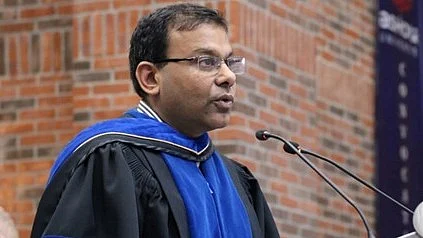
For Ashoka Founder Vineet Gupta - that success offers an important question for another sector: why can India not think with similar ambition in education services?
“If India can become a hub for global capability centres, why can’t we think with the same ambition in education services?” Vineet Gupta said. “We have the talent and the cost advantage. What we now need is a first mover success case.”
The question comes at a time when global student mobility is expanding rapidly. UNESCO notes that 7.3 million students are studying abroad today, compared with about 2 million in 2000. This makes international education not just an academic activity, but a major economic opportunity for countries that can attract, support and retain global learners.
India, however, still captures only a small part of that movement. The country has historically been known more as a source of outbound students than as a destination for overseas learners. That equation is beginning to change, but slowly.
Government data shared in the Rajya Sabha shows that India currently hosts 72,218 foreign students from nearly 200 countries. The Study in India platform has also expanded the formal admission route for international learners, with more than 600 partner institutes and over 8,000 courses listed on the programme’s official portal.
These are important building blocks, but Vineet Gupta believes India will need a sharper approach than simply telling the world that it is open for foreign students.
“Instead of trying to attract international students in a generic way and saying they should come to India to study, we need to identify colleges and campuses that can genuinely offer quality education, strong faculty mentorship, good infrastructure, safety and a complete student experience,” Vineet Gupta said. He further added, “India should have an agency that rates campuses from the perspective of foreign student attractiveness. Let these ratings be published. This will make choices transparent for international students.”
That suggestion shifts the debate from national ambition to campus readiness. For a student considering another country, the decision is rarely about tuition alone. It is also about reputation, safety, housing, healthcare, classroom experience, internships, local support and the ability to build a career after the degree.
This is where India’s next challenge lies. The country has scale, cost advantage and a large higher education network, but every college cannot immediately become part of an export strategy. A more realistic route may be to identify a first set of export-ready campuses, public and private, that already have strong academic credentials, residential capacity, international offices, industry linkages, student support systems and safe local environments.
Such a rating system could also prevent international recruitment from becoming a numbers game. If India wants to be taken seriously as a study destination, students should know which campuses are genuinely prepared to host them and what support they can expect before and after arrival.
The second missing piece is facilitation. Countries that have built strong education export models do not leave international students to navigate fragmented systems on their own. Australia, the UK, France, Germany and Singapore have invested in student support offices, branded national platforms, clearer visa processes and post-study routes.
India has taken steps in this direction through the Study in India portal, which provides a centralised admission interface and guidance for applicants. The portal also states that it offers visa and immigration assistance as part of its student support ecosystem. But to compete globally, the experience will need to become far more seamless across admissions, visas, accommodation, local registration, health cover, internships and career counselling.
Gupta believes this experience layer is not optional.
“For an international student, education is not only about the classroom. Safety, visa simplification, accommodation, internships and career support are all part of the decision. India will have to think from the student’s perspective if it wants to compete globally,” he noted.
The third question is employability. Many students choose destinations not only for academic quality but also for practical exposure after completing their programmes. India may not need to frame this as an immigration pathway, but it can create clearer rules for internships, apprenticeships, industry projects and short-term professional experience.
That would be particularly useful in sectors where India already has credibility: technology, management, healthcare, design, public policy, sustainability, entrepreneurship and Indian knowledge systems. Education-linked services can also extend beyond classroom teaching into admissions review, digital outreach, curriculum development, academic operations, research support and online learning.
India also has distinctive areas that few countries can replicate at the same depth, including yoga, Ayurveda, Sanskrit, Buddhist studies and Indian knowledge systems. These may not replace mainstream professional programmes, but they can help create a differentiated global identity.
The larger point is that education exports cannot be built only through affordability. Lower cost may bring attention, but quality will decide reputation. If India combines credible campuses, transparent ratings, easier student pathways, strong academic delivery and career relevance, it can occupy a more serious position in the global education market.
The early signs are encouraging. Inbound numbers are rising, foreign campuses are entering India, and policy intent has become clearer. But the next phase will require disciplined execution.
India’s services export story has already shown what happens when talent, scale and global demand come together. The education sector now faces a similar possibility. Whether India can convert that possibility into a serious export story will depend on whether it can build campuses and systems that international students can trust.
This is an advertorial. The article is published as received.
Join our official telegram channel (@nationalherald) and stay updated with the latest headlines