


FCNR Account Rules: Currencies, Tenures and Repatriation Explained
Repatriation is one of the most significant advantages of FCNR deposits



For Non-Resident Indians (NRIs), managing foreign earnings efficiently is an important part of financial planning. Among the available deposit options, FCNR accounts remain relevant in 2026, as they help mitigate exchange-rate risk over the tenure and offer a repatriation advantage. However, many NRIs are unclear about the rules governing currencies, tenure limits and withdrawal norms.
Understanding FCNR, its regulatory structure and how it differs from NRE Fixed Deposits can help NRIs make informed decisions.
What Is the Full Form of FCNR?
FCNR stands for Foreign Currency Non-Resident. This type of account allows NRIs to hold term deposits in foreign currencies instead of Indian rupees.
Unlike NRE deposits, which are maintained in INR, these deposits are maintained in foreign currency to protect the principal and interest from exchange rate fluctuations.
Who Can Open an FCNR Account?
These deposits are available to:
● Non-Resident Indians
● Persons of Indian Origin
● Eligible overseas citizens under prevailing regulations
These deposits are specifically designed for individuals earning income abroad who wish to retain funds in foreign currency while earning interest in India.
Permitted Currencies
FCNR deposits are typically available in major global currencies. These commonly include:
● US Dollar
● British Pound
● Singapore Dollar
● Canadian Dollar
● Australian Dollar
The availability of specific currencies may vary by bank, but they are generally limited to widely traded global currencies.
Holding funds in these currencies protects depositors from exchange rate risk between the foreign currency and INR during the tenure.
Tenure Options for FCNR Deposits
Tenure is a crucial aspect of such deposits
They follow the below tenure range:
● Minimum: 1 year
● Maximum: 5 years
Tenure availability may vary by currency. For certain currencies, deposits may be offered for shorter ranges within the overall permissible framework. It is important to note that premature withdrawal may incur penalties and interest adjustments under applicable rules.
Interest and Tax Advantage
One of the main reasons NRIs consider foreign currency deposits is their tax treatment. Interest earned on such deposits is exempt from tax in India for NRIs, under prevailing regulations. Since the deposit and interest remain in foreign currency, the effective return is insulated from INR depreciation or appreciation.
In comparison, NRE Fixed Deposits are held in INR. While interest on NRE deposits is also tax-exempt for NRIs in India, exchange rate risk arises because funds are converted into INR at the time of deposit. Understanding this distinction helps NRIs align deposit choices with currency exposure preferences.
Repatriation Rules Explained
Repatriation is one of the most significant advantages of FCNR deposits.
both principal and interest on these deposits are fully repatriable. This means:
● Funds can be transferred abroad without restriction
● Interest can be credited in foreign currency
● There is no currency conversion requirement at maturity
This feature makes such deposits attractive to NRIs planning to use the funds outside India.
In contrast, NRO deposits are subject to repatriation limits and documentation requirements.
Loan Against FCNR Deposit
Foreign currency deposits may be used as collateral for loans in India, subject to applicable conditions. Loans against these deposits are generally permitted up to a specified percentage of the deposit value. However, the loan must comply with regulatory restrictions on end use and repayment. Borrowing against them allows NRIs to access liquidity without prematurely closing the deposit.
Premature Withdrawal Rules
Premature withdrawal of FCNR deposits is allowed, but conditions apply.
If the deposit is withdrawn before completion of the minimum lock-in period, interest may not be payable. For withdrawals after the minimum period but before maturity, interest is typically recalculated based on the actual tenure and may include penalty deductions. Understanding these conditions is essential before booking long-term deposits.
Difference Between FCNR and NRE Fixed Deposits
While both FCNR and NRE Fixed Deposits serve NRIs, the key differences include:
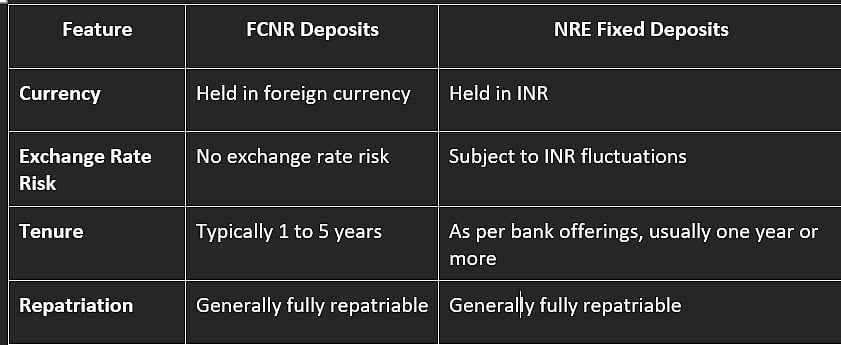
Understanding these differences can help you choose the option that aligns with your financial goals and currency preferences.
Documentation Required
Opening an FCNR account requires standard KYC documentation, including:
● Valid passport
● Visa or residence permit
● Overseas address proof
● PAN details
Digital Access and Management
Digital banking platforms have simplified FCNR deposit management. NRIs can now book deposits, track maturity and manage renewals through online banking portals.
Leading banks in India, including ICICI Bank, offer digital booking options for these deposits, enabling NRIs to open and manage accounts remotely without visiting India.
Is FCNR Suitable in 2026?
FCNR deposits are particularly suitable for:
● NRIs with foreign currency income
● Individuals seeking protection from INR volatility
● Investors prefer predictable returns
● Those planning to repatriate funds fully
However, currency outlook and interest rate comparisons should always be reviewed before committing funds.
Final Thoughts
Understanding FCNR Deposits, its currency options, tenure limits and repatriation benefits is essential for NRIs planning their financial strategy. FCNR deposits provide foreign currency stability, tax efficiency in India and full repatriation flexibility.
When compared with NRE Fixed Deposits, the primary distinction lies in currency exposure. NRIs can use FCNR accounts effectively as part of a diversified savings strategy to achieve long term financial goals.
Join our official telegram channel (@nationalherald) and stay updated with the latest headlines