


Partial vs Total Knee Replacement: How Surgeons Decide
The results also changed significantly based on how often the surgeon performed this operation



Some people find it quite painful to walk down the stairs. It might also be hard to sit or pray. Painkillers help at first, but they stop being effective eventually.
The X-ray finally gives the condition a name, and the doctor provides two options: either the portion of the knee has to be replaced, or the entire surface needs replacement.
Families tend to opt for the second option immediately upon hearing about it, thinking that less cutting equals less risk. However, registry data tells a different story: the choice depends far more on the shape of the damage than on anyone's preference.
Three Parts of The Knee
The knee is made up of three separate compartments pointing inside one joint. The inner side carries most of the body's weight and, in most cases, wears out first. The outer side wears more slowly. The kneecap glides in a groove at the front and forms the third part.
Arthritis rarely destroys all three at once. Cartilage often thins on the inner side alone while the other two stay reasonably healthy. That’s what makes a partial replacement possible.
What Gets Replaced in Each Operation
A partial replacement, also called unicompartmental knee replacement surgery, covers only the worn-out part, while the healthy cartilage stays in place. The cruciate ligaments, the crossed cords that give the knee its natural sense of position, are left alone.
A total replacement covers all three areas. The anterior cruciate ligament (ACL) is removed as part of the procedure, and more bone is trimmed to fit the implant in place.
Both types of knee replacement surgery do the same thing. They cover rough bones with smooth metal or plastic. This stops the bones from rubbing together so the pain goes away. The only real difference is how much of the joint gets new parts.
Which Knees Suit a Partial Replacement?
● The X-ray shows the damage is in only one spot, and the doctor confirms this by checking the knee.
● The front ligament stays in place since the smaller replacement part needs it for support.
● The leg can straighten easily instead of staying stuck in a bent or crooked shape.
● The knee still bends well and straightens almost completely.
Some Signs That Rule It Out
● Inflammatory arthritis affects the entire joint lining, leaving no healthy parts available.
● A total knee replacement surgery is needed if there is a torn front ligament and severe stiffness, or deformity that cannot be fixed. It is also needed if multiple parts of the knee are damaged.
● Very high body weight can put uneven pressure on a small implant. For this reason, surgeons often set a body mass index (BMI) cutoff of around 40, above which a partial isn't advised.
Roughly 10 to 25% of people who need a knee replacement fall under the partial criteria.
The Real Risks of Choosing a Smaller Surgery
The National Registry Data for England, Wales, and Northern Ireland gives a good comparison. Partial replacements had to undergo surgery 2.5 times more often over 10 years. That is an extra 70 surgeries for every 1,000 patients.
The mortality rate for partial replacements was 0.08% and 0.33% for total replacements.
The results also changed significantly based on how often the surgeon performed this operation. The chance of requiring another surgery was 2.5 times higher when it was performed by surgeons who frequently did the operation. However, for surgeons who did it rarely, the chance of another surgery was 3.9 times higher.
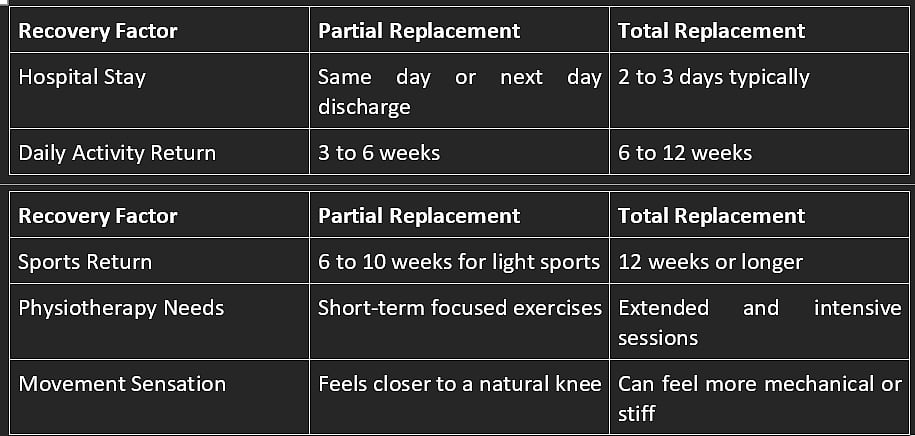
This makes one thing clear: there is no single best choice between the two surgery options. A partial one is best for quick recovery, while a total surgery is best for severe cases that need something that lasts longer.
How Recovery Compares For Both Surgeries
What an X-Ray Alone Cannot Say
Standing X-rays show problems that may not be visible when you lie down. A scan can look like only minor wear when the joint is actually bone-on-bone under load.
Age and activity matter because implants have a working life. A person aged 52 who cycles daily faces different problems than another individual aged 76 who walks regularly.
The final surgical plan is often confirmed only once the joint is opened. The surgeon planning the partial replacement usually requests permission to perform both procedures, as they may find damage to other knee structures during the procedure that they did not see before.
Always clarify this issue in advance with an orthopedic doctor in Mumbai.
Common Mistakes to Avoid
1. Choosing a surgery based on the size of the scar. The depth of the cut doesn't determine healing time; the percentage of the joint affected does.
2. Waiting too long for surgery is the second mistake. If joint damage spreads to another area, a partial replacement can no longer be possible.
3. Assuming a partial replacement will last forever is the third mistake. Another operation is more likely than after a total replacement. Understanding this beforehand can prevent later disappointment.
Where the Decision Finally Lands
Anatomy decides most of this. Partial replacement is feasible when there is only partial damage to the knee joint, healthy ligaments, and deformity that can be corrected in the leg. If arthritis has spread throughout the joint, mobility is lost, or the knee is unstable, total replacement is required.
Neither operation is a lesser version of the other. A working knee requires matching the size of the repair with the amount of the damage. This choice rests more with the surgeon, as it is based on clinical findings rather than personal preferences.
Join our official telegram channel (@nationalherald) and stay updated with the latest headlines