World
Miracle rescue in Venezuela as man found alive eight days after twin quakes
Rescue of a 43-year-old guard in La Guaira raises hope as Venezuela shifts to relief efforts
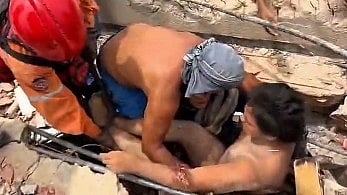
A 43-year-old man has been rescued from the wreckage of a collapsed building in Venezuela eight days after twin earthquakes devastated large parts of the country, offering a rare moment of hope as the disaster response increasingly turns towards humanitarian relief.
The man, identified as security guard Hernan Gil, was pulled out alive on Thursday from the remains of a seven-storey building in the coastal area of Catia La Mar, one of the regions worst affected by last week’s earthquakes. Gil had been trapped since the twin quakes, measuring 7.2 and 7.5, struck Venezuela and caused widespread destruction.
Al Jazeera reported that rescue workers had located him three days earlier and spent days trying to reach him through the rubble. Teams from several countries, including Venezuela, Chile, the United States, Portugal, Costa Rica, El Salvador and Mexico, were involved in the operation. According to rescuers, they eventually dug a three-metre tunnel to extract him after supplying him with water and oxygen through tubes.
His rescue came as hopes of finding more survivors were fading. Many of the collapsed structures in La Guaira have already been marked by search teams to indicate that no signs of life were detected. Officials and emergency workers have said the scale of the destruction has made search operations increasingly difficult as time passes.
In its latest official update, the Venezuelan government said at least 2,295 people had been confirmed dead and around 11,000 injured. The toll is expected to rise, with roughly 50,000 people still reported missing. Authorities have also said that around 13,000 people have been left homeless.
The earthquakes are estimated to have damaged or destroyed about 60,000 buildings, leaving vast areas in need of rescue, recovery and rebuilding. With the chances of locating survivors diminishing, attention is now shifting towards relief efforts for displaced residents and communities cut off from essential services.
Aid agencies have warned that the disaster could trigger a wider health emergency, with overstretched medical facilities facing growing pressure from untreated injuries, infections and poor sanitation. Venezuela’s healthcare system has already been under severe strain for years because of shortages of equipment, trained personnel and reliable electricity.
International agencies have begun mobilising support for the recovery effort. The World Food Programme has appealed for $50 million to provide food assistance to around 500,000 people for three months, while the United Nations Development Programme has estimated physical damage from the disaster at $6.7 billion based on satellite imagery.
Several countries and regional groupings have also pledged financial assistance, including $300 million from the United States, as Venezuela braces for what aid workers say will be a long and difficult recovery.
The rescue of Gil has briefly lifted spirits in a country grappling with one of the deadliest disasters in its recent history. But with tens of thousands still unaccounted for, and entire neighbourhoods reduced to rubble, officials and humanitarian agencies say Venezuela’s challenge is now moving into a far more prolonged phase of relief, rehabilitation and reconstruction.
Join our official telegram channel (@nationalherald) and stay updated with the latest headlines