Opinion
The Indo-Pacific is dead. What did India gain?
Washington has moved on from the strategy. India still bears the burden of its choices, writes Aakar Patel
Last week, on 17 June, it was reported that the 'US has renamed the Indo-Pacific Command back to the Pacific Command'. This news was announced by America’s Department of War, accompanied by an incorrect map of Kashmir.
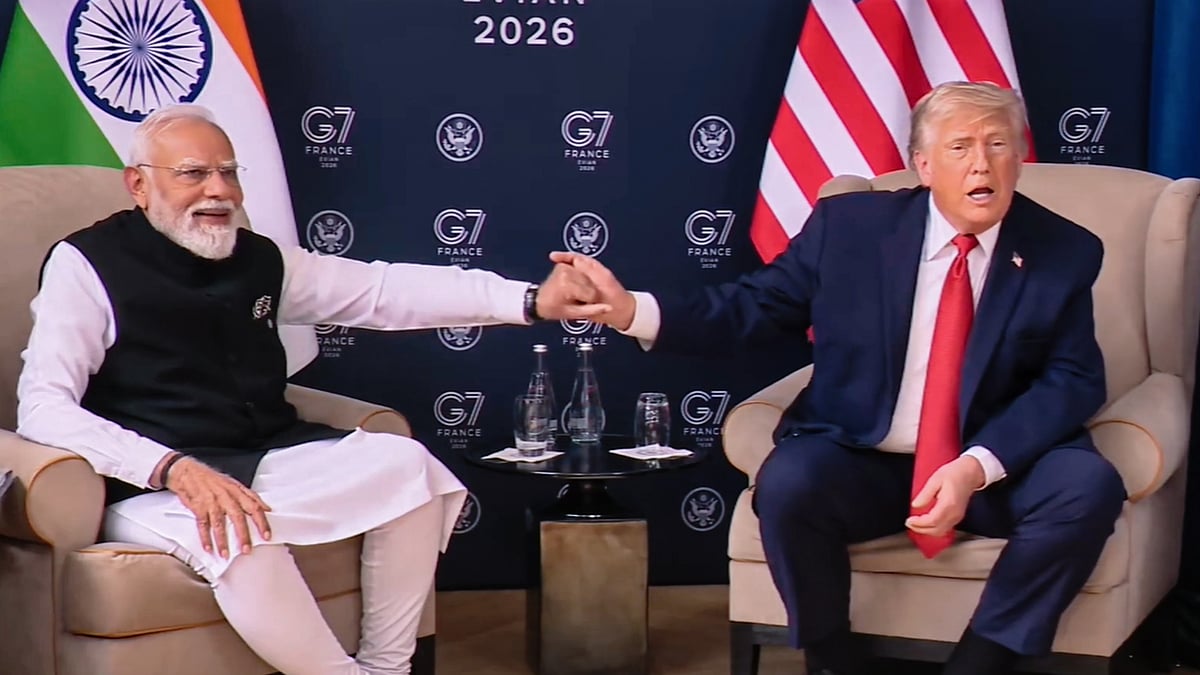
The same day, America’s president met our prime minister in France and said Modi is "a very tough negotiator... You look at this man. He's the most beautiful-looking man. He looks so nice, like an angel. But actually, he's as tough as a killer... But he looks so good. So he gets you by surprise. There are few people like this".
These two 17 June stories are somewhat related. Here is how.
In February 2018, during Donald Trump’s first term, America wrote its strategy for the region it began to call the Indo-Pacific. The aim was ‘to maintain US strategic primacy… while preventing China from establishing new, illiberal spheres of influence’. The Americans wanted India to 'act as a counterbalance to China'. This ‘desired end state’ the US sought was to be ‘India’s preferred partner on security issues’, and ‘the two cooperate to preserve maritime security and counter China’s influence’.
Over a couple of pages, the US laid out the plan of how it would make India a ‘Major Defense Partner’ and how ‘a strong Indian military (would) effectively collaborate with the United States’. The document also laid out what was intended to be done with China: prevent it from ‘harming US competitiveness’ and ‘prevent China’s acquisition of military and strategic capabilities’.
Why was India signing up for this? It is not known. With no discussion in Parliament, no interviews to the media, no press conferences, and no reference to this in his manifestos, Modi took India into a strategic partnership and military alliance with the US against China. In February 2020, during Donald Trump’s famous visit to India and days before the Galwan Valley crisis, Modi committed India to this agreement, essentially ranged against China, and began to execute it.
On 27 October 2020, during the visit of US secretary of state Mike Pompeo, India signed the Basic Exchange and Cooperation Agreement (BECA). It would help India access American intelligence to improve the accuracy of the Indian Army’s missiles and armed drones. Another agreement signed was the Logistics Exchange Memorandum of Agreement (LEMOA). It allowed the two nations’ militaries to replenish from each other’s bases and access supplies, spare parts and services from each other’s land facilities, air bases and ports.
Signing the BECA pact in Delhi, Pompeo attacked China directly: "I am glad to say that the United States and India are taking steps to strengthen cooperation against all manner of threats and not just those posed by the Chinese Communist Party."
Secretary of defense Mark Esper said: "We stand shoulder to shoulder, in support of a free and open Indo-Pacific for all, particularly in light of increasing aggression and destabilising activities by China."
Our defence minister Rajnath Singh and external affairs minister S. Jaishankar, standing next to Pompeo and Esper, did not name China. Rajnath Singh’s prepared remarks (which were later changed) contained the line, later deleted: "Excellencies, in the area of defence we are challenged by reckless aggression on our northern borders." Exhibiting the usual incompetence, this change was not given to the Indian translator in English, who read out the original text, and the Americans released it.
When the paper on America’s strategy had been declassified three months later, China said ‘its content only serves to expose the malign intention of the United States to use its Indo-Pacific strategy to suppress and contain China and undermine regional peace and stability’. It added that ‘the US side is obsessed with ganging up, forming small cliques and resorting to despicable means such as wedge-driving, which fully exposed its true face as a trouble-maker undermining regional peace, stability, solidarity and cooperation’. India did not react to the release of the document.
Another pact, signed weeks after America’s Indo-Pacific strategy was written, was the Communications Compatibility and Security Agreement (COMCASA). It allowed India access to encrypted communications equipment and systems so that Indian and US military commanders, and the aircraft and ships of the two countries, could communicate through secure networks. BECA, LEMOA and COMCASA completed a troika of ‘foundational pacts’ for deep military cooperation between the two countries.
COMCASA was signed in September 2018, five months after Modi travelled to Wuhan to meet President Xi Jinping. There he had signed an agreement on 28 April 2018 that India and China would not be rivals but cooperate with each other. They would ‘push forward bilateral trade and investment’.
The problem, obvious to anyone, was that, whether he fully understood it or not, Modi was hunting with the hound and running with the hare. At the same time as he was holding hands with Xi, he was also winking at Trump’s Indo-Pacific strategy to contain China. Xi’s calculated response was to activate the Ladakh border so that India’s military focus and resources would remain on land and not sea.
We have seen the effects of that in the last six years, with a border that remains tense and militarised and a trade balance totally in China’s favour that we cannot correct despite our efforts.
In his second term, Trump lost interest in his Indo-Pacific strategy. The headline announcing the dropping of the name was only the final, symbolic ending.
The question is, what did we gain from signing up for this casual adventure that was so expensive? The answer is, of course, the second story from 17 June: we got patted on the head and were praised.
Views are personal. More of Aakar Patel’s writing here
Join our official telegram channel (@nationalherald) and stay updated with the latest headlines