Opinion
Why education is slipping out of the grasp of India’s poor
The faith India’s poor and excluded had in education is faltering. And it is the consequence of a policy drift, writes Gurdeep Singh Sappal
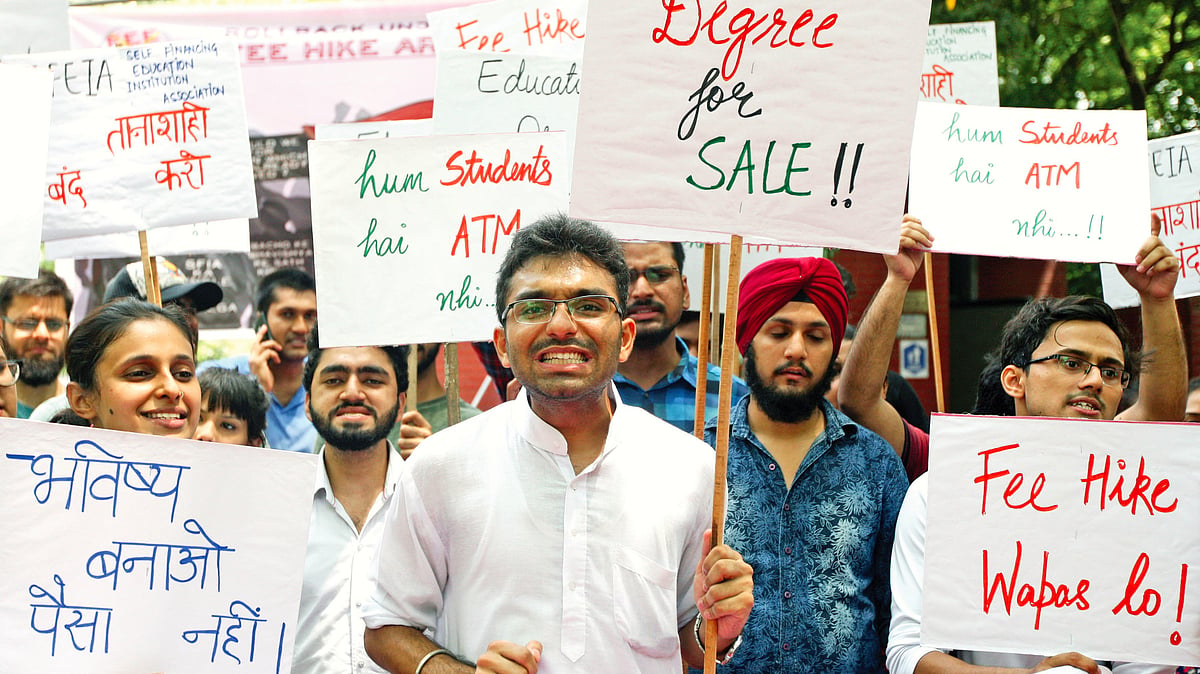
There was a time in Nehruvian India when the poor had faith in a simple yet revolutionary idea: ‘Padh jaayenge, toh badh jaayenge’. Education was the great leveller. It was the escape route out of caste, out of poverty, out of the inherited disadvantages of birth. Education was enshrined in the Constitution as a promise to India’s most poor and disadvantaged citizens.
Public universities, the IITs, the IIMs, government medical colleges were not merely institutions; they were the physical architecture of social mobility.
But the faith India’s poor and excluded had in education is faltering. And it’s not by accident but the consequence of a policy drift.
What began as creeping privatisation two decades ago has been deliberately accelerated under 12 years of BJP rule, turning it into a strategy designed to price education out of the reach of the poor. Coupled with stagnant salaries, the cost of education is leading to worsening poverty.
The entry of private capital into higher education began in the late 1990s and accelerated through the 2000s. It was propelled by the experience of underperforming and crumbling public universities. The infusion of private capital, it was believed, would bring both quality and greater access. But the experience of the past three decades has proven the folly of those expectations.
India’s higher education system is the third largest in the world by enrolment. We have 43 million students in over 60,000 colleges and 1,200 universities. These numbers underline the monumental wasted potential.
A country that aspires to be a knowledge superpower is producing graduates who can’t find jobs and innovators who fail the test of commercial application. It is re-engineering education in a way that dulls critical faculties and equates success with the ability to crack multiple-choice tests.
The higher education economy
The single most consequential effect of privatisation has been the transformation of a public good into a private commodity. Private institutions have mushroomed while public ones by and large are starved for resources.
The fees of premium institutions have shot up. The tuition fees of IIM-A (Ahmedabad), for example, surged from Rs 4 lakh in 2007 to Rs 27 lakh in 2021; of IIT Bombay from Rs 1.08 lakh in 2008 to Rs 8 lakh in 2024-25. In the private sector, a regular BA degree in an average university today costs Rs 3–6 lakh; a BTech Rs 8–20 lakh. Management degrees can cost from Rs 5–30 lakh. And the burden of higher cost has been passed on to students.
High tuition fees is not the whole story. India’s higher education system has been captured at the point of entry by a parallel, unregulated, multi-billion-rupee coaching industry. JEE and NEET, the two national entrance examinations for engineering and medicine, are so disconnected from the school curriculum that it is now practically impossible to crack these exams without coaching. The entrance examination, which is supposed to select talent from the educational system, has itself become a separate educational system.
The GST collection from coaching institutes grew from nearly Rs 2,200 crore in 2019-20 to over Rs 5,500 crore in 2023-24! This is an industry that profits from the failure of the formal education system; it’s a business model built on institutional inadequacy.
The coaching industrial complex is not educating India; it is extracting wealth from anxious families by exploiting the gap between what schools teach and what entrance tests demand.
Education as a loss-making investment
In the UPA years under Dr Manmohan Singh, salaries in India grew three to five times over ten years. Nurses, engineers, teachers, civil servants, private sector employees, all saw real income growth.
In these circumstances, the investment in education felt like a rational decision because the ‘returns’ were generous. The social contract between education and its reward was intact.
By contrast, for nearly a decade in the Modi years, starting salaries for fresh graduates have stagnated at Rs 3-4 lakh per annum, even as the cost of education has multiplied three to seven times. And this, if they get a job. Most don’t!
The last available figures of the All-India Survey of Higher Education (AISHE) 2021-22 show total enrolment in higher education at 4.33 crore. The average has hovered in the same range for the past few years. In 2023, only 81.2 lakh got a job, including 39.1 lakh in sectors like IT services and banking.
The India Skills Report 2025 places graduate employability at 60 per cent for BTech graduates and 45 per cent for arts graduates. Nearly 45 per cent of graduates aged 20 to 24 are jobless. In 2024, two out of five IIT graduates, or 40 per cent, went unplaced.
Meanwhile, corporate profits in several sectors have gone up five times. Wealth is being generated alright, but it’s not reaching those who labour. Wages are decoupled from growth. By design. Labour protections have been weakened systematically. Wage floors have not been raised to compensate for inflation and employment has been ‘casualised’. The rich are getting richer and the poor graduate gets a crippling debt with his degree.
This is not a market outcome; it’s a policy outcome. When corporate profits grow five times and salaries do not move, the distribution of economic gains has been determined by a government that chose whose interests it will prioritise and protect.
The accreditation scandal
Aspiring families will pay any price for a degree if the brand has cachet, if the positioning is attractive. This psychology drives the explosion of private universities. Designer courses are being fashioned with fancy names for maximum marketability and advertised aggressively with fraudulent placement statistics.
Gullible students and their families are often unable to tell a good course from a scam. Accreditation ratings and NIRF (National Institute Ranking Framework) ratings are of little help. The accreditation architecture itself is in a shambles. In February 2025, the CBI arrested NAAC inspection committee members for accepting cash, gold, laptops and phones in exchange for A++ ratings.
The NAAC (National Assessment and Accreditation Council) dismissed 900 of its 5,000 assessors after the scandal, but it still didn’t invalidate the fraudulent grades they had awarded! Tainted institutions with fake A++ ratings continue to attract students and their families’ hard-earned money.
In March 2025, the Madurai bench of the Madras High Court stayed the NIRF rankings. It found that the National Board of Accreditation (NBA) relies entirely on unverified, self-submitted data. A 2024 exposé found over 50 institutions falsely advertising accreditations or using forged certificates.
****
The government’s own Economic Survey 2024-25 acknowledged the need for regulatory transparency in higher education. It’s an admission that the current framework is failing.
Investing in education is today making families poorer. Even those fortunate enough to get jobs work on salaries that will take them years to recover just the fees paid for their education.
During the UPA years, an entire generation moved into their own houses, buying them on EMIs. Today, it’s practically impossible for young employees to dream of their own house.
When the poor and marginalised conclude that education is no longer affordable, that a degree will lead nowhere, that the salary will never recover the cost, they will gravitate towards a rational decision: to stop sending their children to universities.
When that happens, these children will perforce return to hereditary, caste-based occupations, undoing the Constitutional promise of social mobility for all Indian citizens.
Gurdeep Singh Sappal is a Permanent Invitee to the Congress Working Committee. More by the author here
Join our official telegram channel (@nationalherald) and stay updated with the latest headlines