


Why Noida and Manesar were burning
Worker agitations in the industrial hubs of the NCR hold a mirror to India’s economic health, writes Gurdeep Singh Sappal
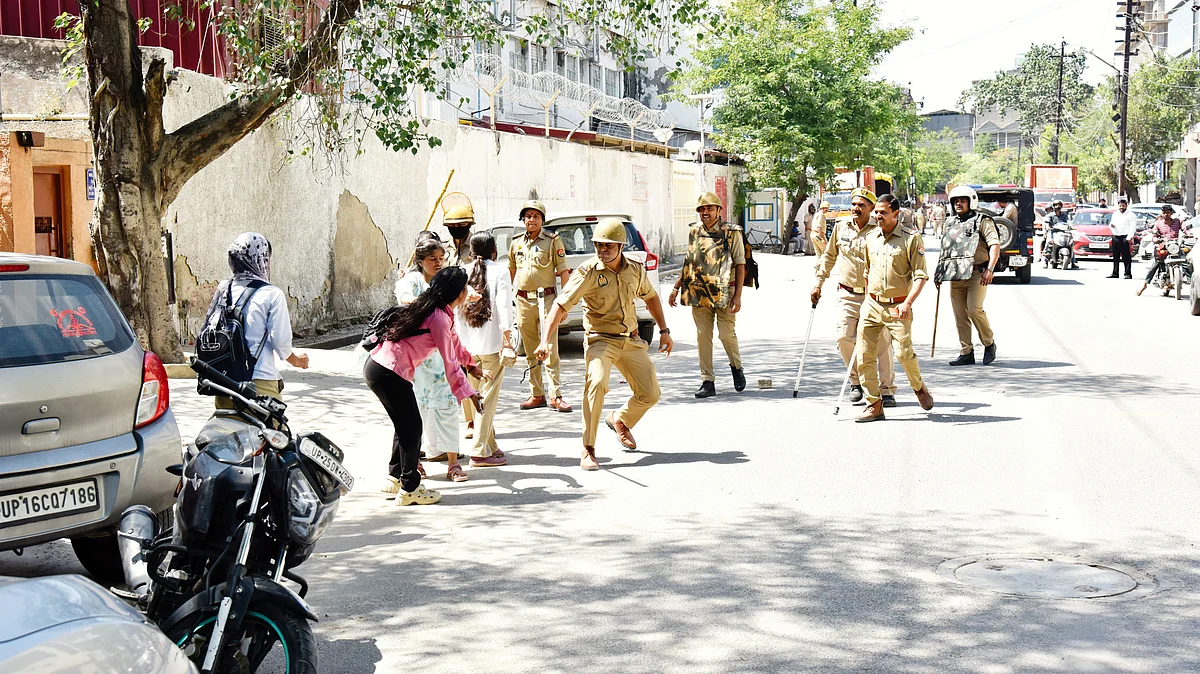


When factory workers in Noida’s industrial sectors protested on 13–14 April, India’s prime time TV anchors got to work on a plausible conspiracy theory. Who was stirring the pot? A foreign hand? The 9.00 pm theatre was familiar: split screens, hyperventilating talking heads and a likely whodunit candidate — Pakistan. Uttar Pradesh chief minister Yogi Adityanath warned darkly of ‘anti-social elements’ conspiring to destabilise the state’s development.
If you didn’t know better, the TV debates wouldn’t lead you to the truth that in the past ten-odd years, wages have been nearly stagnant while rents have doubled and inflation has soared. Corporate profits are at a fifteen-year high while the purchasing power of the worker outside the factory gate is at a corresponding low. For those who see it, this is an inevitable consequence of Modinomics — built for the top, paid for by the bottom.
What really happened to wages
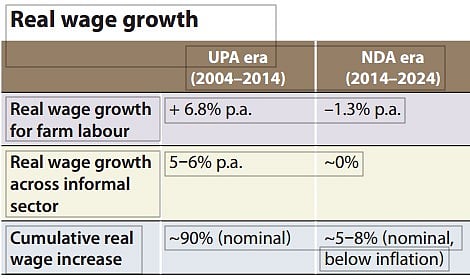
The story of wages in India over the past two decades is revealing. In the UPA years (2004–2014), under Dr Manmohan Singh, real wages in India’s informal sector grew at 5–7 per cent annually. This was the fastest sustained wage growth in the history of independent India, driven by a combination of genuine economic expansion, the NREGA wage floor — which forced an increase in informal sector pay — rising farm support prices and an IT sector competing for talent.
Then came 2014, and the clock stopped.
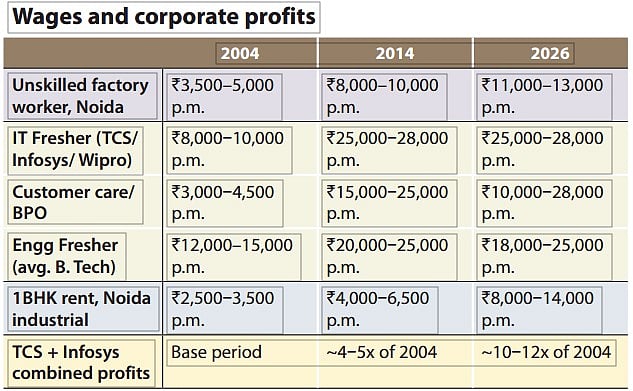
Revealingly, where IT profits have grown tenfold since 2014, entry-level salaries are stagnant. The customer care worker, who earned Rs 15,000–25,000 in 2014 now earns less, in the lower tier, as the sector has fragmented into unregulated gig arrangements with no floor.
And the wages of unskilled factory workers have risen by Rs 3,000 in 12 years! Meanwhile, the Noida room rent has gone up from Rs 4,000–6,000 in 2014 to Rs 8,000–14,000 now. Inflation outpaced the wage worker’s income but not the landlord’s.
That is the economic compact the Modi government has quietly enforced and that is the reason the streets of Noida erupted in protests last week.
Drawing on Labour Bureau and NSSO data, economists Jean Drèze and Arindam Das have documented a near-total collapse in real wage growth since 2014. These findings have no interpretive bias and are not contested. They are drawn from official government data, the Wage Rates in Rural India (WRRI) series of the Labour Bureau and the periodic National Sample Surveys.
A plain reading of the data confirms that the annual growth rate of real wages over the past ten years has been near zero at the all-India level. For agricultural labour, the figure is even more alarming — a decline in real terms.
When education makes you poorer
Education has been known to be a trusty ladder out of poverty, a reliable tool for upward mobility. But for the first time in the history of independent India, the return on investment in education is negative for a growing section of the population.
A family that mortgages land, borrows from relatives, or takes an education loan of Rs 15 lakh to send their child to a private engineering college is no longer investing in upward mobility; they are simply incurring debt, a millstone around their neck.
Assuming there is a job after graduating, the starting salary will be Rs 18,000–22,000 a month, and the next decade will go servicing the loan, if they are lucky enough to find stable employment. A simple BA degree in a private university costs upwards of Rs 6 lakh, and most graduates join the ranks of gig workers or the semi-skilled labour market.
Outstanding education loans nearly doubled between 2020 and 2024, from Rs 65,000 crore to Rs 1.29 lakh crore. This boom is not evidence of educational aspiration; it is evidence of a population that is trapped between the imperative of educating their children and a labour market that offers nothing in return.
The coming reversion to caste
When education stops delivering returns, even rational families will hesitate to invest in it. When a B. Tech degree earns less than driving a Zomato delivery bike, the calculation changes. That calculation is already being made, quietly, in millions of Indian homes.
The consequence is predictable. The aspiring class of first-generation learners will find themselves driven towards semi-skilled gig work — delivery riders, mall customer service, warehouse sorters, supply chain labour... For those who cannot access even that, the oldest fallback will reassert itself: work defined not by merit or aspiration but by caste.
The carpenter’s son becomes a carpenter. The weaver’s daughter remains a weaver. Not by choice or with pride but because alternatives have been shut out.
This is not alarmism. It is the endpoint of a system where education costs 11–12 per cent more every year, wages stagnate in real terms and the state has gutted every institution that once cushioned the impact.
The reversion to a caste-based economic structure is round the corner. If people start believing that a degree will lead to debt and not to a better livelihood, the premium on education will simply evaporate.
The workers who set vehicles ablaze in Noida last week were not ‘Pakistan assets’. They were not ‘anti-nationals’ nor ‘urban Naxals’. They were people earning Rs 11,000–13,000 a month in a city where the room rent is 45 per cent of their income, where prices have surged after war broke out in West Asia, where the last meaningful wage revision happened a decade ago. They are the victims of a new labour code that forces them to work 12-hour shifts and dresses it up as a ‘voluntary’ act!
They are people who have been told, for more than a decade now, that India is the world’s fastest growing major economy, but they see no evidence of it in their wage slip.
The BJP governments of Haryana and Uttar Pradesh responded to the protests by deploying the Rapid Action Force, arresting workers for rioting and forming committees. The TV channels, their editorial courage long since traded for advertising and access, looked for signs of ‘a foreign hand’.
But the hand that wrote this story is Modi’s. The Noida fire was lit by a welding torch and the fuel to keep it ablaze has been accumulating for a decade. It has a name too — Modinomics.
Gurdeep Singh Sappal is a Permanent Invitee to the Congress Working Committee. More by the author here
Join our official telegram channel (@nationalherald) and stay updated with the latest headlines