POLITICS
ECI barricaded as civil society reps seek to serve ‘impeachment’ notice on CEC
Delegation including former Delhi LG Najeeb Jung and Yogendra Yadav was denied access to the poll panel and will hold a Press Club briefing
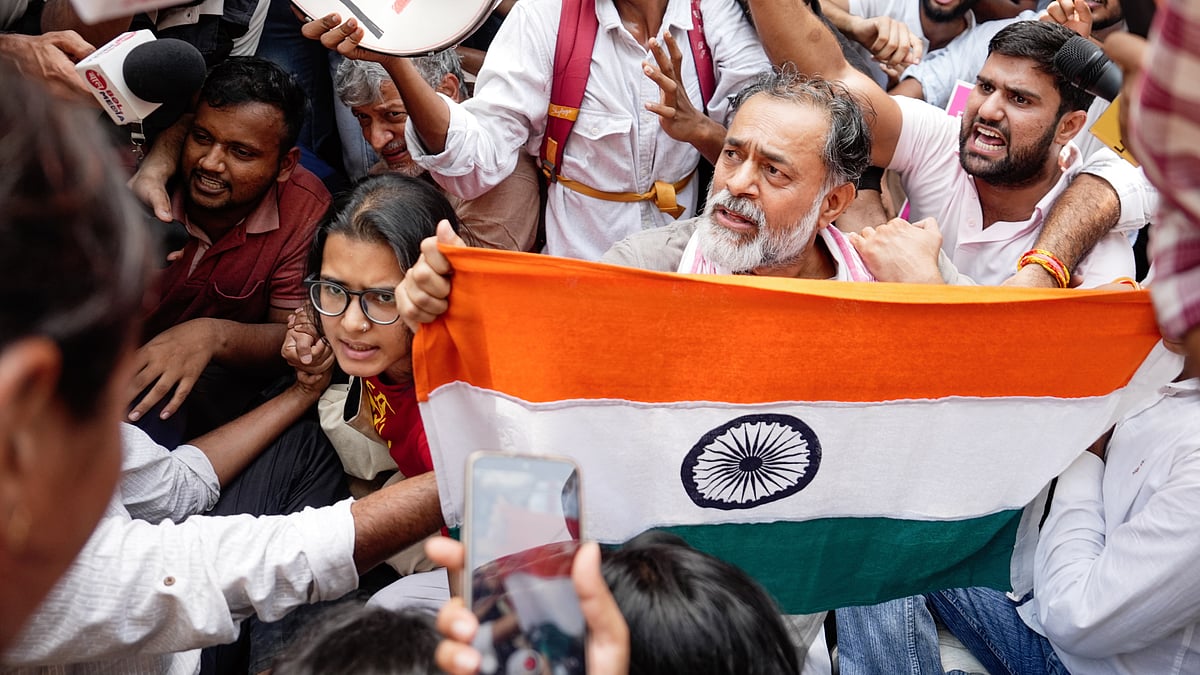
Delegation of former bureaucrats and civil society activists stopped by police from entering Election Commission of India to meet CEC Gyanesh Kumar and serve ‘people’s notice of impeachment’.
The group, which questioned why citizens could not enter a publicly funded institution to meet a public servant, shifted its planned 4.00 pm visit to a 5.00 pm press conference.
Its six-charge notice accuses Kumar of undermining the ECI’s collective functioning, unauthorisedly altering Form 6, centralising electoral-roll administration, causing mass disenfranchisement through SIR, compromising impartiality and breaching statutory duties.
A delegation of citizens, including former Delhi lieutenant-governor Najeeb Jung, former Union home secretary G.K. Pillai and political activist Yogendra Yadav, was stopped from entering the Election Commission of India (ECI) on Monday, 5 October, preventing them from meeting chief election commissioner Gyanesh Kumar and serving him a 'Notice of Impeachment'.
The delegation had sought an appointment with Kumar at 4.00 pm to hand over what it described as a 'people’s notice of impeachment'. But, according to Yadav, Delhi Police barricaded all routes leading to the ECI, forcing the delegation to shift its planned proceedings to the Press Club, where it was scheduled to address a press conference at 5.00 pm.
"I clearly failed to convince Delhi Police to take it easy. ECI is fortress. All routes to ECI are barricaded. So our delegation will now address a press conference at the Press Club at 5 pm," Yadav said in a post on X.
The document prepared by the group, titled 'Chargesheet and Notice of Impeachment', accuses Kumar of six instances of alleged "proved misbehaviour" and calls for his removal under Article 324(5) of the Constitution. The allegations are made by the signatories and do not constitute a finding by a court or any statutory authority.
The first charge accuses Kumar of "subversion of the collective functioning of the Election Commission". The signatories allege that he repeatedly exercised powers vested in the Commission without placing matters before the full three-member body. They cite the special intensive revision (SIR) of electoral rolls, alleging that it was undertaken without adequate discussion, consultation, rule-making or recorded proceedings.
The document also refers to alleged objections by the other two election commissioners to decisions taken without their knowledge and to meetings held without agendas and minutes. The signatories say the functioning of the Commission as a collective body is a statutory and constitutional requirement.
The second charge, and one that assumes particular significance following Monday's Supreme Court hearing, concerns the alleged "wilful and unauthorised alteration of Statutory Form 6".
The group alleges that Kumar authorised and continued the use of a modified Form 6 despite objections within the Commission that the alteration was "unauthorised and illegal". It also points to the subsequent restoration of the original Form 6 as evidence, according to the signatories, that the earlier procedure lacked lawful authority.
The statement alleges that voters whose names had previously appeared on electoral rolls but were subsequently excluded were effectively required to claim that they were applying for inclusion for the first time. It says such applicants were additionally required to sign a declaration carrying a warning of criminal punishment for false statements.
The Supreme Court on Monday separately clarified that it had not approved any modification to Form 6 and said it wanted to examine the records to establish who had made the changes. "Any modification to Form 6 has not been approved by us. Let’s be clear. When records are produced, we would like to see who has modified it," Chief Justice of India Surya Kant said.
The court was hearing a petition challenging alleged changes to Form 6 and the manner in which decisions relating to the SIR had been taken. The ECI had said in a 26 September statement that the declaration attached to Form 6 for SIR had been upheld by the Supreme Court, while maintaining that the statutory form itself had not been amended.
The third charge in the citizens' notice relates to what it calls "unlawful centralisation and manipulation of electoral-roll administration". The signatories allege that ECINET was deployed in a manner that undermined or displaced the statutory role of Electoral Registration Officers, who are legally responsible for additions, deletions and corrections to electoral rolls.
They further allege that the ECI's subsequent decision to constitute an expert committee to examine whether ECINET complies with the governing Acts and Rules showed that the system's legal compliance had not been adequately established before it was deployed.
The fourth charge accuses Kumar of "unprecedented mass disenfranchisement through SIR". The signatories allege that the exercise was implemented without adequate preparation, consultation, rules, training or mechanisms to quickly correct wrongful exclusions.
They claim that the exercise shifted the burden of voter registration onto citizens and subjected millions to requirements that foreseeably resulted in wrongful exclusion. The document cites what it describes as the ECI's responses to RTI applications saying that the Commission had not taken a decision to initiate an SIR across the country in 2025, and argues that this raises questions about where the decision to launch the exercise originated.
The notice claims that 13.3 crore names had already been deleted from pre-SIR electoral rolls and alleges that the gap between India's adult population and electorate could reach 15 crore or more by the time the exercise is completed. It says the alleged exclusions have disproportionately affected women, the poor, migrants, minorities and elderly voters.
The fifth charge concerns what the group describes as conduct "incompatible with independence and impartiality". The signatories allege that Kumar's public interventions against Opposition leaders, combined with decisions and actions surrounding the SIR, have created a "reasonable and substantial apprehension of political partisanship".
"You can no longer be a referee in a game where you are widely perceived to be aligned with a player," the document says.
The sixth and final charge accuses Kumar of "repeated breach of statutory duty". It cites Section 32(1) of the Representation of the People Act, 1950, and links the alleged alteration of electoral forms, circumvention of Electoral Registration Officers, use of ECINET, concealment of records, non-disclosure of information and failure to rectify alleged violations.
Taken together, the signatories say the allegations represent a sustained pattern rather than isolated administrative lapses, resulting in what they describe as large-scale disenfranchisement, erosion of public confidence and weakening of the ECI's institutional independence.
They conclude that Kumar has forfeited the "moral and constitutional authority" to continue as CEC and formally demand his removal, asserting that the alleged acts constitute "proved misbehaviour" within the meaning of Article 324(5).
The notice is signed by a wider group than the delegation initially announced. Besides Jung, Pillai, Anjali Bhardwaj and Yadav, the list includes former bureaucrats Amitabha Pandey, Jayashree Mukherjee and Yashovardhan Azad, former ambassador Ashok Sharma, former civil servant Ashish Joshi, and activists Aishe Ghosh, N. Sai Balaji, Dinesh Srirangarajan, Sandeep Yadav and Amrita Johri, among others.
Join our official telegram channel (@nationalherald) and stay updated with the latest headlines