


‘I wanted to fill this unpardonable gap’
A previously unpublished conversation with the legendary Mahasweta Devi, whose birth centenary we are observing this year
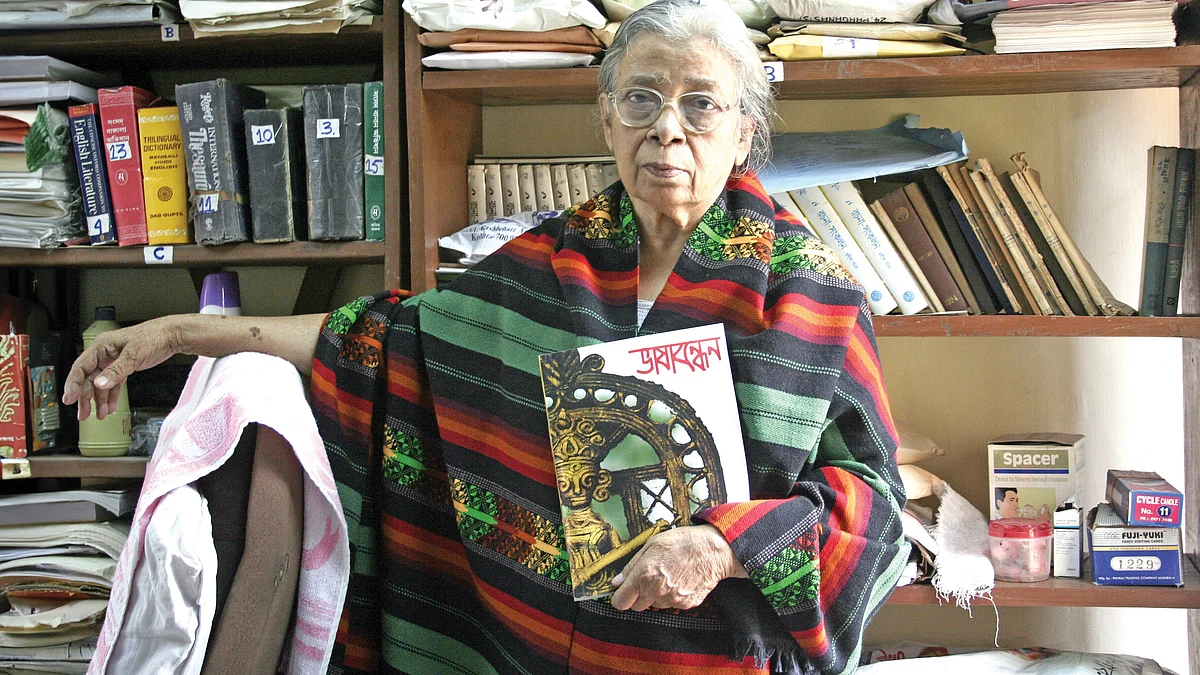


Mahasweta Devi (1926–2016), whose birth centenary we are observing this year, remains a powerful voice through her novels and short stories. She’ll always be remembered for her literary brilliance, but no less for her social activism and the empathy that animates her works. A winner of many prestigious awards, including the Magsaysay and Jnanpith, her work has inspired memorable plays and films such as Govind Nihalani’s Hazar Chaurasi ki Maa.
Former professor of human sciences Subhoranjan Dasgupta, who was lucky to have known her well, recounts a previously unpublished conversation.
In your very first book Jhansir Rani (Queen of Jhansi, 1956), you abjured the typical biographical format, which might have presented her as a figure of romance.
Yes, I broke new ground. My book was not a biographical novel in the accepted sense of the term. On the contrary, I depended on meticulous historical research rooted in that region and in the imagination of the common people, particularly villagers.
I examined local ballads and folklore, engaged in long interactions with people who ransacked their memories to recall the queen as she had been handed down through generations. The result of this grassroot exploration was the production of a ‘human history’ centred around the queen, as recollected and retold by the people themselves.
You followed the same method in later masterpieces too, like Aranyer Adhikar (Rights of the Forest, 1977) and Titumeer (1998).
Yes. I tried to create a form of historical fiction where the stress is on the revolt of the trampled and the exploited, be it under the great Muslim peasant-rebel Titumeer of Bengal or under Birsa Munda in Jharkhand (then Bihar).
I confess I have a special weakness for Aranyer Adhikar because there I tried to interweave two layers — documentation and fearless battle. We have to admit that the conventional historiography of our freedom movement has not given the Santhals the respect they deserve for their rebellion against ruthless colonial exploitation.
I wanted to fill this unpardonable gap, and what helped me immensely was my first-hand knowledge of the region and my intimacy with the local people. Once again, their memories, folk ballads, in short, their many-faceted invocation of the past ‘humanised’ my narrative.
You are perhaps the only Indian author of our times who consciously penetrated into the lives of the rural folk and tribals — exploited, cheated, impoverished at every step, yet so vibrant. This was not the occasional foray of an urban intellectual but a lifelong passion. Can you explain this deliberate choice?
I cannot explain it. I can only say that I made a choice. I ignored the mainstream and I opted for them. I did not go to the Ganga and Jamuna, I went to the unknown hills and rivers deliberately. And do you know what I discovered? The great respect and great love the Adivasis and tribals aroused in me. Let me say in all candour: the tribal society of our country is much more civilised, knowledgeable, even more sophisticated than those who clutter our metropolises. I went to them to seek inspiration.
In the process, you came very close to the Lodhas, Sabars and other tribal communities. Did this intense engagement reduce your output?
Tell me, who measures the genuine worth of creativity by quantity? Many urban writers are churning out thousands of books every year on the trials and travails of the middle class. Don’t we consign this abundance to oblivion?
On the contrary, my social activism has deepened my experience — giving it concrete-existential shapes — and defined the nucleus of my commitment. This valuable experience is layered with the invocation of myths, legends, folktales, collective memory. In short, magic realism.
When you read Budhani Ekti Raat Kahani (Budhan, a Tale of Night, 2001), you confront the intensity of this magic realism. Or, when you read Bashai Tudu (1978), the mysterious story of a Naxalite who revives miraculously after every encounter that riddles him with bullets.
Also Read: That ‘glittering aspiration’ called India
Are you the only one in contemporary Bengali literature to have transcribed the experience of ‘the wretched of the earth’ in literary texts?
I need to correct a possible erroneous impression that only I have concentrated on the marginalised and the lowly. In West Bengal, powerful novelists like Debes Ray and Amiya Bhusan Majumdar, who were never popular in the obvious sense of the term, have also traversed the same tormented terrain. For example, Debes Ray’s magisterial Teestaparer Brittanto (A tale from the banks of the Teesta, 1988) is devoted to the subalterns, their woes, their struggles.
Similarly, in Bangladesh, Hasan Azizul Huq, probably the most forceful short story writer of our time, and novelists like Shawkat Ali and, above all, Akhtaruzzaman Elias have highlighted, with rebellious rigour, the deprivation and resistance of people condemned to the lowest rungs in towns and villages. In fact, I would like to salute Elias as the greatest novelist of our day, the very best, after Manik Bandopadhyay. Believe me, he has attained this exemplary status in both Bengals by writing just two novels. Elias proved that it isn’t quantity that matters, but quality, dedication and commitment.
I would also like to stress that our literary movement, limited though resolute, has received due recognition: renowned directors have turned our texts into stirring plays and films. Though we have never craved the applause of millions, Usha Ganguli’s marvellous dramatisation of Rudali (The Mourner), that too in Hindi, was hailed as a landmark production in West Bengal. Elias’s epic-like Khwabnama (Dream Elegy) and Chilekothar Shepai (Sentry of the Attic) were staged in both Dhaka and Kolkata with marked enthusiasm.
Last but not least, my Hazar Churasir Ma (Mother of 1084) inspired Govind Nihalani to create the moving Hindi film Hazaar Chaurasi ki Maa (1998). The oppressed and erased, in short, the subalterns, won the recognition they deserve, a solemn acknowledgement, neither cheap nor tawdry.
You are hundred per cent leftist, but what sort of leftism appeals to you? Do you feel closely attached to any particular party?
You have put a delicate and difficult question but I shall answer it. You know that I come from an illustrious leftist or rather communist background. My father Manish Ghatak (pseudonym ‘Jubanashwa’) was a rebel-poet of sorts. My uncle was the filmmaker Ritwik Ghatak whose adherence to Marxism calls for no special mention. And my first husband, the famous dramatist Bijan Bhattacharya, heralded the new movement of Bengali drama by writing Nabanna (1944) in the glory days of IPTA (Indian People’s Theatre Association).
When I dwell on this background, I find that our official communist movements have not been able to address the burning questions of our country and society. They have become far too ‘parliamentarised’ and this tendency partly explains why I wrote Bashai Tudu and Hazar Churasir Ma, two creative texts which unforgivingly expose the brutality of state machinery.
Does this mean that I regard the extremist, Naxalite movement as the only answer? Not at all. I expose the sheer mercilessness of the state and cry for a system that will not provoke desperate young men to take up the gun.
I myself have adopted the constitutional route and opposed the death penalty of several extremists. My appeal was explicit in my letter to the President of India, ‘In the land of Buddha, Mahavir and Gandhiji, let it not be said that there is no place in our hearts for mercy’. I remain a leftist, an ardent one. I am still searching for an appropriate path to human and social deliverance.
And this aspired-for deliverance focuses inevitably on the emancipation of the tortured, tormented Indian woman. I am referring to characters in Rudali (1979) and Gohumani (1993)…
Of course, women fight against semi-feudal, patriarchal oppression, particularly in villages, because they have to live and win. Live — not just survive. I cherish a special weakness for Gohumani. Though bonded labour was abolished by law in 1976, it continued to survive in Palamau. In 1979-80, when the bonded labourers began their fight, I joined them. Gohumani is an outcome of that actual experience and struggle.
What surprises you most?
You know, I have lashed out against the powers that be without mincing words. For example, I opposed the CPI(M) regime tooth and nail during the Nandigram tragedy. But still, god knows why, the rulers choose me as their country’s voice. Why? I was requested to lead the Indian delegation to the 2006 Frankfurt Book Fair where India was honoured as the partner-country. You know what I said in my inaugural address? “My country, torn, tattered, proud, beautiful, hot, humid, cold, sandy — my country.”
Join our official telegram channel (@nationalherald) and stay updated with the latest headlines