


Central Delhi lost nearly 74% of its healthiest ecosystems over 3 decades: Study
Analysis of 32 years of satellite data shows a sharp decline in ecologically robust areas across the capital as urbanisation, habitat fragmentation and shrinking green cover take a toll
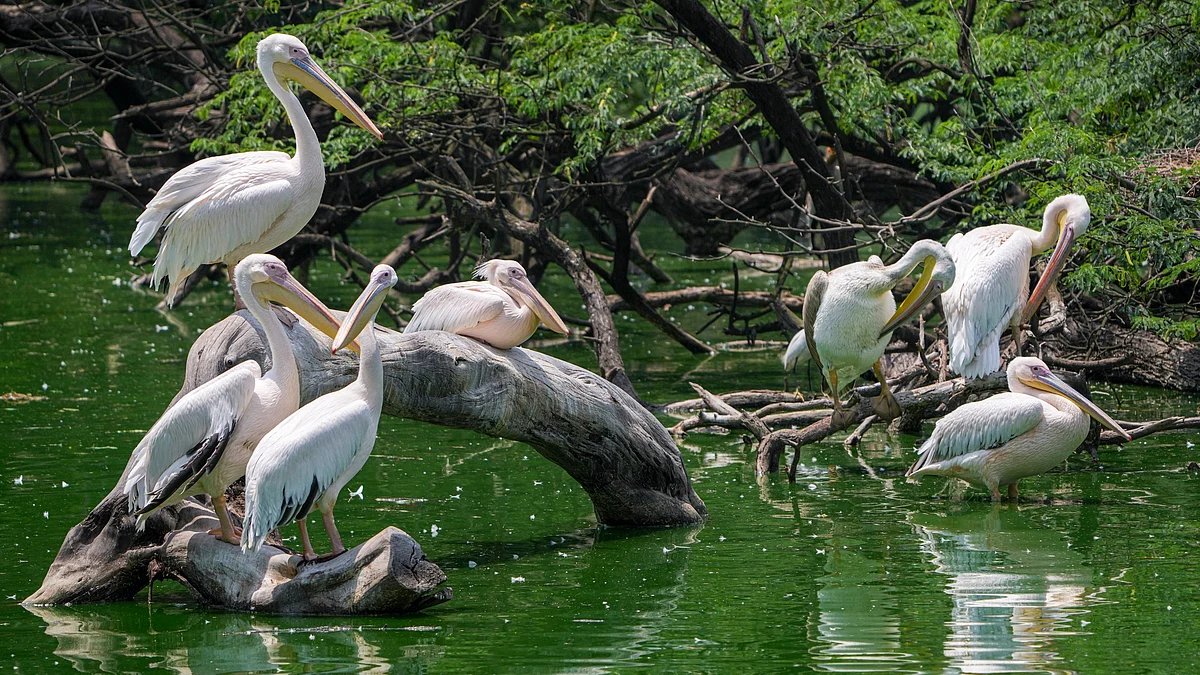


Large parts of Central Delhi that once contained some of the capital's healthiest ecosystems have witnessed a dramatic ecological decline over the past three decades, with nearly 74 per cent of these areas disappearing between 1991 and 2023, according to a new study.
The study found that land in Central Delhi classified as having "excellent" ecosystem health shrank from 13.88 square kilometres in 1991 to just 3.63 square kilometres in 2023 — a decline of 73.8 per cent.
During the same period, the area categorised as having "poor" ecosystem health expanded from 38.57 sq km to 54.90 sq km.
Titled Crossing the Ecological Threshold: Spatio-temporal Dynamics of Blue-Green Space Ecosystem Health in Delhi Using a VORR Framework, the study was conducted by researchers from Jamia Millia Islamia's Department of Geography and Department of Environmental Science.
The researchers analysed Landsat satellite imagery from 1991, 2001, 2011 and 2023 to assess changes in ecosystem health across Delhi. The analysis covered six land-use categories — dense vegetation, open green spaces, cropland, water bodies, wastelands and built-up areas.
The findings point to a broader ecological decline across the capital, where forests, wetlands, water bodies and green spaces have come under increasing pressure from urban expansion, shrinking natural cover and habitat fragmentation.
Across Delhi, the area classified as having poor ecosystem health increased by 50.8 per cent, rising from 541.47 sq km in 1991 to 816.36 sq km in 2023. The city's median Ecosystem Health Index also declined by 53 per cent during the period, indicating a substantial weakening of ecosystem functions.
The assessment measured ecosystem health through indicators such as vegetation productivity, ecological connectivity, resilience to environmental disturbances and the ability of landscapes to recover after stress.
Areas ranked as having "excellent" ecosystem health typically contain dense vegetation, healthier water systems and strong ecological connectivity. In contrast, areas classified as "poor" are characterised by extensive urbanisation, fragmented habitats and limited recovery potential.
Researchers found that ecological deterioration was visible across most districts, although the severity varied.
North Delhi recorded one of the steepest declines, with the area under poor ecosystem health more than doubling from 62.16 sq km in 1991 to 131.18 sq km in 2023.
Southwest Delhi witnessed a 132 per cent increase in poor ecosystem health areas, while West Delhi recorded an increase of around 60 per cent over the study period.
East Delhi, Shahdara and Northeast Delhi emerged among the weakest-performing districts, with very little land remaining in the good or excellent ecosystem health categories. The study linked this trend to rapid urbanisation, industrial activity, degradation of the Yamuna floodplain and shrinking green cover.
South Delhi remained relatively better placed due to the presence of the Delhi Ridge and protected forest areas, which continue to support biodiversity and ecological functions despite mounting development pressures.
The New Delhi district showed signs of partial recovery. The area classified as having excellent ecosystem health declined from 38.62 sq km in 1991 to 11.35 sq km in 2001, before recovering to 23.39 sq km in 2023, suggesting that conservation and restoration efforts may have improved conditions in some locations.
The deterioration was not limited to the poorest-performing ecosystems.
Across Delhi, the area classified as "excellent" declined by 51.5 per cent during the study period, while land in the "good" category fell by 36.4 per cent and the "fair" category by 48.3 per cent.
Although areas categorised as "moderate" increased by 48.7 per cent, the researchers noted that this reflected ecosystems under stress rather than genuine ecological improvement.
The city's natural landscapes also continued to shrink. Areas retaining continuous natural cover — including forests, wetlands, open green spaces and water bodies — declined from 49 per cent of Delhi's total area in 1991 to just 30 per cent in 2023.
According to the study, this reflects the steady conversion of natural land into residential, commercial and infrastructure projects, along with the fragmentation of the remaining green spaces.
Researchers also documented a sharp decline in ecological resilience, which measures an ecosystem's ability to withstand disturbances such as pollution, heat stress and land-use change while continuing to function.
Delhi's ecological resilience index fell from 0.61 in 1991 to 0.36 in 2023.
Similarly, the city's capacity to recover from ecological disturbances weakened over time. Areas with strong recovery potential, once spread across several districts, have increasingly become concentrated in the Delhi Ridge, protected forests and parts of the Yamuna floodplain.
Environmental activist Bhavreen Kandhari said the findings reflected a worrying trend.
“What is particularly alarming is the finding that this trajectory reflects governance failure rather than an inevitable consequence of urban growth. Delhi cannot continue treating forests, wetlands, floodplains and urban green spaces as vacant land. The land-grabbing model has to change if we want a future for the city,” she said.
The study concluded that healthy ecosystems, once distributed across much larger parts of Delhi, have increasingly been pushed towards the city's periphery, while built-up areas have continued to expand.
Roads, buildings and paved surfaces steadily replaced natural landscapes over the study period, weakening ecological connectivity and reducing the city's ability to sustain healthy ecosystems.
Join our official telegram channel (@nationalherald) and stay updated with the latest headlines