


SC declines to halt mangrove removal for Versova–Bhayandar coastal road
Cites public benefit and safeguards as it upholds Bombay HC nod to BMC project
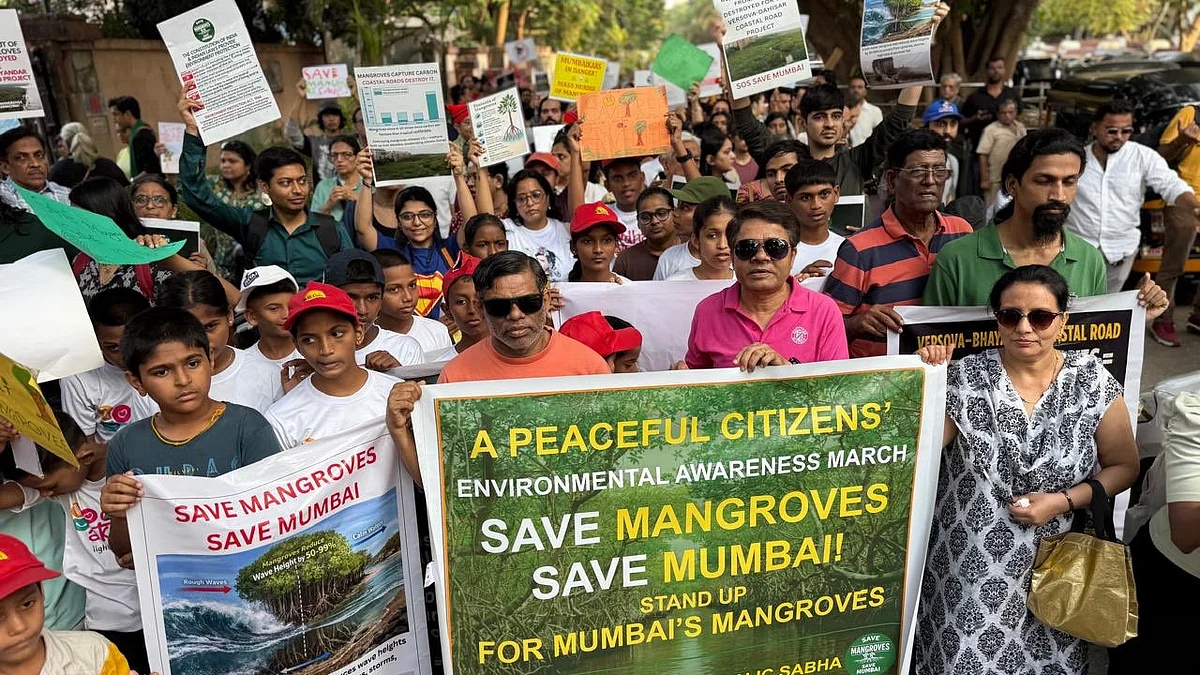


The Supreme Court on Friday refused to interfere with a Bombay High Court order permitting the Brihanmumbai Municipal Corporation (BMC) to remove over 45,000 mangrove trees for the proposed Versova–Bhayandar coastal road project.
A bench comprising Chief Justice of India Surya Kant and Justices Joymalya Bagchi and Vipul M. Pancholi was hearing a plea filed by environmental group Vanashakti challenging the high court’s 12 December 2025 order.
The high court had granted approval subject to conditions, including that the BMC file annual status reports for ten years detailing progress on mangrove restoration and compensatory afforestation.
Declining to intervene, the Supreme Court observed that the project would have a “significant and beneficial impact on the general public” by easing congestion on the western highway. “There will be other significant advantages for the residents of Mumbai due to the construction of the road,” the bench noted, adding that adequate safeguards had been imposed by the high court.
The project involves the diversion of 103.65 hectares of land and the removal of around 45,675 mangrove trees. According to the plan, 36,675 mangroves will be relocated, while approximately 9,000 will be permanently cut.
The Court recorded the BMC’s undertaking to carry out compensatory afforestation on an equivalent area of non-forest land in Chandrapur district. It also directed that annual compliance reports be submitted to the high court, detailing afforestation efforts and mangrove restoration.
Senior advocate Chander Uday Singh, appearing for the petitioner, argued that the BMC had secured permission by repurposing a prior afforestation exercise. He pointed to satellite images from October 2025 — two months before the high court’s order — to support the claim.
Solicitor-general Tushar Mehta, appearing for the BMC, rejected the allegations. He submitted that the project would significantly reduce travel time and traffic congestion, thereby lowering carbon emissions.
Singh urged the Court to revisit the proposal to minimise the number of mangroves being cut. “If the amount of cutting can be minimised, if we save at least 10,000, that is a huge benefit for the nation. Mangroves absorb CO2 (carbon dioxide) more than five times that of a normal forest. We are not questioning the project; saving mangroves will not hamper it,” he argued.
Justice Bagchi, however, noted that any challenge to the number of trees being diverted would require questioning the Stage-I environmental clearance. He also observed that the high court had not relied solely on the project proponent’s submissions but had examined the environmental clearance process.
Reiterating the ecological importance of mangroves, Singh submitted that they take decades to regenerate and play a crucial role in protecting Mumbai from flooding. The bench, however, emphasised that the figures had been determined by expert bodies and that the Court could not second-guess such assessments. It also underscored the High Court’s continuing oversight through mandatory reporting. “In view of the safeguards taken by the High Court, we see no reason to interfere,” the bench said.
The case, Vanashakti vs Brihanmumbai Municipal Corporation, concerns the balance between infrastructure development and environmental protection in one of India’s most densely populated urban regions.
Join our official telegram channel (@nationalherald) and stay updated with the latest headlines