


Hawks and the Nobel Peace Prize
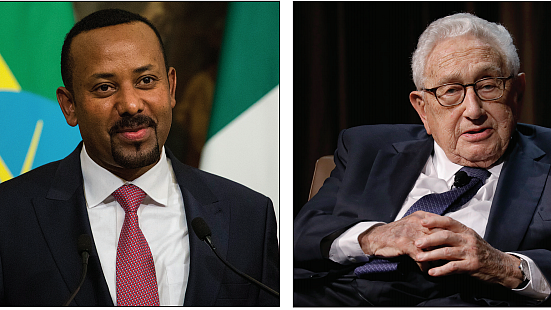
The Nobel Peace Prize winner in 2019, Ethiopia’s Prime Minister Abiy Ahmed has since then gone to war and fallen from the pedestal. He is among a growing list of hawks given the Peace Prize


In 2008, during my first visit to Addis Ababa, Ethiopia’s bustling capital city, I was amazed at the scale of Chinese investment in the country, mostly in the form of high-rise constructions. These were buildings, which were being erected to host large multinationals, promising to usher a new era for the Ethiopians.
Ditching the car rides back to the hotel after the day long meetings, I would attempt to stroll on non-existent sidewalks, perhaps because they reminded me of my home country. Outside of the dazzling buildings where we, the United Nations folks, met and discussed the future of the world, there was poverty, lack of civic hygiene and a general sense of apathy among its citizens.
I remember being bewildered at the proliferation of beauty salons, promising a lighter skin shade to the Ethiopians, at every nook and corner. I had assumed they were in demand, going by the critical mass and the queues in front of the parlours.
I had kept myself updated on Ethiopian politics over the past decade, having visited the country a few times. Hence, it was a pleasant surprise to learn about the Nobel Peace Prize being conferred on its young and dynamic Prime Minister, Abiy Ahmed, in 2019, for his “efforts to achieve peace and international cooperation, and in particular for his decisive initiative to resolve the border conflict with neighboring Eritrea”.
I had heard only admiration for the Prime Minister, particularly in the corridors of the United Nations, which lavished praise upon itself for having ended the Ethiopia-Eritrea conflict. After Rwanda, this was going to be the second success story.
It was early 2020 and I was in Seattle for a meeting. During a shared ride, learning the driver was from Ethiopia, I had struck a conversation with him about Ahmed. This was the first time that I heard anything negative about the Ethiopian Prime Minister. The driver, Teklu, had claimed that it was only a matter of time before the façade was lifted and the world would know the truth about the Ethiopian leader.
His words were to ring true within a year. Abiy Ahmed has now joined the ranks of authoritarians this world inhabits, following his offensive on the Tigrayan People’s Liberation Front (TPLF), a regional government in Ethiopia that had once dominated its ruling coalition. Late last year, Ahmed also admitted that soldiers from Eritrea are fighting against the Ethiopian army alongside TPLF, bringing the peace talks with Eretria to an abrupt close.
He has sealed Tigray’s borders, effected an internet blockage and a media blackout, blocked all international aid to the region, possibly putting thousands at risk. It has been widely reported that both Ethiopian and Eritrean troops have massacred large numbers of civilians in the region, thus bringing an end to the promise Mr. Ahmed had once shown.
This fall from grace also blots the credibility of the Nobel Peace Prize committee, which had shown haste in conferring the young Prime Minister with one of its most prestigious honours.
The Nobel committee accepts the nominations from just about anybody before the January 31 deadline each year. You will find the names of several dictators in the annals of the nominations for the Nobel Peace prize, including, but not limited to, Benito Mussolini, Adolf Hitler and Joseph Stalin (twice). The committee has gone on record to say that these infamous dictators were never considered for the prize. In recent years, there is Donald Trump and his son-in-law, Jared Kushner, who were in the reckoning. India’s current Prime Minister, Narendra Modi was nominated in 2019 by his party’s regional office for his efforts in ‘launching world’s largest healthcare scheme’. This was before India was hit by second wave of Covid.
Abiy Ahmed is not alone in this ignominy gallery. He is joined by the famous Aung San Suu Kyi and Henry Kissinger, who won the prize in 1973 and 1991, respectively. While both of them are well known world figures, their selection for the world’s most coveted prize has been questionable as time has passed. The future generations would find it difficult to believe Kissinger was awarded the Peace Prize for his efforts in ending the war in Vietnam.
It must be recalled here that in immediate years before he was awarded the peace prize, Kissinger okayed Operation Menu in 1969-70, allowing for the carpet bombing of Cambodia, resulting in 4247 civilian deaths.For Indians, he will be remembered for the (released in the declassified documents) words he used in 1971 for our late Prime Minister, Mrs. Indira Gandhi and for Indians at large, in a conversation with President Richard Nixon. Readers would recall that Mrs. Gandhi had cocked a snook at the Nixon-Kissinger duo in their efforts to call off her efforts in liberating Bangladesh.
Suu Kyi was, until recently, considered a global icon for democracy. It would probably have been difficult to predict her future course of (non) action and antipathy towards the Rohingyas. She was always walking the thin line between her love for democracy and the military junta. Her late father, Bogyoke Aung San, father of the modern Burmese nation, was also the founder of the Myanmar Armed Forces.
The one man who comes to mind who defines peace is Mohandas Karamchand Gandhi. Nominated five times in 1937, 1938, 1939, 1947, and in 1948, he never won it. The Norwegian body apparently considered awarding Gandhi the prize posthumously, but it had never been done before, and hence the idea was flirted with but dropped. It’s worth noting that up until 1960, the Nobel Prize awardees were limited to Europeans and Americans. Perhaps the reason why the global icon for peace was denied the prize. In the year the world lost the Mahatma, no Nobel Peace Prize was awarded for “lack of any suitable living candidate”.
Gandhi never needed the Nobel, or any other epithet. In 1989, when the prize was awarded to Dalai Lama, the committee said it was “in part to the memory of Mahatma Gandhi”. It is heartening to note that in the following decades after Gandhi’s assassination, known proponents of Gandhian values have been honoured with the coveted prize -- MLK Jr, Nelson Mandela, the Dalai Lama and Barack Obama, among them.
(The author worked for the United Nations for more than a decade in New York, serving as UNICEF’s Chief of Communications)
Join our official telegram channel (@nationalherald) and stay updated with the latest headlines