


Sacked Ukraine defence minister urges questions over Zelenskyy’s knowledge of corruption
Mykhailo Fedorov says Ukrainian president should explain whether he knew about corruption in his inner circle; also renews call for wartime elections
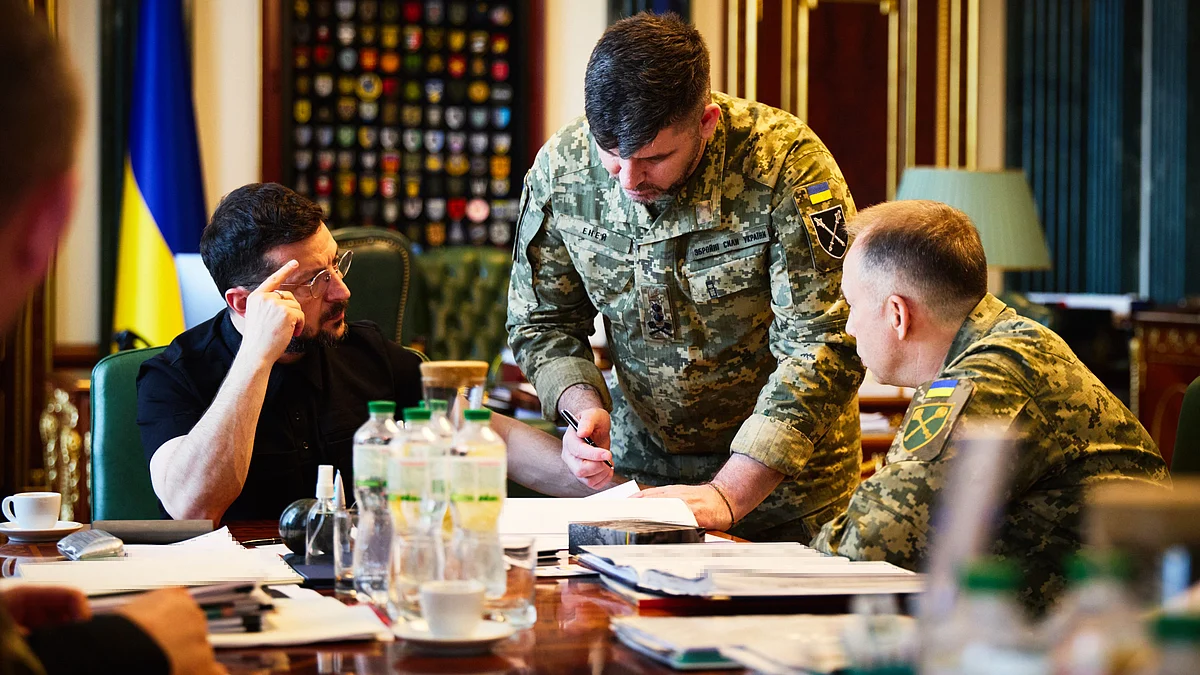


President Volodymyr Zelensky has said dismissed Defence Minister Mykhailo Fedorov was “pushed” into actions he considered misguided, including his involvement in protests against the government and calls for elections during the war.
Zelensky made the comments while publicly detailing his differences with Fedorov for the first time, saying he still had a positive personal view of the former minister despite their political rift.
“I really had and still have a very positive attitude toward Mykhailo. We have been through a lot together. But I believe that he himself goes, or is pushed, into the wrong things,” Zelensky said.
Fedorov, a popular minister credited with modernising Ukraine’s military and accelerating its use of drones and other technologies, was dismissed last month after reportedly falling out with the country’s top military commander.
His dismissal triggered protests, which continued for several weeks before ending without reversing the decision. Fedorov subsequently called for elections in Ukraine.
Zelensky said he had offered Fedorov four options to continue working in the government, but that the former minister rejected all of them.
Zelensky rejects wartime election calls
Zelensky strongly rejected Fedorov’s call for elections, saying a vote during the war could destabilise the country.
“I believe elections during a war like this would generally pose enormous risks. Holding elections right now would be a tsunami for the state that would split Ukraine apart,” he said.
Zelensky said he had previously faced pressure to hold elections during the war, but no international partners had presented a workable plan for conducting a vote safely, legitimately and democratically.
Ukraine has been under martial law since Russia's full-scale invasion in 2022, preventing national elections. Zelensky’s five-year presidential term formally ended in May 2024.
Fedorov has argued that democracy should not become a casualty of the war and has said that Ukraine would no longer be a democracy if elections were never held.
Starlink dispute adds to rift
Zelensky also appeared to link Fedorov to an awkward episode involving SpaceX’s Starlink satellite communications system and its founder Elon Musk.
He said the Defence Ministry had informed him earlier this year that SpaceX had agreed to allow Ukraine to use Starlink over Russian territory for deep-strike operations, subject to political approval.
Based on that information, Zelensky said he raised the issue with US President Donald Trump and told him that Musk had agreed to the proposed use.
The matter was subsequently discussed with Musk, including the question of financing. But Zelensky said Trump later told him that Musk had rejected the proposal and regarded it as a dangerous escalation.
“He said that I had supposedly deceived him because Musk had denied Ukraine the use of Starlink on Russian territory. I went back to our Ministry of Defence, and they said that maybe it was so,” Zelensky said.
Zelensky did not directly accuse Fedorov of providing false information, but said the episode was among the factors behind “some of the steps” taken against him.
He also criticised protesters who had targeted former army chief Oleksandr Syrskyi and current Defence Minister Maj. Gen. Yevhen Khmara.
“Maybe someone doesn't like Syrskyi for one reason or another. But the slogans Syrskyi is the devil, Khmara is the devil,” he said. “Listen, this is too much.”
Defence faces budget shortfall
Zelensky also described severe financial pressure on Ukraine’s war effort, saying the Defence Ministry faced a $27 billion budget shortfall after funds intended for the second half of 2026 were brought forward earlier in the year.
He also addressed a corruption investigation that led to the dismissal of a senior official in his office.
“The heads of anti-corruption agencies have zero questions for me. They understand perfectly well that I am not involved in anything like that. And this is important to me,” Zelensky said.
He said anti-corruption investigators had not implicated him in the money-laundering case and that a deputy head of the presidential office had been named among the suspects.
Ukraine claims battlefield gains
Despite the financial and military pressures, Zelensky expressed optimism about developments on the battlefield.
He said Ukrainian forces had almost completely regained control of the Dnipropetrovsk region, with about 10 square kilometres and three small villages remaining under Russian control.
He said another military operation was under way elsewhere and that its results were expected by the end of August.
Zelensky also predicted that Ukraine could achieve parity by the end of 2026 between territory occupied by Russia since the start of the year and territory retaken by Ukrainian forces.
According to his figures, Russia has occupied around 990 square kilometres since January, while Ukrainian forces have retaken roughly 820 square kilometres.
He said Russia’s principal objective remained the Konstantynivka-Sloviansk-Kramatorsk axis and that Moscow continued to demand Ukraine’s withdrawal from the Donbas as a condition for a settlement.
Patriot missile shortage
Zelensky also highlighted Ukraine’s worsening shortage of Patriot air-defence interceptors as Russian ballistic missile attacks intensify.
He said Ukraine received 675 Patriot missiles in 2023, compared with 364 in 2025, with 264 expected in 2026.
Zelensky said Ukraine wanted to secure an additional 300 Patriot missiles ahead of winter, while its Air Force had requested 360.
He said the United States and European allies were struggling to increase production and that Ukraine hoped to obtain even 5% or 10% of US reserves if it could pay for them.
Zelensky estimated that Russia could eventually produce up to 1,300 ballistic missiles a year, compared with current production capacity of about 600.
Ukraine was also preparing alternatives to Starlink, including a European communications project, he said, as Russia and China develop competing systems.
Join our official telegram channel (@nationalherald) and stay updated with the latest headlines