


Sushma lied about international support to India on Doklam
The union minister of External Affairs said in Parliament that India has international support in the current stand off with China. But she is deluding herself if she believes in what she said
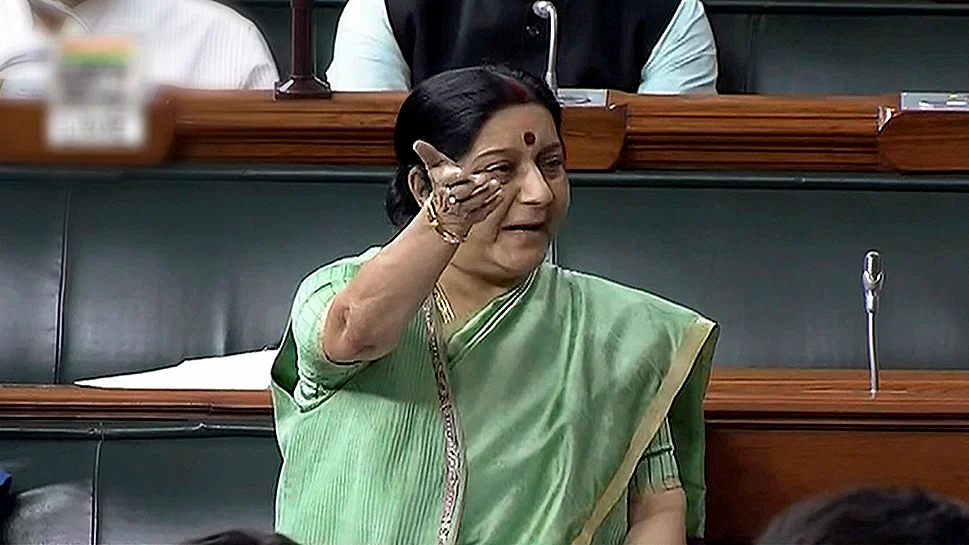


Indian External Affairs Minister Sushma Swaraj in her statement to parliament plainly lied to MPs when she said the whole world is supporting India in the current confrontation with China. She is deluding herself if she believes what she said. If she didn’t and yet made the claim, she was contemptuous of the legislature.
Not one of the major European entities, when asked, came out in favour of New Delhi. A spokesperson for the European Union said: “I have no comment to make.” An official source at the German Foreign Ministry stated: “Germany stands firm for a peaceful and diplomatic settlement of disputes.” The British Foreign Office put on record: “We urge China and India to work together to resolve any disagreements peacefully.” The French Foreign Ministry echoed: “We think it is desirable that China and India settle their disagreement by dialogue.”
In the US, a Pentagon spokesman told Press Trust of India: “We encourage India and China to engage in direct dialogue aimed at reducing tensions and free of any coercive aspects.” Modi unwisely abandoned India’s post-cold war equidistance from colliding power blocs by signing a strategic pact with President Barack Obama – which sadly converted India into a frontline agent of Washington to contain China. While this may be dead in the water under Donald Trump, the Chinese still see this as an ill-intention on the part of India.
In effect, the world’s biggest trading bloc plus three of the other four permanent members of United Nations Security Council are unprepared to stick their necks out and upset China, even when they are sympathetic to India’s stance. Self-interests and economic benefits accruing from China govern international reaction in the present global scenario.
It can be argued, countries don't express in public what they say in private. And the Pentagon's statement can be read as indicating to China to back-off. However, since the sovereignty of Bhutan, a tiny, vulnerable state, is involved, shouldn’t the international community have been more sympathetic? And correspondingly, shouldn’t Indian diplomacy have extracted better results?
Let us examine the facts. The defence of Bhutan is India’s responsibility as enshrined in treaties. Therefore, if a third country violates Bhutanese territory to build a road through it, India is obliged not to remain idle. Therefore, if Indian troops have entered Chinese land to signal to China that it should vacate what it has occupied in Bhutan, then that is fair gamesmanship diplomatically and militarily. Little Bhutan has no capability to resist the might of the People’s Liberation Army. It can only fall back on India’s assistance to assert its rights.
Beijing flexing its muscle, adopting a threatening tone towards India is not unusual, but this is presently at a much higher pitch than normal. There has been over the decades, a roguish aggressiveness about communist China’s attitude to the world. That said, Chinese belligerence towards India had considerably tapered off since 1993, when the two countries signed the landmark Peace and Tranquility Treaty and which has resulted in a $100 billion goods and services trade turnover between the two countries from a negligible level – much to China’s advantage. Building blocks since the agreement, including Beijing’s formal acceptance of Sikkim being an integral part of India, had established a degree of mutual confidence as well as an accommodation on the part of China on issues like the Nuclear Suppliers Group waiver to India and cooperation at international fora on various matters of global concern.
But that collaborative approach dissipated after Narendra Modi’s criticism of China during his visit to Japan in 2014. Since entering the central government, Modi has not held a single press conference with Indian journalists, but is not shy to confide in foreign scribes. Adam Roberts of The Economist in a recent book talks about Modi’s “fascination with America”. He also says the man “spoke of his affection for China”. People need to appreciate being awe-struck with the United States stems from gullibility and a petty businessman’s mentality. Love of China from an admiration for its authoritarianism.
Under Manmohan Singh, the stand-off at Doklam would probably have been sorted out without the general public in India coming to know much about it. It has become an issue, because disinformation from the Bharatiya Janata Party has attempted to give an impression of Modi standing up to the Chinese, where previous Indian governments didn't. A section of Indian media bought this hook, line and sinker, thereby prompting the Chinese to blame Hindu nationalism for the tension. And since it has become quite an overt spat, China, caught in an act of surreptitiously straying into Bhutanese land, is finding it difficult to retreat.
There’s no doubt Hindu extremist bellicosity is a cause of a number of India’s current external problems. But Doklam is not one of them. Publicly, in sharp contrast to their abusiveness towards Pakistan, the bhakts have been whimpering like a mouse while China has roared like a dragon. China, though, should be under no illusion that patriotic, secular Indians – as opposed to Hindu jingoists - are united in their opposition to Chinese transgression of Bhutanese territory.
Follow us on: Facebook, Twitter, Google News, Instagram
Join our official telegram channel (@nationalherald) and stay updated with the latest headlines
- Sushma Swaraj
- China
- Donald Trump
- Sikkim
- United Nations
- European Union
- Barack Obama
- United States
- Bhutan
- Washington
- Beijing
- Japan
- Dr Manmohan Singh
- Pentagon
- PM Narendra Modi
- Doklam
- Doklam standoff
- Hindu jingoism