


The mystery of the Fairford withdrawal
Was there really a 'terror threat' to US bombers in the UK's Fairford airbase? Where does Iran come in?


Ever since WWII, American armed forces have remained stationed on British soil. The United States joined the Allied effort against Nazi Germany in response to British Prime Minister Winston Churchill’s appeal. On D-Day, 6 June 1944, a joint operation of Anglo-US troops landed on the Normandy coast, liberated France from German occupation and turned the tide of the war in Europe.
Both nations, particularly Whitehall, describe the continued US–UK alliance as a “special relationship”. Despite occasional bumps, solidarity has been steadfast and London, more than Washington, has adhered to the understanding.
In 1982, Britain would have preferred a joint operation when Prime Minister Margaret Thatcher despatched the Royal Navy to recapture the Falkland Islands in the South Atlantic from Argentina. In 1983, when Americans parachuted into Grenada in the eastern Caribbean to oust — indeed exterminate — the island’s Prime Minister Maurice Bishop, the United Kingdom was not taken into confidence. This was an insult because Queen Elizabeth II was Grenada’s head of state.
Cut to 2003, when British Prime Minister Tony Blair collaborated with US President George Bush in the controversial invasion of Iraq. Saddam Hussain’s regime was not in possession of ‘weapons of mass destruction’ as alleged by the CIA, and was therefore not a nuclear threat to any country, let alone the US.
This year, British premier Keir Starmer turned the tide of cooperation, by refusing to participate in President Donald Trump’s unlawful attack on Iran. Trump attempted to retaliate by hinting that Argentina enjoyed territorial rights over the Falklands, even as aggressive noises emerged from the right-wing government in Buenos Aires.
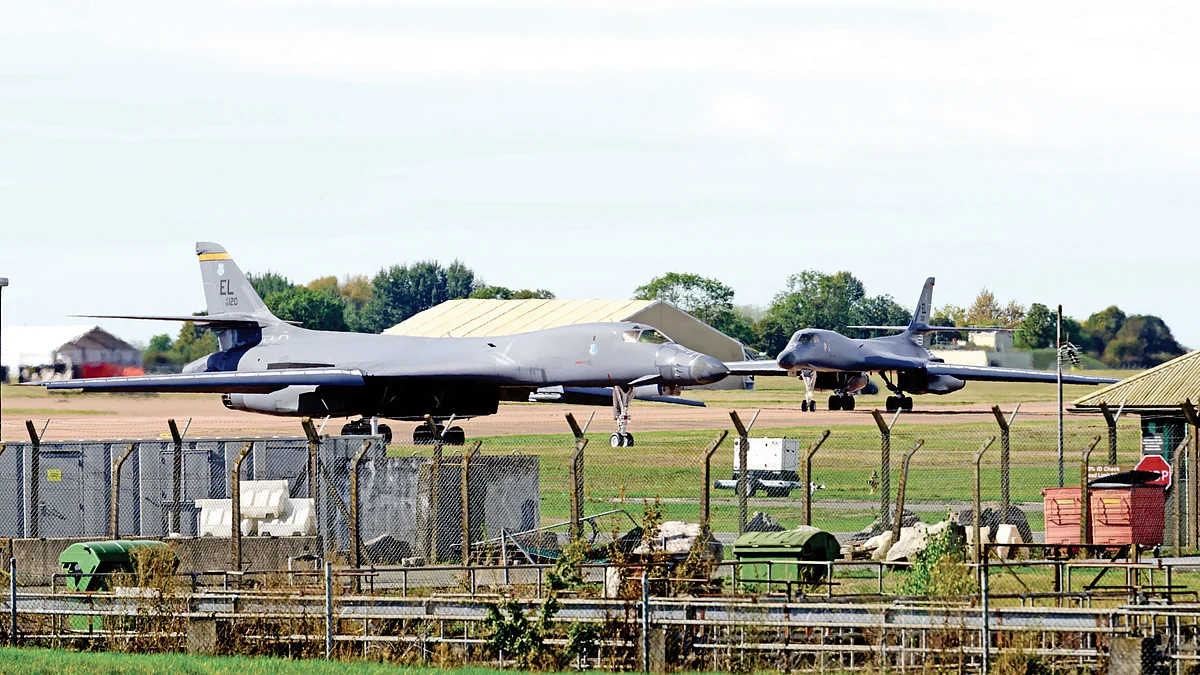
Among the US Air Force stations across Royal Air Force bases is RAF Fairford in Gloucestershire. In recent months, after Britain approved an American request for defensive strikes on Iran, US B-1 and B-52 bombers have flown from Fairford towards West Asia.
On 27 September, local residents noticed three white vans near the base, and reported ‘suspicious activity’ to the police. Five Londoners and a British Iranian national (all in their twenties) were arrested on suspicion of explosive and terrorism offences, handcuffed, and questioned. A ‘potential terror plot’ was declared.
An assistant commissioner of police told media that investiga- tors are currently exploring “multiple lines of enquiry”, including whether proxies or individuals were working (knowingly or unknowingly) on behalf of a foreign State.
The UK’s Counter Terrorism Policing, which is leading the probe, said no improvised devices were found in the vans, but a “quantity of petrol” was recovered.
At the time the incident became public, the US military stated it was “working closely” with its UK counterparts “to monitor this situation, minimise impacts and ensure the safety of US personnel, their families and the local community”. Additionally, 85 households in the vicinity were temporarily evacuated.
On 28 September, US secretary of state Marco Rubio told Fox News that a “foreign actor” was clearly involved. It was, he said to another news outlet, “a very serious situation”.
The men arrested were, however, released on bail, albeit under ‘stringent conditions on their movement and contact with others’. Trump expressed his surprise at this, adding, “We know everything about them, we would not have released them.” In fact, he went to the extent of saying, “We had them under view for a long time, and we got them.”
British Prime Minister Andy Burnham urged people “not to speculate while the authorities establish the full facts”. Referring to a “string of indications” pointing to Iran’s involvement, he added: “We will say more in due course but we can confirm […] that we believe Iran to have played a part.”
In turn, the Iranian embassy in London responded with a categorical rejection and strong condemnation of what it called “unfounded and malicious speculations” linking Iran to the incident. It even threatened legal action “to safeguard the rights and interests” of Iran and its people.
The investigative methods of the British and the Americans differ. The former rely more on deduction and detection and often deliver better results. Heavy-handedness is not their style. Releasing detainees on bail can lead to them lowering their guard, which in turn can lead investigators to the masterminds. It should soon be evident if this approach will bear results.
Meanwhile, the US administration went into action. Eight B-1 bombers were pulled out from Fairford and sent back to the US. Trump said this was due to “some threats”. US media suggested the decision was based on intelligence indicating that Iran was plotting a drone attack on expensive US aircraft. While Trump refused to be drawn into this, speculation in Washington centred around such a possibility, were US-Iran hostilities to resume.
10 Downing Street effectively rejected such reporting by emphasising that RAF Fairford was safe. It pointed to an earlier statement by Trump wherein he praised the UK’s police, defence and security services in relation to the base.
While Rubio played down the threat theory, saying it was “not unusual” for military assets to rotate and relocate, Trump’s remarks have added fuel to the narrative that Britain is teeming with Muslim terrorists because of the UK’s immigration policy. This has been uncomfortable for Britain.
However, as the international community now knows better than to take Trump’s pronouncements at face value, the reputational damage to Britian could be limited. The more pertinent question would be: does the pullout weaken western Europe’s ability to defend itself against a hypothetical threat from Russia?
Ashis Ray was editor-at-large of CNN, and is the author of The Trial that Shook Britain. More of his writing here