


US offers Ukraine 15-year security guarantee as part of peace plan: Zelenskyy
Kyiv believes a far longer commitment — closer to 50 years — would be necessary to credibly deter future Russian aggression
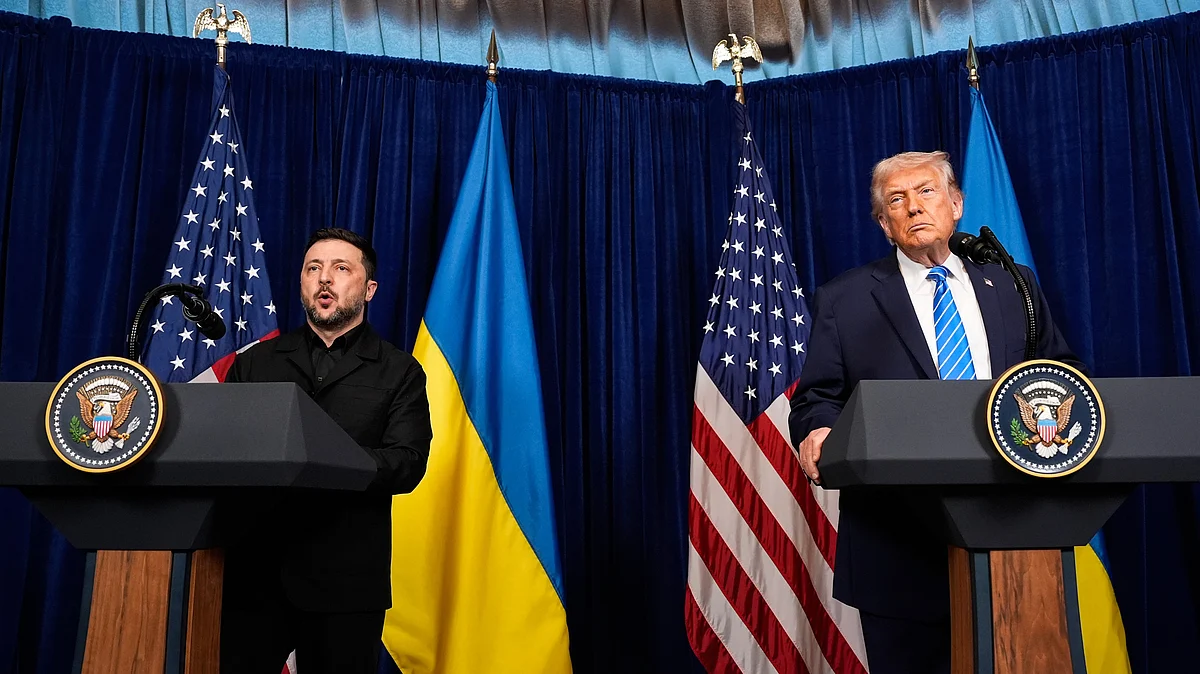


The United States has offered Ukraine security guarantees lasting 15 years as part of a proposed peace framework, Ukrainian President Volodymyr Zelenskyy said on Monday, 29 December, while making clear that Kyiv believes a far longer commitment — closer to 50 years — would be necessary to credibly deter future Russian aggression.
Zelenskyy’s comments followed talks with US President Donald Trump, who hosted the Ukrainian leader at his Florida resort at Mar-a-Lago on Sunday as Washington intensifies a US-led diplomatic push to end the nearly four-year war. Trump said after the meeting that Ukraine and Russia were “closer than ever before” to a settlement, while also conceding that months of negotiations could still unravel.
“Without security guarantees, realistically, this war will not end,” Zelenskyy said in voice messages sent to reporters via WhatsApp, underlining Kyiv’s long-standing insistence that any ceasefire or peace deal must be anchored in enforceable protections.
Though the precise contours of the proposed guarantees have not been made public, Zelenskyy said they would include mechanisms for monitoring a peace agreement and the “presence” of international partners. He did not elaborate on what form that presence might take, a sensitive issue given that Russia has repeatedly stated it will not accept the deployment of NATO troops on Ukrainian soil.
Also Read: Learning to live with Trump’s America
Security guarantees have emerged as the central fault line in negotiations. Ukraine argues that earlier arrangements — most notably the 1994 Budapest Memorandum, under which Kyiv gave up its nuclear arsenal in exchange for assurances from major powers — failed to prevent Russian aggression. For Kyiv, anything short of binding, long-term commitments risks freezing the conflict rather than ending it.
Trump, according to Zelenskyy, said he would consider extending US guarantees beyond the proposed 15-year period. Any such guarantees would require approval by the US Congress, as well as ratification by the parliaments of other countries involved in supervising a settlement.
Negotiators are still struggling to bridge major gaps, including questions over territorial control, the sequencing of troop withdrawals, and the future of the Russian-occupied Zaporizhzhia nuclear power plant, Europe’s largest nuclear facility and one of the 10 biggest in the world. The plant’s status is seen as particularly volatile, given concerns about nuclear safety in an active war zone.
Trump acknowledged that despite progress, the talks could collapse, reflecting the sharply conflicting demands of Moscow and Kyiv. Russia continues to insist on recognition of territories it occupies, while Ukraine has ruled out ceding sovereign land.
Kremlin spokesman Dmitry Peskov said on Monday that Russian President Vladimir Putin and Trump were expected to speak in the near future. There was, however, no indication that Putin would hold direct talks with Zelenskyy, something the Russian leader has largely avoided since the early months of the war.
European allies are also positioning themselves around the security guarantee debate. French President Emmanuel Macron said Ukraine’s partners would meet in Paris in early January to “finalise each country’s concrete contributions” to the guarantees, signalling that Europe could play a role in long-term oversight even if US commitments are time-bound.
Ukraine has been at war with Russia since 2014, when Moscow illegally annexed Crimea and backed separatist uprisings in the eastern Donbas region. Russia's full-scale invasion of Ukraine launched in 2022 dramatically expanded the conflict and reshaped European security, making guarantees for Ukraine a test case for the post–Cold War order.
Zelenskyy said the 20-point peace plan currently under discussion should ultimately be endorsed by Ukrainians in a national referendum, a move aimed at securing domestic legitimacy for any compromise. However, such a vote would require a ceasefire of at least 60 days, something Moscow has shown little willingness to accept without a comprehensive settlement already in place.
For now, the gap between a tentative diplomatic framework and a durable peace remains wide. As Zelenskyy’s remarks underscored, the success or failure of the talks may hinge less on the length of guarantees on paper — and more on whether they convince Ukraine that history will not repeat itself once again.
With AP/PTI inputs
Join our official telegram channel (@nationalherald) and stay updated with the latest headlines