


US revokes Xinhua journalist’s visa after China expels NYT correspondent
Reciprocal move deepens media access tensions as Washington and Beijing clash over journalist expulsions days after Trump visit


The Trump administration has revoked the US visa of a Chinese journalist employed by state-run news agency Xinhua, in what appears to be a retaliatory response to Beijing’s expulsion of a New York Times correspondent in February.
A person familiar with the matter confirmed that the journalist’s visa had been cancelled. The individual spoke on condition of anonymity due to restrictions surrounding visa matters. A State Department official also acknowledged that plans were in place to revoke the visa.
The move follows China’s decision to expel Vivian Wang, a New York Times correspondent based in China, in a case widely linked to the newspaper’s DealBook Summit event featuring Taiwanese President Lai Ching-te — despite Wang having no involvement in the programme.
The action marks one of the relatively rare instances in which Washington has directly answered Beijing’s removal of an American journalist with reciprocal measures.
The New York Times, which first reported the US decision, said it does not support government interference in journalists’ work or press credentials. In a statement issued Friday, 29 May, the newspaper called for Wang’s reinstatement and urged both countries to restore journalistic access.
“The Chinese government’s decision to expel Vivian Wang is wrong,” executive editor Joseph Kahn said in a statement published on the newspaper’s corporate website. He argued that the move would further limit independent reporting on China at a time of heightened global importance.
China’s embassy in Washington did not immediately respond to requests for comment.
The dispute unfolds against a backdrop of sharply reduced US media presence in China, where repeated clashes over journalist visas and accreditation have already left several American news organisations operating with limited staff.
Wang, who had reported from China for the New York Times since 2020, is departing at a time when American media representation in the country is already significantly diminished.
“The number of correspondents from American media outlets allowed to work in China has now fallen to an alarmingly low level, at a time when the need for people everywhere to understand China is greater than ever,” Kahn said.
According to reporting around the case, Beijing’s decision came after the Times’ DealBook Summit 2025 featured a recorded conversation with Taiwanese President Lai Ching-te conducted by host Andrew Ross Sorkin. During the interview, Sorkin referred to Taiwan as a country, while Lai criticised Beijing’s actions in the Taiwan Strait and said Taiwan would take all necessary steps to defend itself.
China claims Taiwan as part of its territory and has long opposed international treatment of the self-governed island as a sovereign state. Taiwan has governed itself since 1949, when Mao Zedong’s Communist forces won China’s civil war and the defeated Nationalists retreated to the island.
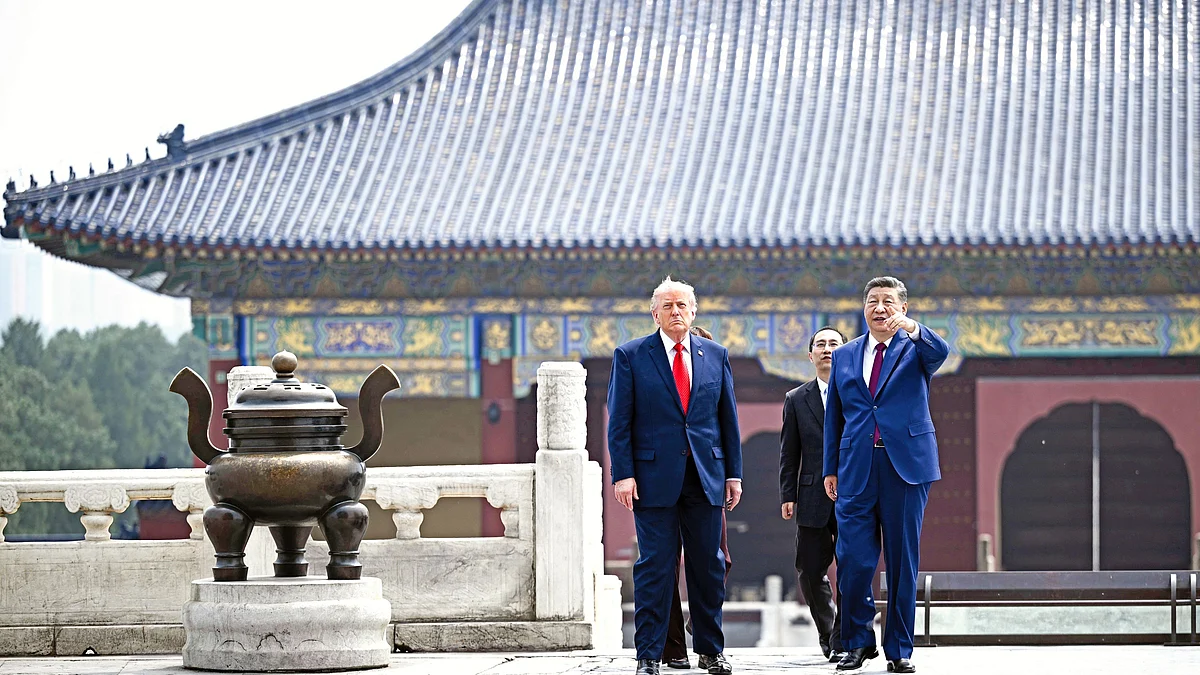
The Taiwan issue remains among the most contentious points in US-China relations. During a summit with President Donald Trump in Beijing earlier this month, Chinese President Xi Jinping warned that mishandling the Taiwan question could cause China and the United States to “collide or even clash”.
The expulsion of Wang has also unsettled other Western media organisations that may seek to interview Taiwanese leaders or cover Taiwan-related issues while maintaining reporting access inside China.
Foreign journalists working in China must obtain accreditation from the Chinese foreign ministry, and Beijing has repeatedly used visa and accreditation policies to bar, remove or restrict reporters whose coverage it considers hostile, inaccurate or politically objectionable.
In 2020, China expelled three Wall Street Journal journalists after the newspaper published an opinion article titled 'China Is the Real Sick Man of Asia' in the early stages of the Covid-19 outbreak.
That same year, as relations between Washington and Beijing deteriorated, the US State Department designated several major Chinese media organisations as “foreign missions”. Xinhua, which functions as an official news arm of the Chinese Communist Party and state, was among the organisations covered by the designation. China responded by sharply tightening visa limits for American journalists.
According to the Foreign Correspondents’ Club of China, at least 18 journalists from the Washington Post, New York Times and Wall Street Journal were expelled from China in the first half of 2020 alone. Others received visas valid for only brief periods ranging from one to three months.
The two governments later reached a limited arrangement allowing a small number of American correspondents to return to mainland China. Wang was among those permitted under that understanding.
With AP/PTI inputs
Join our official telegram channel (@nationalherald) and stay updated with the latest headlines