


Amid statewide protests, Jaipur holds silent vigil on Aravalli issue
A Supreme Court–backed redefinition of the Aravalli hills has sparked protests and fears of unchecked mining in the state
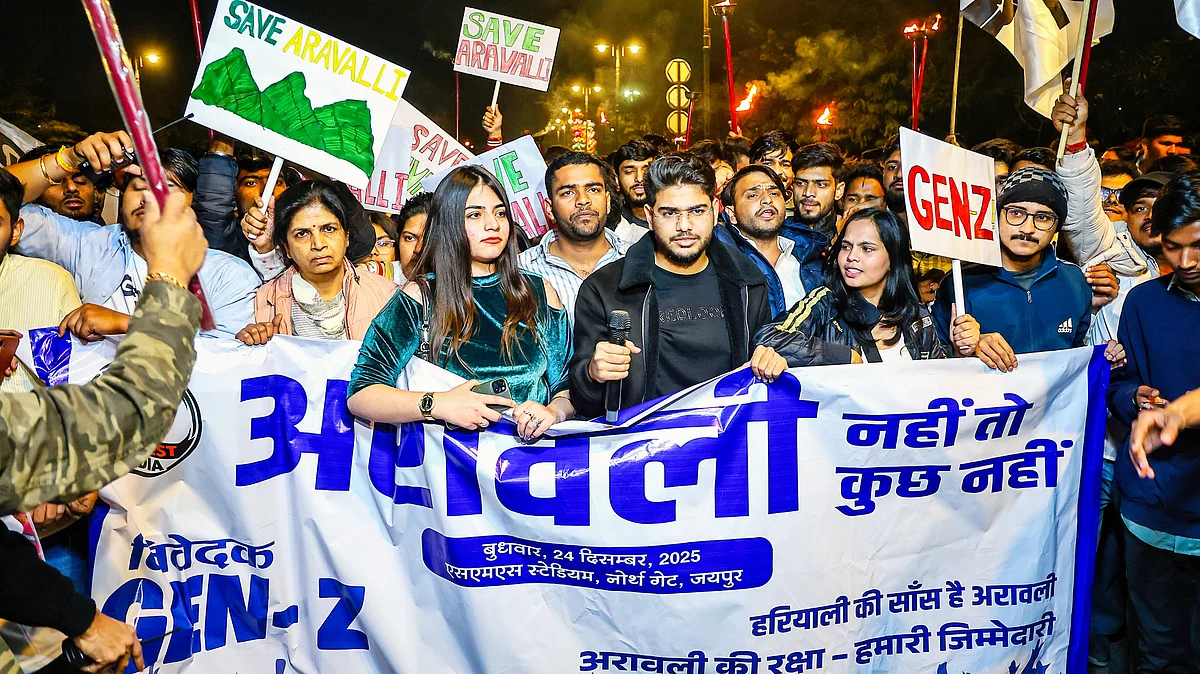


On Thursday, 25 December, a large group of citizens gathered at Central Park in Rajasthan's capital Jaipur to stage a silent protest against both the government’s stance and the recent decision of the Supreme Court of India to accept the revised definition of the Aravalli hills.
The protest was led by G.S. Bapna, secretary of Bharat Seva Sansthan and a former advocate-general of the state. Holding placards, participants argued that the new benchmark would effectively remove legal protection from vast stretches of the Aravallis. Several morning walkers and park-goers also joined the demonstration.
Bapna underlined the ecological centrality of the range, saying water systems, forests, wildlife habitats, tourism sites, temples, forts and palaces all depend on the Aravallis. He warned that around 20 per cent of the range had already been ravaged by mining, and that continuation at the same pace could lead to its complete disappearance. “The Gen-Z generation and future generations will never forgive us if this happens,” he said.
The Aravalli mountain range has emerged as a major political and environmental flashpoint in Rajasthan, with protests intensifying across the state against a new, uniform definition of the hills that critics warn could leave more than 90 per cent of the range exposed to mining and construction.
The protests follow the Supreme Court’s 20 November decision to accept a definition recommended by a Centre-led expert panel. Under this framework, only landforms rising 100 metres or more above the local relief would qualify as part of the Aravalli hills. Environmentalists argue this single parameter dramatically shrinks the area eligible for protection.
The stakes are particularly high for Rajasthan, which contains about 550 km of the Aravallis’ total 692-km length. Since the ruling, demonstrations have spread to cities such as Jodhpur, Udaipur and Sikar.
Earlier this week, clashes were reported in Jodhpur, where police resorted to a baton charge and detained several protesters. In Sikar, demonstrators climbed Harsh Mountain — a 945-metre peak within the Aravalli system — to register their opposition.
Facing mounting anger, Rajasthan chief minister Bhajan Lal Sharma sought to reassure critics, saying in Jhalawar that his government would not permit any tampering with the Aravalli range. He also took a swipe at former chief minister Ashok Gehlot, who had changed his social media display picture to 'Save Aravalli'.
“Merely changing your DP to ‘Save Aravalli’ is not going to do anything on the ground. These are mere theatrics… I assure every one of you that we will not touch the Aravalli ranges nor will any illegal mining continue there,” Sharma said.
Concerns, however, have been fuelled by analysis showing how sweeping the impact of the new definition could be. As reported by the Indian Express, the 100-metre benchmark would leave more than 90 per cent of the Aravalli landscape outside the protective umbrella, making it vulnerable to mining and construction with potentially severe environmental consequences.
Union environment minister Bhupender Yadav has attempted to allay fears, stating that mining would be permitted in only 0.19 per cent of the Aravalli hills and that no new mining leases would be granted until a detailed study is completed.
Critics counter that the issue is not merely the percentage opened to mining, but the precedent set by narrowing the legal definition of the range itself.
Civil society groups have called for a legal review. “The Rajasthan government should go to the Supreme Court to file a review petition against this order, or it will be the death of the Aravalli… Rajasthan has the maximum stake for Aravalli, so we should move,” Kavita Srivastava, national president of the People’s Union for Civil Liberties, told the Indian Express. “There is no way this judgment is acceptable.”
Environmentalists argue that the controversy echoes earlier battles fought to protect the Aravallis. In his book Aravalli Par Naya Sankat, Magsaysay awardee Rajendra Singh traces the anti-mining movement back to the late 1980s and early 1990s, when sustained legal and grassroots campaigns led to the closure of thousands of mines. Singh has warned that the new definition, justified in the name of sustainable development, risks undoing those gains.
According to data cited in his work, only about 8.7 per cent of the Aravalli landscape lies above the 100-metre threshold. Activists also fear the ruling could disproportionately affect tribal and local communities, whose homes, farms and cultural sites are largely located below that level.
With Congress and other Opposition parties mobilising support and protests expected to intensify, the Aravalli debate has once again become a test case — not just for environmental protection, but for how development, federal politics and judicial interventions intersect in one of India’s most ecologically fragile regions.
With PTI inputs
Join our official telegram channel (@nationalherald) and stay updated with the latest headlines