


Constitution must guide judiciary where law is silent: CJI Surya Kant
CJI says principles of dignity, liberty and equality must remain unchanged as technology evolves
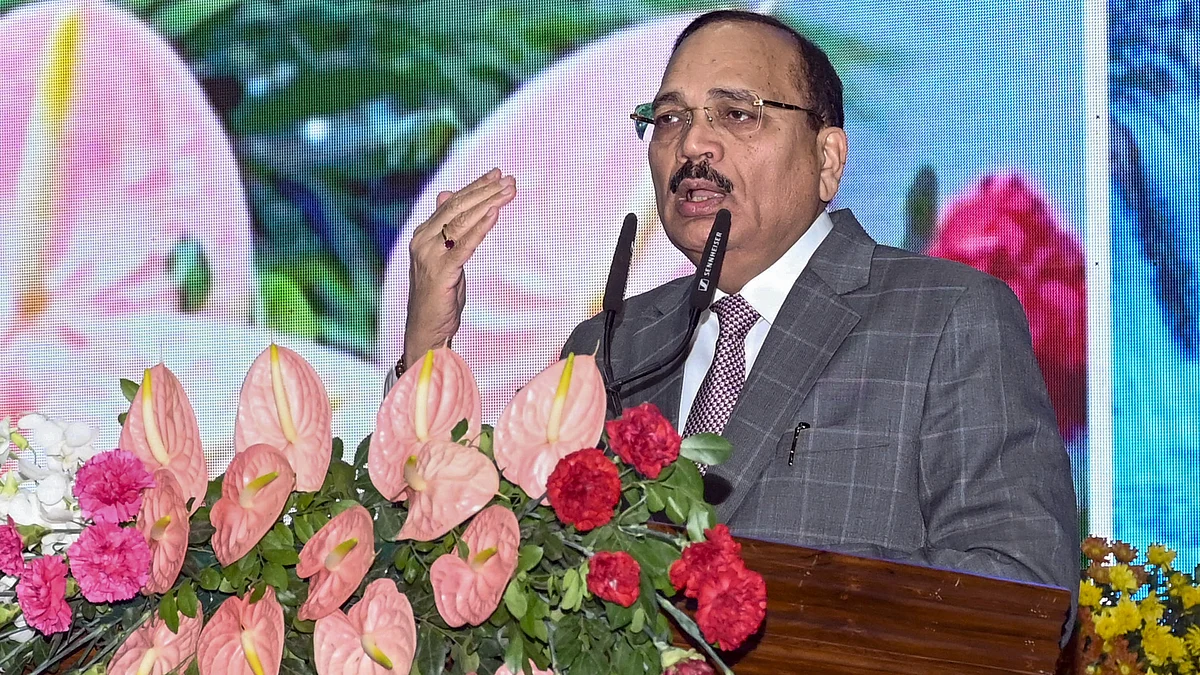


CJI Surya Kant says constitutional principles must guide the judiciary as AI and deepfakes raise new legal questions.
CJI praises Delhi High Court's contribution to civil, commercial and intellectual property jurisprudence.
Supreme Court judge Justice Vikram Nath lauds high court's institutional growth over six decades.
Where the law is silent, the Constitution must guide the judiciary, as its promise of dignity, liberty and equality remains unchanged by technological advancements, Chief Justice of India Surya Kant said on Friday, 30 October.
The CJI said the judiciary was increasingly confronted with questions that were scarcely imaginable a decade ago, including whether works generated by artificial intelligence (AI) could claim copyright protection, how the law should respond to deepfakes, and how innovation could be encouraged without allowing technology to undermine individual rights.
"Such questions will rarely find ready answers in the statute book. Where the law is silent, it is the Constitution that must guide us. Its promise of dignity, liberty and equality does not change with technology, and every new question must be answered in that light," the CJI said while addressing the inaugural event marking Delhi High Court's 60th anniversary.
He said Delhi High Court, by holding firmly to these constitutional principles, could approach an uncertain and rapidly changing world with an open mind without losing sight of the individuals it exists to protect.
The CJI also highlighted the special relationship between the Supreme Court and Delhi High Court, saying it was not merely because the two institutions were practically neighbours, but also because the latter shouldered a disproportionately large share of the Supreme Court's burden compared with other high courts.
"Many times, when a matter is mentioned before us, we find ourselves reminding the counsel that Delhi High Court is just around the corner, and that relief may well await them there before their matter even reaches our board," he said.
Supreme Court judge Justice Vikram Nath, who also addressed the gathering, praised Delhi High Court for its contribution to the development of law and its institutional growth over the past six decades. In a lighter vein, Justice Nath said Delhi High Court judges sometimes appeared to be "more powerful than judges of the Supreme Court".
In his address, CJI Kant said the Delhi High Court had a responsibility of extraordinary magnitude. When the high court was established in 1966, it was not merely another high court serving a growing city but an institution situated at the heart of the country's political and administrative life, he said.
Questions concerning "governmental authority", "individual liberty" and "public accountability" were bound to reach its courtrooms, with consequences extending far beyond the national capital, he said, adding that these responsibilities had multiplied over the decades.
The CJI said Delhi had expanded in every direction over the past few decades, its commerce had flourished and millions more had made the city their home.
"Litigation has naturally grown alongside the city, as have the numbers of advocates and litigants before this court. What began as a court of just four judges is today an institution that resolves disputes of remarkable variety and complexity. This high court deserves every appreciation for rising to those demands," he said.
He also praised the high court's specialised intellectual property division, saying it had earned a formidable reputation in India and abroad for the quality of its jurisprudence.
The event was attended by other Supreme Court judges, Delhi High Court acting Chief Justice Nitin Wasudeo Sambre, and sitting and former judges of the high court.
With PTI inputs
Join our official telegram channel (@nationalherald) and stay updated with the latest headlines