


Illegal mining can cause irreversible damage: SC to set up expert panel on Aravallis
Apex court seeks names of domain experts to examine mining issues holistically; extends abeyance on uniform definition of Aravalli hills
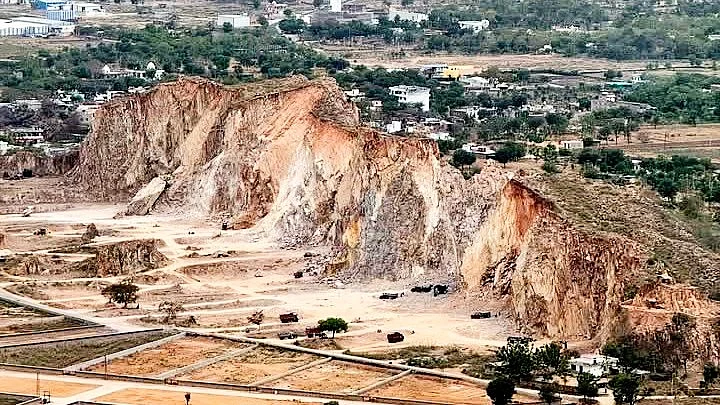


Observing that illegal mining can lead to irreversible environmental damage, the Supreme Court of India on Wednesday said it will constitute an expert committee to carry out an exhaustive and holistic examination of mining and allied issues in the Aravalli range.
A Bench comprising Chief Justice of India Surya Kant and Justices Joymalya Bagchi and Vipul M. Pancholi directed Additional Solicitor General Aishwarya Bhati and amicus curiae K. Parameshwar to suggest, within four weeks, the names of environmentalists and scientists with expertise in mining and related fields for constituting the panel. The court said the committee would function under its direction and supervision.
The apex court also extended its earlier order keeping in abeyance its 20 November directions that had accepted a uniform definition of the Aravalli hills and ranges.
During the hearing, the court was informed that illegal mining was taking place at scattered locations in the Aravallis.
Taking note of this, the Bench recorded the assurance of Additional Solicitor General K. M. Nataraj, appearing for the Rajasthan government, that no unauthorised mining would be permitted.
The matter is being heard in a suo motu case titled In Re: Definition of Aravalli Hills and Ranges and Ancillary Issues, initiated by the top court amid a controversy over the definition of the Aravalli range.
Earlier, on 29 December last year, the Supreme Court had kept in abeyance its 20 November directions approving a uniform definition of the Aravalli hills and ranges, citing the need to resolve “critical ambiguities”. These included concerns over whether criteria such as a minimum elevation of 100 metres and a maximum 500-metre gap between hills could strip large portions of the range of environmental protection.
On 20 November, the court had accepted a uniform definition of the Aravalli hills and ranges and imposed a ban on the grant of fresh mining leases within the Aravalli areas spanning Delhi, Haryana, Rajasthan and Gujarat, pending expert reports.
The court had accepted the recommendations of a committee constituted by the Ministry of Environment, Forest and Climate Change, which proposed defining an “Aravalli Hill” as any landform in designated Aravalli districts with an elevation of 100 metres or more above its local relief. An “Aravalli Range” was defined as a collection of two or more such hills located within 500 metres of each other.
The recommendations were aimed at strengthening protection for the Aravallis, regarded as the world’s oldest mountain system, but drew objections from several quarters, prompting the court to revisit the issue through an expert-led examination.
Join our official telegram channel (@nationalherald) and stay updated with the latest headlines