


How not to bring schools back on track
Kashif Kakvi on the reality of MP’s ‘Sandipan Vidyalaya’ initiative even as thousands of government school students wait to be ‘adjusted’
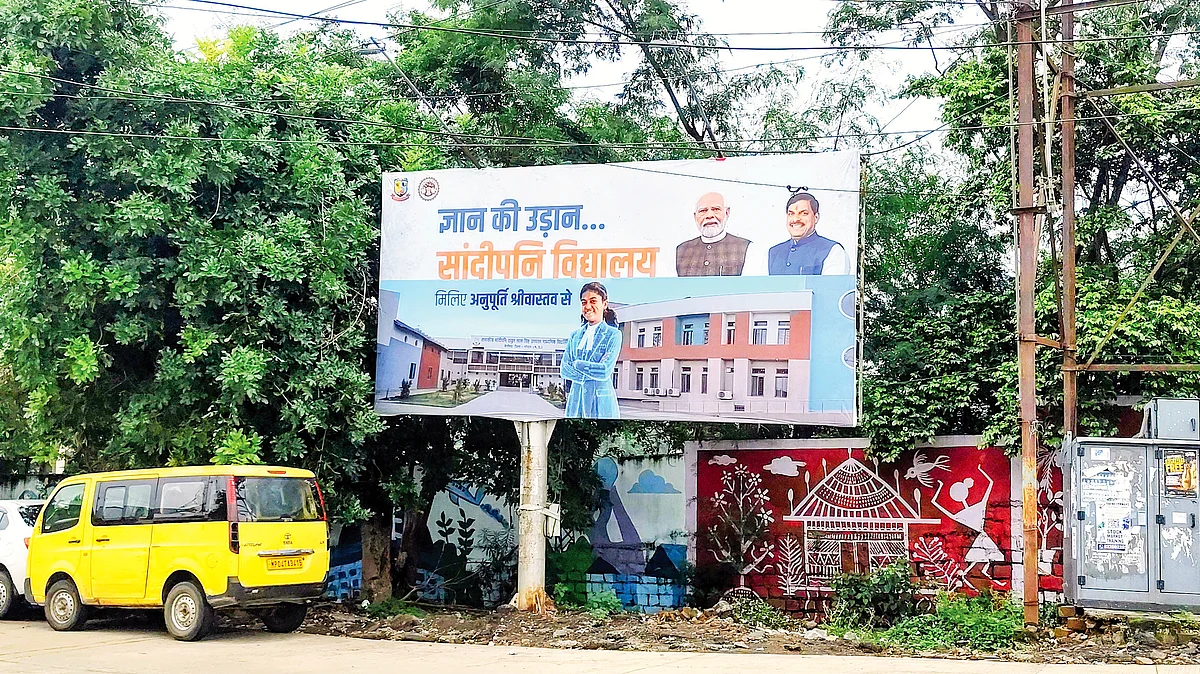


Since 2025, Madhya Pradesh has been flaunting its Sandipani schools. A showcase, or shall we say, showy project that aims to ‘modernise’ a handful of government schools, having set aside Rs 13,000 crore with the purported aim of supplying ‘high-quality’ education.
The results are mixed. While some schools in urban centres (Bhopal, Indore, Gwalior) boast of smart classrooms, computer and robotics labs, libraries and free bus services, even gyms, the majority of government schools continue to languish.
In districts like Balaghat, Betul and Jhabua, many Sandipani schools — formed by merging 15 to 30 existing government schools — remain incomplete, disrupting the education of thousands of students.
On 14 August, more than 300 students of an all-girls’ school in Ujjain’s Sarafa area gathered outside the collector’s office to protest the government’s plan to shut their school and shift them seven kilometres away to a proposed Sandipani school. Many of them were in tears. They already walk six-seven kilometres to school every day. Doubling their daily trudge would put an end to their schooling.
On 18 August in Dhar, poor food and inadequate hostel facilities triggered the girls of Mata Shabari Kanya Shiksha Parisar to hit the streets.
The government claims to have completed 161 new school buildings and 97 schools have been provided with more modern facilities. That’s a drop in the ocean: the state has 82,000 government schools. In the rural areas of Khandwa, Neemuch, and in tribal areas, many proposed schools are still under construction as basic problems of overcrowded classrooms, patchy electricity and inadequate facilities persist.
Sandipani schools plan to cater to 8 lakh students — that’s a little over 10 per cent of the 70 lakh students (from primary to higher secondary level) currently studying in government schools. The overwhelming majority of students will not benefit, points out Congress leader Pratap Grewal, a consistent voice on issues of school education in the Assembly.
This month, the state witnessed student protests in more than 20 districts, inspired partly by the Jantar Mantar protests in July. While the demands are similar to those in other states, a new flashpoint in Madhya Pradesh is the closure and merger of existing schools into Sandipani schools.
That’s what sparked protests in Katni, Ashoknagar, Pandhurna, Vidisha, Bhopal and elsewhere. Parents and teachers alike have argued that shutting village schools often forces children, especially girls, to travel up to 15 km through forest or unsafe terrain, without reliable public transport.
The Madhya Pradesh High Court sought answers from local administration after a historic school in Jabalpur, ‘upgraded’ to Sandipani status, was abruptly shut and relocated 12 km away.
****
The spotlight suddenly shifted to schools in 2022, a year before Assembly elections. Apparently alarmed by reports of the shoddy state of government schools, the then chief minister Shivraj Singh Chouhan embarked on his cosmetic ‘CM Rise’ programme. Every district (55 of them) was promised a CM Rise school. Several existing schools were classified as ‘utkrisht’ (excellent). Model Schools were renamed CM Rise Schools and teachers transferred, disrupting students just before their examinations.
When Mohan Yadav took charge in December 2023, school education was not among his stated priorities. That changed, at least notionally, in April 2025, when Yadav rebranded the scheme.
“CM Rise Schools will be called ‘Sandipani Vidyalaya’, inspired by the Sandipani ashram of Hindu mythology,” he said. He inflated their numbers at will — anywhere between a very specific 9,000 to the nebulous ‘hazaaron (thousands)’.
Phase 1 is supposed to cover 368 Sandipani schools at a cost of over Rs 13,525 crore and an enrolment target of 4.43 lakh. Another 405 schools are planned under Phase 2, with a budget of Rs 11,390 crore and an enrolment target of 4.05 lakh. There is talk of gurukul-style mentoring in cutting-edge subjects like AI and robotics. It’s an attempt, a government official said, “to bring school education back on track”.
In Bhopal, only three of the eight proposed Sandipani schools are ready, while thousands wait to be ‘adjusted’ in other government schools. Forty per cent of the sanctioned strength of 2.89 lakh teacher posts lie vacant even as over a lakh guest teachers are agitating to be regularised and for pay parity with permanent teachers.
In Betul’s Multai, a Sandipani school, newly built at a cost of Rs 44 crore, drew public outrage over basic structural flaws, classrooms left in near darkness during the day and a poorly designed corridor slope that caused severe waterlogging in the rains.
Complaints of favouritism have marred the selection of Sandipani school principals; several deserving teachers who challenged the process in the high court were selected only after judicial intervention. At a Sandipani school in Dabra, Gwalior, a principal was accused of creating a fraudulent Government e-Marketplace (GeM) account using a colleague’s Aadhaar and OTP to make fictitious purchases.
The state’s own data shows that over the past decade, enrolment in government schools has fallen by 62 lakh students — more than half of them girls. The number of primary and middle schools has fallen from over 1.14 lakh a decade ago to roughly 82,000 today, according to data presented in the last budget session of the Assembly.
The number of mid-day meals served fell from 60 lakh in 2016 to 37 lakh in 2025. The distribution of bicycles — a scheme designed to keep girls in school — dropped from 3.29 lakh (2013) to 1.63 lakh (2025). As many as 8,600+ schools run with a single teacher, and over 28,000 have only two teachers.
Even the Union ministry of education’s UDISE+ 2025-26 report — released on 17 August — which credits Madhya Pradesh with improvements on several access and infrastructure indicators, sits uneasily with the department’s own enrolment and dropout numbers. Parliament records reveal that the state’s dropout rate in primary and middle schools is a worrying 49 per cent. On composite rankings such as the School Education Development Index, Madhya Pradesh is at #28 among states and Union Territories.
Over the past decade, the school education budget has grown from Rs 16,000 crore (in 2016) to Rs 40,000 crore (2026). Yet, enrolment has declined sharply and dropout rates exceed the national average. Mysteriously, the official literacy rate keeps climbing along with budget allocations.
Questioned in the Assembly, the government said students were migrating to private schools. When it was pointed out that private schools showed a similar decline, the government blamed a declining population. Just anything to avoid accountability.
Join our official telegram channel (@nationalherald) and stay updated with the latest headlines