


Meerut court awards death penalty to Rastogi, Shukla in 'blue drum' murder
Death sentence comes after 13-month trial involving 126 hearings and 22 prosecution witnesses
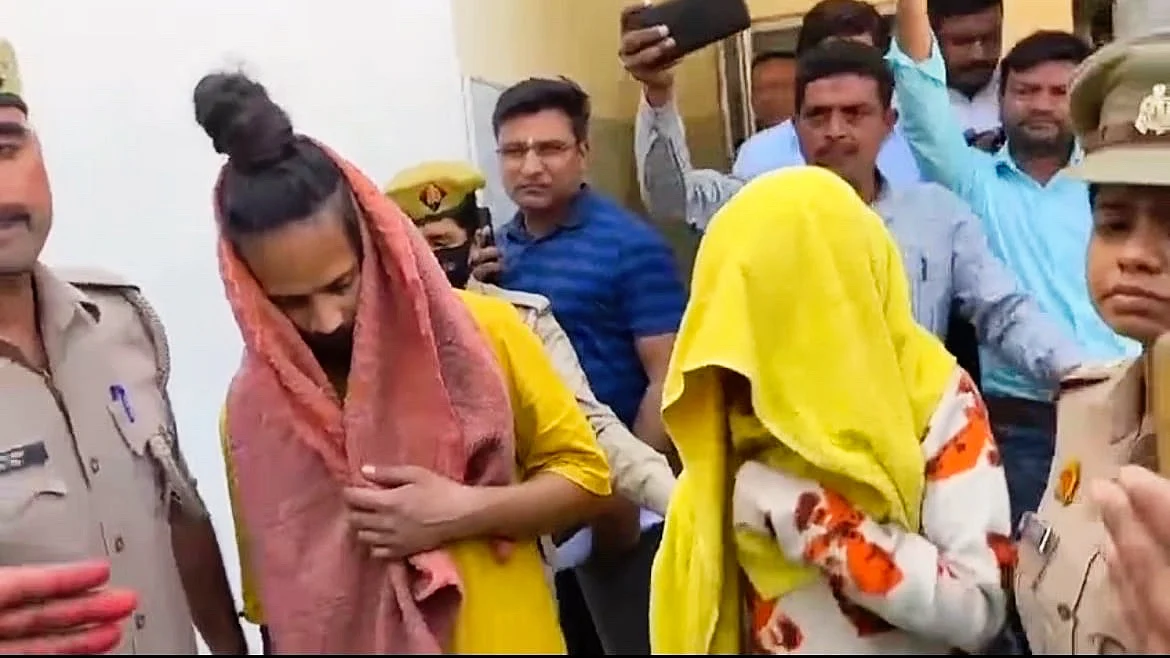


Meerut court sentences Muskan Rastogi and Sahil Shukla to death for Saurabh Rajput's murder.
Prosecution cites 22 witnesses and evidence relating to the concealment of Rajput's dismembered body.
Death sentence follows a 13-month trial involving 126 hearings; high court confirmation is required.
A Meerut court on Wednesday, 14 October sentenced Muskan Rastogi and her partner Sahil Shukla to death for the murder of her husband, Saurabh Rajput, a former merchant navy officer, in the sensational blue drum murder case that shocked the country in March 2025.
District judge Arvind Kumar Mishra pronounced the sentence, court officials said. Both Muskan and Sahil, who have been in custody since their arrest, appeared before the court through video conferencing.
The court had convicted the two on 30 September for murdering Rajput and attempting to conceal his body. The sentencing followed a 13-month trial that involved 126 hearings.
According to the prosecution, Rajput was killed on 3 March 2025 at the couple's rented house in Meerut's Brahmpuri area. Muskan and Sahil allegedly stabbed him to death, dismembered his body and placed the remains inside a blue plastic drum, which was subsequently filled with cement to conceal the crime.
The case came to light after Rajput's remains were discovered inside the drum at the house. The gruesome nature of the crime, along with the allegation that Rajput's wife had plotted his murder with her partner, drew widespread public attention.
Rajput, 29, had married Muskan in 2016 after the couple eloped to persuade their families to accept their relationship. He had previously worked in the merchant navy before moving to London, where he took up a job as a sales manager. He returned to India in February 2025 to celebrate birthdays with his wife and their daughter, according to reports.
The prosecution examined 22 witnesses during the trial, presenting evidence relating to the alleged purchase of materials used in the crime. These included the blue drum, a knife, cement and other items. Witnesses connected with the purchases helped investigators establish the circumstances surrounding the killing and the alleged attempt to dispose of the body.
Hotel managers and cab drivers were also examined to establish the movements of the accused after the murder. Records relating to their stays at different locations were placed before the court as part of the prosecution's case.
Rajput's family had sought the strictest possible punishment following the conviction. After the 30 September verdict, his mother, Renu Rajput, questioned why Muskan had killed her son, saying she wanted an opportunity to ask her the question directly.
The death sentence marks the latest development in a case that has remained in the public eye because of the brutality of the murder and the attempt to conceal the victim's remains. Under Indian law, a death sentence awarded by a trial court is subject to confirmation by the high court before it can be carried out.
With PTI inputs