


'Waterman of India' Rajendra Singh takes Aravalli row to Supreme Court
Following Singh’s letter to CJI and alarm sounded by other activists, apex court to hear suo motu case amid public protests
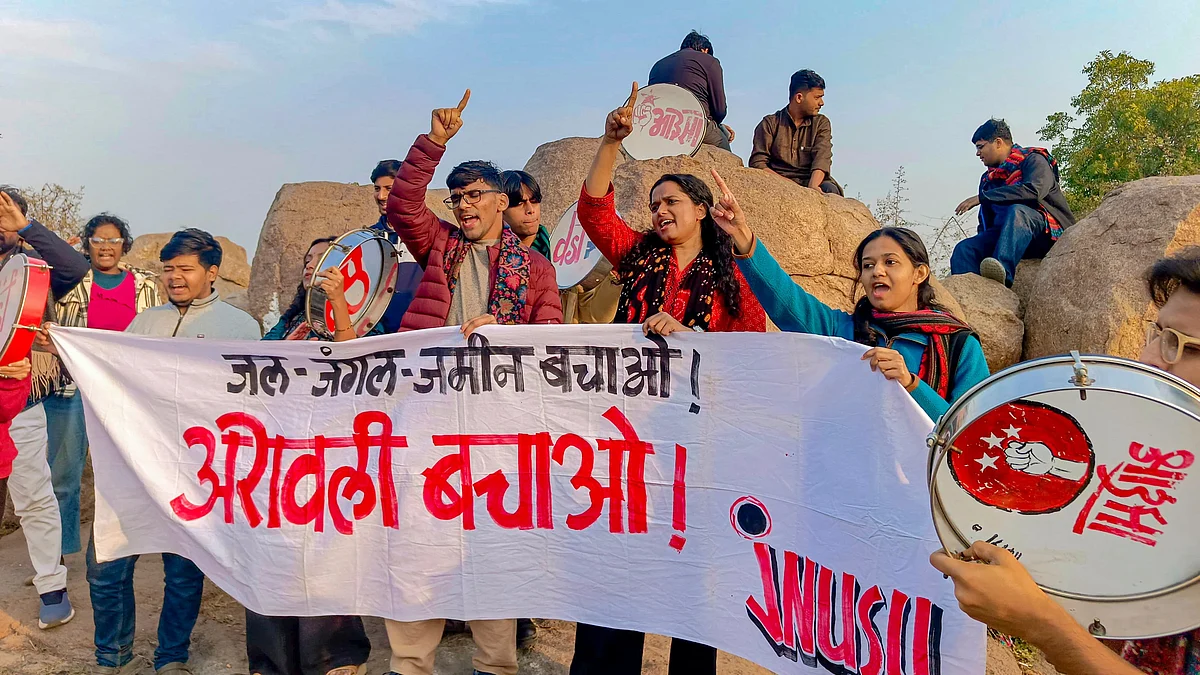


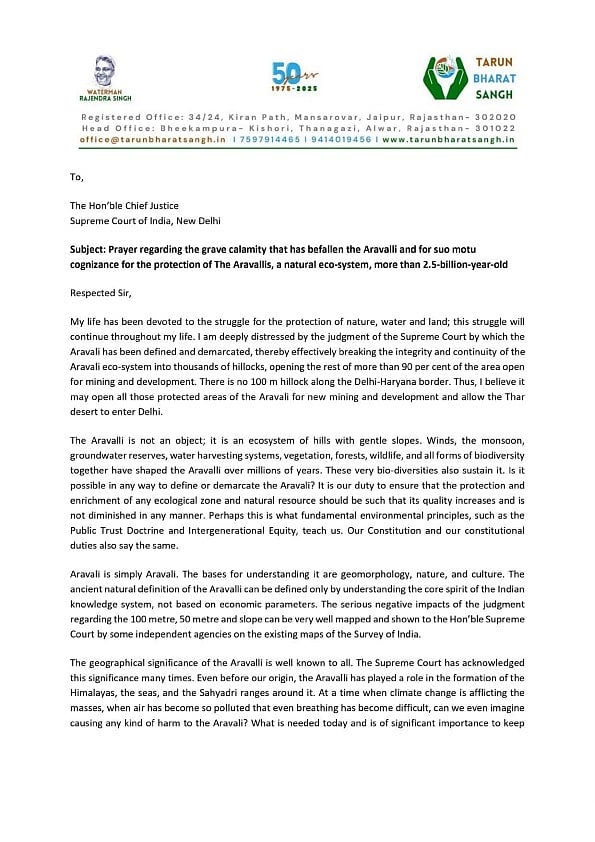
The Supreme Court on Monday is hearing the growing controversy over the redefinition of the Aravalli hills, days after water conservationist Rajendra Singh wrote to the Chief Justice of India seeking suo motu intervention to protect the ancient mountain range from mining and construction.
The matter, listed as Definition of Aravalli Hills and Mountain Ranges and Related Issues, is being heard by a three-judge bench of the Supreme Court of India comprising CJI Surya Kant, and Justices J.K. Maheshwari and A.G. Masih. The apex court has taken up the issue on its own motion.
At the heart of the dispute is a revised definition of the Aravalli hills that relies primarily on a uniform height-based criterion, classifying as 'Aravalli' only those landforms rising 100 metres or more.
Environmentalists argue that this departs sharply from earlier approaches that treated the Aravallis as an interconnected ecological and geological system, based on factors such as continuity of hill formations, forest cover and hydrology. Critics say the new definition could exclude large, degraded or fragmented sections of the range from protection, potentially allowing mining and construction in areas previously considered part of the Aravalli ecosystem.
In his letter to the Chief Justice in Hindi, Singh — popularly known as the 'Waterman of India' and president of the Tarun Bharat Sangh — warned that the court’s acceptance of this narrower definition could expose vast stretches of the range to commercial exploitation.
“The Aravalli is not merely a mountain range. It is a living ecological system that sustains water, forests, biodiversity, climate balance and life itself,” Singh wrote, arguing that reducing the hills to technical or height-based criteria ignores their ecological role.
He cautioned that redefining the Aravallis to permit mining or construction would cause irreversible damage. “Any attempt to define or limit the Aravalli through narrow technical criteria amounts to dismantling an ancient natural system that cannot be reconstructed once destroyed,” the letter said.
The hearing comes amid intensifying protests across Rajasthan — the state with the lion's share of the Aravalli hills and hence the most to lose — where environmental groups, lawyers, youth, and Opposition leaders have mounted an increasingly fierce pushback to the Centre's reclassification. Critics argue that the new definition could leave more than 90 per cent of the 692-km Aravalli range vulnerable to mining and real estate activity.
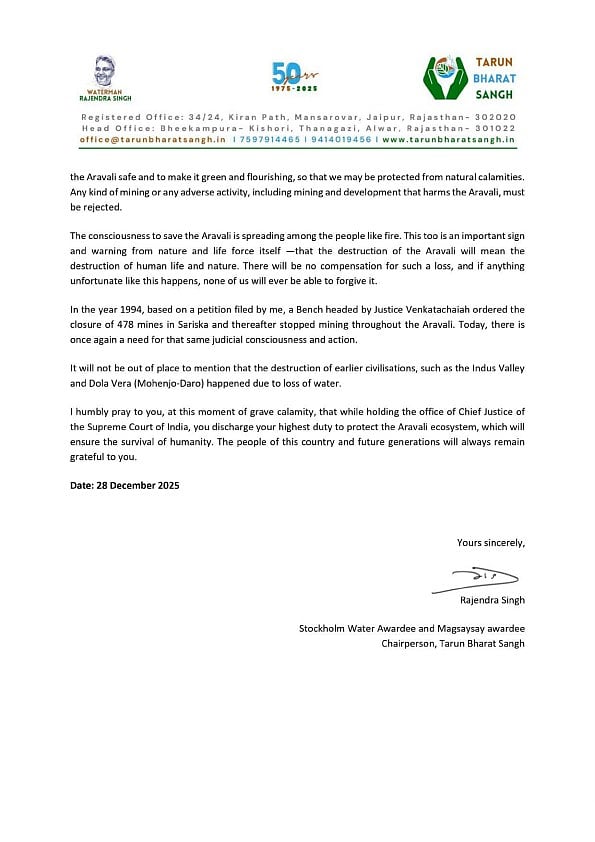
Singh linked the issue directly to the climate crisis and water scarcity in northwest India. “At a time when climate change and water scarcity pose existential threats, weakening protection for the Aravallis will directly endanger the survival of present and future generations,” he warned.
Environmentalists have also formally sought a recall of the Supreme Court’s 20 November order that accepted the revised definition. Neelam Ahluwalia, an environmentalist and member of the Aravalli Virasat Jan Abhiyaan, said the changes were introduced without adequate scientific assessment or public consultation.
“There is nothing called sustainable mining in a critical mountain ecosystem like the Aravallis. You cannot redefine an entire mountain range to enable mining,” Ahluwalia told news agency ANI, calling the move “completely unacceptable”.
She cautioned that applying a uniform height-based criterion to an ecologically complex and ancient mountain system could have serious implications for water security, food systems and climate stability for millions of people in Rajasthan, Haryana and the National Capital Region.
She also questioned the government’s claim that only two per cent of the Aravalli region would be affected, saying no supporting data has been placed in the public domain.
Referring to earlier proceedings, Ahluwalia said the Supreme Court’s Centrally Empowered Committee (CEC) had, in March 2024, recommended a comprehensive environmental impact assessment of the entire Aravalli range, but no such study has been conducted so far.
According to activists, both legal and illegal mining activities are already ongoing across at least 37 districts in the Aravalli belt, resulting in deforestation, groundwater depletion, river pollution and mounting public health concerns.
Calling for decisive judicial action, Singh urged the court to reassert its earlier protective approach. “Under the Public Trust Doctrine and the principle of intergenerational equity, it is the duty of the State and the judiciary to protect natural resources for those yet unborn,” he wrote.
Join our official telegram channel (@nationalherald) and stay updated with the latest headlines