


Bunker Roy passes away, leaving behind a glorious legacy of rural self-reliance & empowerment
A national squash champion who chose social work over a conventional career, Roy built a pioneering institution in Rajasthan
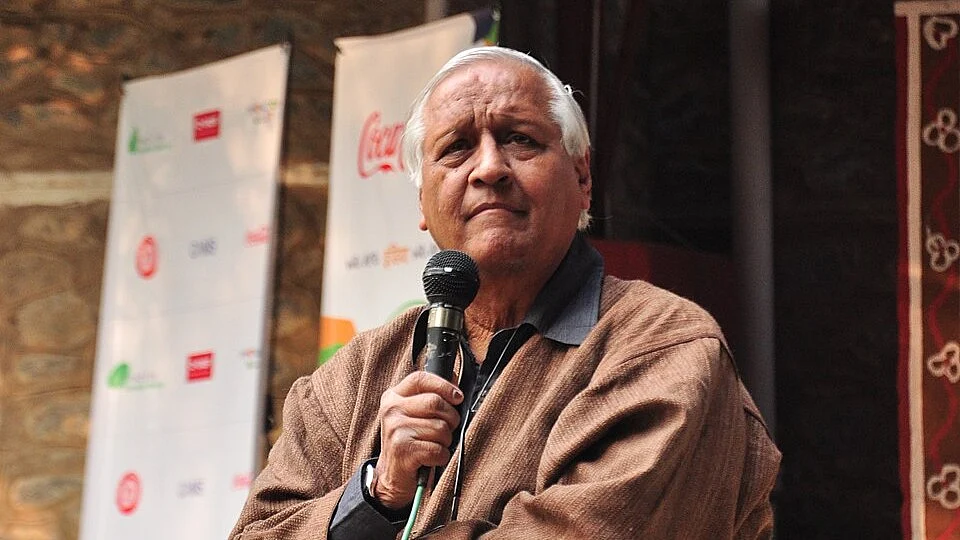


Bunker Roy gave up a promising sporting career to work among rural communities.
His Barefoot College trained women from marginalised communities as solar engineers.
His work took the model of rural self-reliance to 96 countries.
Sanjit ‘Bunker’ Roy, the social activist who transformed rural development through his pioneering Barefoot College initiative, has passed away. He devoted his life to empowering marginalised communities through education, practical skills and sustainable technologies, taking his model of grassroots development from a village in Rajasthan to communities across the world.
Born in Burnpur, a steel town in West Bengal, Roy was given the nickname ‘Bunker’ by his civil servant father. He attended The Doon School, where he was a contemporary of former Prime Minister Rajiv Gandhi. He later studied at St Stephen’s College in New Delhi, where he pursued his passion for squash.
Roy became the national squash champion in 1965 and represented India at three consecutive world championships. He played alongside leading Indian players, including Anil Nayyar, Akhtar Ali and Ali Isaphani. Yet, having reached the top of the sport, he chose a markedly different path.
His commitment to social work had begun early. In 1967, he worked in Bihar's famine-hit Palamu district. Five years later, in 1972, he moved to Tilonia, a remote village in Rajasthan's Ajmer district, where he established the Social Work and Research Centre (SWRC).
Tilonia had neither a reliable source of drinking water nor electricity. Roy, inspired by Mahatma Gandhi's principles of self-reliance, simplicity and decentralisation, set out to build an institution that would equip rural communities with the knowledge and skills to address their own challenges.
The initiative eventually grew into Barefoot College, which challenged conventional models of formal, urban-centric education. Instead of relying on academic qualifications, it emphasised practical, skill-based learning, particularly for people from disadvantaged rural communities.
Children who had dropped out of school, described by Roy as “dropouts, cop-outs and washouts”, were among those encouraged to return to learning through night schools. The initiative also saw girls outnumber boys in several of these schools.
One of the college's most distinctive programmes trained illiterate and semi-literate rural women, particularly grandmothers from communities without electricity, to become solar engineers. Known as the ‘Solar Mamas’ programme, it enabled women with little or no formal education to install, maintain and repair solar equipment in their villages.
Roy developed a six-month, hands-on training course that used colour-coded circuitry and tactile learning instead of conventional textbooks. The programme was taken to communities across Africa, Asia and the Pacific, bringing electricity to villages that had remained beyond the reach of conventional power networks.
Barefoot College also expanded its work to rainwater harvesting, water testing, rural healthcare, education, women's empowerment, handicrafts and the development of wastelands. Its Tilonia campus, built largely by local rural masons, operates using solar energy and rainwater harvesting.
The institution attracted international attention, with World Bank president Robert McNamara and King Charles among the prominent visitors who travelled to Tilonia to see Roy's model of rural development in practice.
Amitav Ghosh, the distinguished author, once observed that Roy, a national squash champion, could have pursued a career as a diplomat, bureaucrat or corporate leader. Instead, he chose to work among rural communities, driven by the belief that people needed competence, confidence and the conviction that they could shape their own futures.
Roy's work also had a significant environmental dimension. Barefoot College's initiatives were credited with reducing 1.1 billion kg of carbon dioxide emissions through mitigation and sequestration. His programmes reached 96 countries and benefited an estimated three million people.
In 2010, Roy was named among Time magazine's 100 most influential people in the world. The following year, his wife, Aruna Roy, received the same recognition for her work in advancing the Right to Information and employment rights through the Mazdoor Kisan Shakti Sangathan (MKSS).
Aruna Roy, a former IAS officer, had left the civil service and joined Bunker Roy's work in Tilonia. She later moved on to establish MKSS in Rajasthan, where, along with activists including Nikhil Dey, she played a pivotal role in campaigns that helped secure the Right to Information and employment guarantee through legislation. She is also a recipient of the Ramon Magsaysay Award and the Lal Bahadur Shastri Award for Excellence in Public Administration.
Bunker Roy received several honours for his work. Barefoot College was awarded the Aga Khan Award for Architecture for its campus in Tilonia. The recognition, however, became contentious over the attribution of the architectural work. After the role of architect Neehar Raina and the contribution of local Barefoot architects came into focus, Roy declined to accept the award on behalf of the institution and returned it.
In 1998, he received the Indira Gandhi Paryavaran Puraskar from the Union environment ministry. Barefoot College won an Ashden Award in 2003 for bringing solar power to rural villages. In 2013, Roy received the Clinton Global Citizen Award.
Tributes poured in following his death. Former Rajasthan chief minister Ashok Gehlot said Roy had made a remarkable contribution to rural self-reliance, education and development.
Congress MP Shashi Tharoor recalled Roy's vision of training rural grandmothers as “Barefoot Solar Engineers”, saying it had illuminated thousands of off-grid homes in India and across the developing world. He said Roy had left behind an enduring legacy of dignity, community empowerment and environmental stewardship.
Congress leader Jairam Ramesh said Roy had played a key role in creating new opportunities for voluntary organisations to participate in development schemes and programmes.
For Roy, the measure of development was not the acquisition of formal qualifications or the adoption of urban models, but the ability of ordinary people to improve their own lives. From a little-known village in Rajasthan, he built an institution that carried that conviction across continents.
Join our official telegram channel (@nationalherald) and stay updated with the latest headlines