


Reforms, referendum and roadblocks
Despite overwhelming popular support for the July Charter of constitutional reforms, its implementation won’t be easy in new Bangladesh
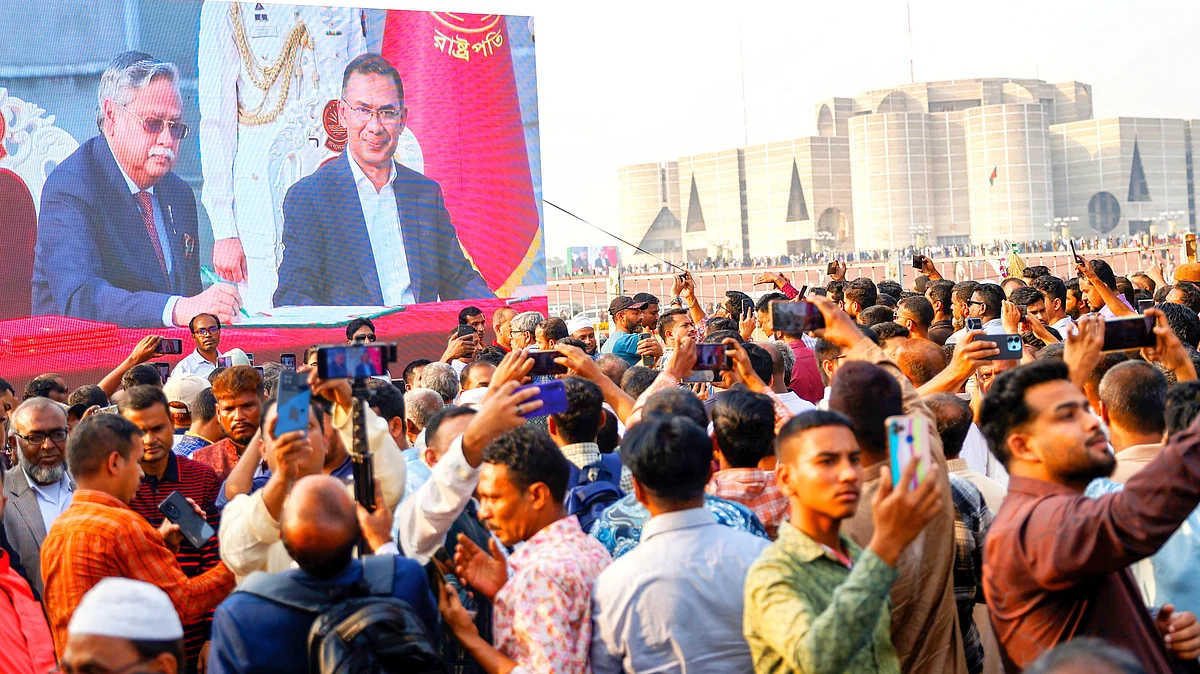


The Bangladesh Nationalist Party’s (BNP) landslide victory in the recent elections may just be the beginning of a protracted face-off with the opposition Jamaat-e-Islami and National Citizen Party (NCP). Central to this is the BNP’s refusal to join the Constitution Reform Commission (CRC) despite backing the July Charter of referendum, underscoring a schism in the country’s politics.
The simultaneous staging of the general election and the referendum meant the elected MPs had to take two oaths — one as MP and the second as a CRC member. The second oath obligated the MPs to implement the July Charter. “Taking oath as CRC member would bind us to implement the July Charter, overriding our notes of dissent to key provisions of the charter,” a senior BNP leader told National Herald.
Asserting that the CRC’s formation remains outside the formal constitution Salahuddin Ahmed, BNP’s policy-making standing committee member and newly elected MP, said: “We have not been elected as members of the Constitution Reform Council; creation of the council is yet to be incorporated in the Constitution.”
Things came to a head on the morning of 17 February when newly elected Jamaat and NCP members initially refused to take oath as MPs. “We will take no oath unless BNP MPs do so as members of Constitution Reform Council alongside regular MPs,” said Jamaat’s deputy chief Abdullah Mohammad Taher. They relented after intense backroom parleys and took dual oaths but boycotted the swearing-in ceremony of Prime Minister Tarique Rahman and his Cabinet. The ruling BNP, however, remains outside the CRC.
So why did the Jamaat and NCP eventually relent? “Not taking oaths was not our party’s decision. Our alliance partners and some of our members may have expressed their own opinions,” newly elected Jamaat MP from Dhaka-14 Mir Ahmad Bin Quasem told National Herald. There was also a buzz about challenging the CRC, hinting at a protracted legal battle.
****
After the collapse of Sheikh Hasina’s Awami League government on 5 August 2024, the interim administration of Muhammad Yunus took office not only to oversee the election of a new democratic government but also to introduce reforms to eliminate dynastic politics — be it Mujibur Rahman’s lineage under Awami League or Ziaur Rahman’s family under BNP.
Multiple reform bodies were set up culminating in the National Consensus Commission (NCC) tasked with consolidating recommendations into a single binding political declaration in the form of the July Charter. This was signed by 26 political parties on 17 October 2025.
The 61-page July Charter talked about the ‘consensus, achieved through mutual and collective deliberations among various political parties, alliances and forces… (which) aims to reform the constitution, electoral system, judiciary, public administration, police administration and mechanisms for combating corruption.’
On 13 November 2025, President Mohammed Shahabuddin Chuppu authorised the Bangladesh Election Commission to conduct a referendum. The referendum asked voters to accept or reject a linked package of, among others, four key reforms — restoring the caretaker government system; establishing a bicameral Parliament; overhauling the judiciary and election commission; and, limiting prime ministerial terms to two. A ‘yes’ vote meant acceptance of the entire package; a ‘no’ vote rejected all reforms outright.
The charter — adopted through the 12 February referendum — is now a politically binding ‘pledge of commitment from the signatories’ to implement the 84 reform proposals, roughly half of which require amending Bangladesh’s existing Constitution. By refusing to take the second oath, BNP MPs are not empowered to implement the July Charter.
The referendum threw up mixed results. According to Election Commission data, with a voter turnout of 60.25 per cent, while 62.74 per cent supported the charter, nearly 30 per cent opposed it. Approximately 9.5 per cent ballots were found invalid. Significantly, in 11 parliamentary constituencies — including three in strong-holds like Gopalganj and the hill districts — the vote was a ‘no’.
****
The charter redefines Bangladesh’s national identity, proposing a change from Bengali to Bangla-deshi to include ethnic minorities like Chakmas, Marmas and Santhals who felt marginalised by a linguistically defined identity.
While Bengali remains the primary state language, the charter recognises all mother tongues. Four Mujib-era legacies of nationalism, democracy, socialism and secularism have been replaced by equality, human dignity, social justice and religious harmony. The charter replaces secularism and freedom of religion with ‘guaranteed coexistence’ and ‘due dignity of all communities’.
Other changes involve blocking an individual from simultaneously serving as prime minister, leader of the House and party president; expanding the powers of the president to appoint heads of human rights, law and information commissions. The charter reinstates the non-party caretaker government to oversee general elections (abolished by the Awami League in 2011) and bars the prime minister’s office from appointing judges, instead setting up a Judicial Appointments Commission led by the chief justice.
Taking note of digital blackouts and the youth-led nature of the 2024 uprising, the charter recognises uninterrupted internet service as a fundamental right, elevating digital access to a constitutional level. It also explicitly protects the right to personal information.
With a two-thirds majority, the BNP now believes it needn’t commit itself to implementing a charter that does not sufficiently reflect its concerns. Of the nine notes of dissent, the party had strong reservations against the provision of proportional representation to elect upper house members, fearing it will weaken the mandate of major parties.
Some activists and student leaders have also rejected the charter, describing it as a ‘political compromise’. The exclusion of the Awami League from the consultative process also makes the charter not quite inclusive or representative enough.
“What happened on the morning of 17 February should have been avoided as it does not send a good message,” ambassador Mohammad Humayun Kabir told National Herald. For the time being, the opposition parties may have relented, but non-implementation of the charter could deepen political rifts despite the BNP’s brute majority in Parliament.
Sourabh Sen is a Kolkata-based independent writer and commentator on politics, human rights and foreign affairs. More of his writing may be read here
Join our official telegram channel (@nationalherald) and stay updated with the latest headlines