


India’s China policy: A masterclass in strategic muddle
From repeated LAC incursions to the 2024 disengagement deal, New Delhi’s approach to Beijing raises multiple questions
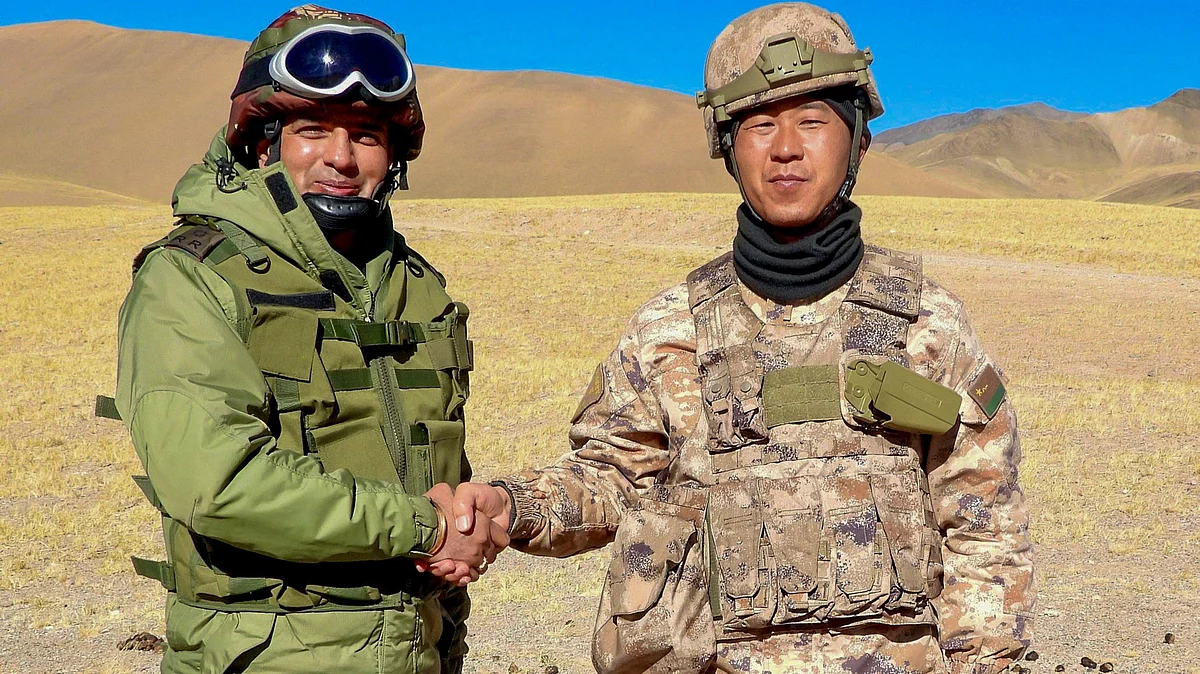


There is an alarming video doing the rounds on Indian social media showing an undated confrontation between platoons of Indian jawans and the People’s Liberation Army (PLA) at a contentious border area in the state of Arunachal Pradesh.
The alarm is not about the confrontation, though, as such encounters have now become routine. It is what the Indian platoon commander says to his Chinese counterpart that is disconcerting. When the PLA officer defiantly claims he is on Chinese territory, the Indian officer helpfully points out, “You are 20 km inside our territory — if you were a little inside, it is understandable.”
The two sides then agree to ‘go back’. However, what remains unexplained is that if the Indian unit is patrolling well within its borders, where will it ‘go back’ to? And if the Chinese have intruded so far, will they retreat fully, especially when they are confident they are on their own ground?
Many viewers of the clip were appalled by what they felt was a limp-wristed defence of our borders. They were concerned whether the military or political leadership had dictated that ‘minor’ trespasses be overlooked, as such oversight would embolden any hostile force to venture further, which China has been doing brazenly.
Thereby lies the limitation in India’s China policy, which appears overtly conciliatory and decidedly incoherent.
New Delhi has placed border peace as a baseline requirement, the 3,488-km de facto Line of Actual Control (LAC) being the longest disputed border in the world that divides the two nuclear-armed neighbours.
Understandably, how does a nation frame a policy on a formidable adversary that occupies vast swathes of its territory? Indian intelligence in 2020 estimated that, with its sustained push, China controlled a cumulative 1,000 sq. km of land in Ladakh through multiple inroads since the 1980s, thereby unilaterally redrawing the LAC. Besides, China annually publishes maps that portray several disputed Indian-administered territories as part of Chinese territory and renames these with Chinese names.
In May 2020, shortly after Covid struck the world and India, over 5,000 PLA troops breached the LAC to overrun vast tracts of this region, and a month later, Chinese soldiers armed with stones, nail-studded sticks, iron rods and clubs killed 20 jawans at Galwan along the LAC in eastern Ladakh. Beijing’s report of four PLA deaths was widely contested.
Also Read: Modi’s roar-turned-whimper at China border
India’s China policy has had to tread a cautious course, as Prime Minister Narendra Modi has not only avoided identifying Beijing as the aggressor, but has also insisted that “no intruder is present inside India’s borders, nor is any post under anyone’s custody”. He had also urged Washington not to bring up China’s border transgressions, according to former US ambassador Kenneth Juster, who was asked by an Indian television channel in 2022 why his country had not made any statement about Beijing’s aggression.
Indian forces deliberately refrain from retaliatory cross-border intrusions, even as PLA sections regularly breach the LAC. As part of its deception warfare at the LAC, China has been constructing ‘dual-use’ villages and installations, subsequently upgrading civilian settlements to military enclaves and converting civilian airfields into PLA Air Force (PLAAF) bases. It has built as many as 628 xiaokang (well-off) model border defence villages from Ladakh to Arunachal. While most of these villages are on the Chinese side, many are also on disputed territory.
“Face-offs have happened with China at several locations along the border in Arunachal in the past few days, and they still continue,” acknowledged Indo-Tibetan Border Police (ITBP) director-general Shatrujeet Kapur, a week before his retirement on 31 October.
Terming the front his force’s “most difficult” border, and describing China as “powerful” and India’s “biggest adversary”, Kapur conceded, “It will be difficult to compete with China using traditional methods; they have modernised and invested heavily in their PLA….”
India’s ministry of home affairs (MHA) too acknowledges that “the border is not fully demarcated and the process of clarifying and confirming the LAC is in progress”.
The MHA-controlled ITBP is the primary border-guard force along the LAC, while the Indian Army is the second-line force that jointly patrols with the ITBP.
External affairs minister S. Jaishankar has stressed that the boundary situation had to remain stable for broader bilateral relations to progress. “If peace and tranquillity in the border areas are disturbed, then the relationship will have consequences,” he noted.
As the Modi government credited itself for its breakthrough agreement with Beijing in 2024 that led to mutual troop disengagement at the last two remaining friction points of Depsang Plains and Demchok village in eastern Ladakh, a closer look revealed that, unwittingly or otherwise, New Delhi had played into Chinese hands, if not negotiated a complete sell-out.
It so happens that both these strategic spots are well within what India considers its territory, Demchok located some 600 metres from the LAC, while Depsang is part of the 37,244-sq. km high-altitude desert of Aksai Chin that China had appropriated in its only war with India, in 1962, but which India claims is part of Ladakh.
The Indian Army indicated that both sides now coordinate patrolling in their respective areas, but left unsaid that the ‘respective areas’ were Indian territory. Thus, New Delhi had implicitly accepted foreign armed presence on Indian soil and was simultaneously satisfied that the Chinese side had granted Indian soldiers access to their own areas.
Though Modi and Xi Jinping have met 23 times since the former became prime minister in 2014, he has surprisingly failed to take up the eastern Ladakh issue even telephonically with the Chinese president. This was incongruous, as Modi, as self-anointed vishwaguru or universal sage, has aspired to restore peace between Israel and Gaza, and Russia and Ukraine, counselling them to resolve their conflicts amicably.
Significantly, Xi has never broached the LAC intrusion at any stage. Indeed, in an unprecedented embarrassment for India, a PLA column invaded parts of eastern Ladakh even as Xi was meeting Modi over tea at Mahatma Gandhi’s Sabarmati ashram in Gujarat in September 2014, just months after Modi was sworn in.
Despite China’s transgressions, India’s demonstrative ‘business as usual’ approach saw China overtake the United States to become its largest goods trading partner in fiscal 2026 (April 2025–March 2026), with bilateral trade reaching $151.10 billion, compared to $140.89 billion with the US. As though indulging China yet further, India bore a record trade deficit of $112.16 billion, with its $19.47 billion worth of exports to China vastly overshadowed by imports worth $131.63 billion.
Views are personal
Sarosh Bana is executive editor of Business India fortnightly in Mumbai, and regional editor, India/Asia-Pacific, of Naval Forces, Germany. More of his writing here
Join our official telegram channel (@nationalherald) and stay updated with the latest headlines