


‘India is my country too’
High priests, step aside. Swati Singh gives us a protester’s perspective on a memorable slice of Indian history
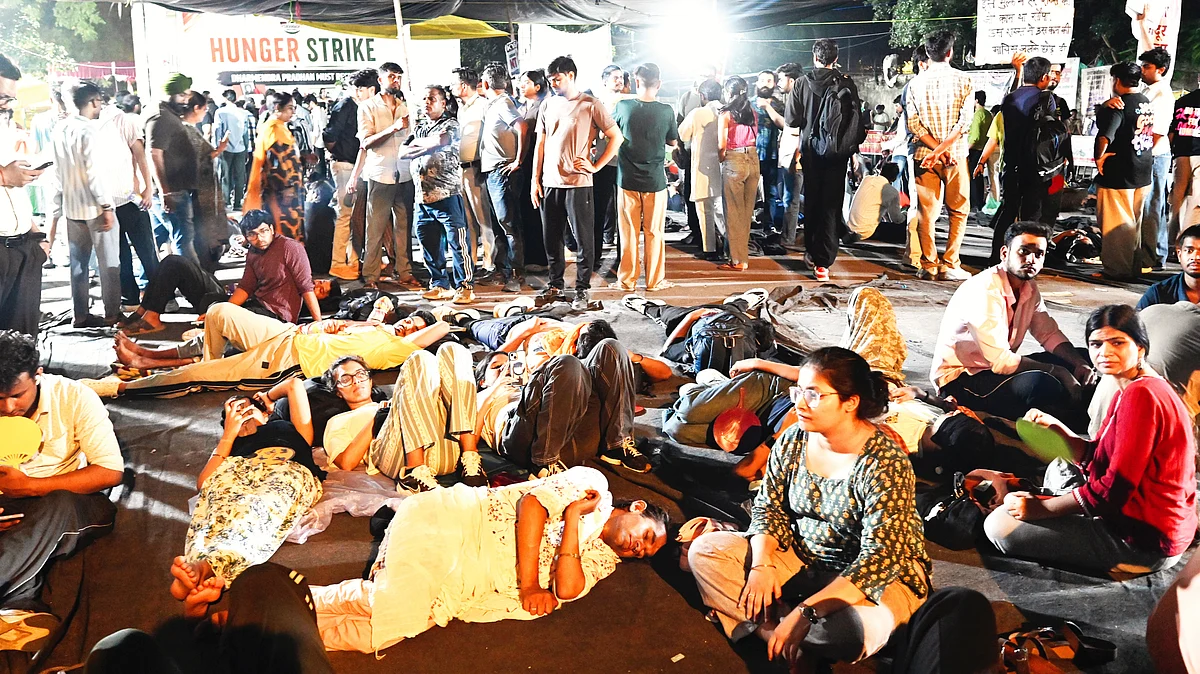


'Go be the prime minister’, my dad would say every time I said something remotely critical of the government. ‘You can’t change anything just by talking about it’, he would say every time I said something needed to be done.
I always thought he made sense: if I wanted something done, I should be doing something to get it done. I’d speak to people around me and form opinions too, but also feel disheartened that it made no impact. And then came 25 July, the day India’s Union minister of education resigned and I realised that just by supporting what I felt was right, I could make an impact.
In the beginning of June this year, a satirical campaign launched by Abhijeet Dipke as a response to India’s unemployed youth being called ‘cockroaches’ made it out of Instagram, my favourite app on earth, on to Jantar Matar, to protest the NEET examination leak and India’s broken education system that it had come to symbolise.
At least 21 students had died by suicide due to this leak. A lot of hearts including mine cried for these students. Just two years ago, I was taking multiple entrance tests, and to see students die because of something that could have been avoided and controlled made me angry. So a lot of us took to the streets.
Initially, when I joined the protest, I had no hope of anything changing. There were not enough of us and more than enough against us. As these numbers interchanged places, a flame of hope rekindled in our hearts. Students from all over India joined in, there were too many to even fit in the protest site. It was a student protest, and a huge chunk of the protesters were part of what we proudly call ‘Gen Z’.
What does Gen Z do best? We make memes, we run social media. That is exactly what we did. For a news piece may not be the best form, news media not the best platform to call out mainstream news media. For there was a stark difference between what was being shown on the news and what was happening on ground. So Instagram, not for the first time, became a better source of news than the news channels. Imagine a meme spelling it out more truthfully than a Sunday special news feature!
While those who could support the protest online did their part, those on ground chose to voice their pain and anger through slogans revering our freedom fighters and some sarcastic ones too, through music, nukkad natak and cosplay. At least three Spidermans, two Gandhis, The Powerpuff Girls and a gorilla.
The protest gained traction and huge crowds gathered near the protest site. I carried pepper spray for the first few days, as I normally do, and then I started forgetting it at home. As a woman, feeling that safe in a crowd that big made me feel relieved. Wherever you go in the world, if you are a woman, you face a threat. I don’t know how, but in this protest, there wasn’t a moment when I felt I had to be on my guard. I was free to think about why I so wanted to be a part of that crowd.
20 July, the black day of Indian democracy, demonstrated multiple realities. Students marching for a cause, the brutality rained upon them by the very people supposed to protect them, the heartlessness of those who believed the students deserved it and the courage and determination of the students who did not retaliate with violence.
Students bled, fainted, cried, pleaded with the police but not once did they hit back. There were more of us than them, and if we wanted to, we could take over but that was not the fight we were fighting.
This fight was for our education, and we were not going to let them end it before the wind even turned our way.
It is not very difficult to start a fight in India, you can honk in the wrong tone and get into a fight. Even so, the students managed to offer roses to those who mercilessly beat them. We reacted not with force but with love. We offered food and water to the police, convincing ourselves they were just doing their jobs. Our slogans over the next few days included ‘Delhi Police, we love you’ and others that will not make it to the paper if mentioned here.
On the night of 24 July, I sat with a girl who came from another state and had been sleeping at the protest site since 17 July. She told me she was headed back home. She was enrolled in college and actively missing classes. She said she couldn’t let a protest for education affect her education. We talked about how they might talk reforms the next day and how it wouldn’t come close to the resignation we were demanding.
But it did. The day she left Delhi, she left knowing this was her country too, and she had the power to protect herself and her people. And so did I. For the first time in a long time, I could believe that this nation is as much mine as it is some politician’s.
There may have been some false notes and missteps in the protest, some by people trying to harm it, others by people trying to make it work. What comes of it may not be everything we want. Nonetheless, it made this government baulk and it made us believe we have a say in what goes on in our country. For once, the first sentence of our national pledge felt true.
Join our official telegram channel (@nationalherald) and stay updated with the latest headlines