


Can India reclaim its police from power, politics, ideology?
Avay Shukla examines the erosion of police independence, growing political interference and ideological capture, and the long road to reform


Any dispassionate and objective observer of India would surely have noted the decline of the country's public institutions, both constitutional and statutory, over the last decade. I speak here not of their performance (though that, too, is a matter of concern in many cases), but of their waning independence, increasing politicisation, failure to adhere to their mandates, lack of accountability and insensitivity to public concerns. And at the top of the list of such bodies is the police, particularly in the north Indian states, the Hindi heartland or the cow belt, which now, unfortunately, also includes Assam, Bengal and Odisha.
This should be a matter of particular concern to all law-abiding citizens because no other institution touches the public more directly than the civil police. It is the first port of call for any citizen coming into contact with the law; it has the power to use sovereign physical force; it can deprive people of their personal freedom; and it can embroil anyone in years of legal troubles.
The police are today the primary agency through which this government functions because this regime does not believe in democratic institutions or practices — consultation, advice, dialogue, persuasion or sensitivity to public opinion. The only medium of administration it knows is FORCE. It therefore has to rely on the police, and that is where the deterioration begins.
A uniformed force that commits transgressions and excesses on behalf of the government soon becomes immune to the rule of law and begins to function as a law unto itself. It turns rogue and becomes as unaccountable to the government as the latter has become to the people. The two develop a parabiotic relationship: one to stay in power, the other to exercise its now unfettered authority for its own aggrandisement.
Also Read: Regime change: The new four-letter word
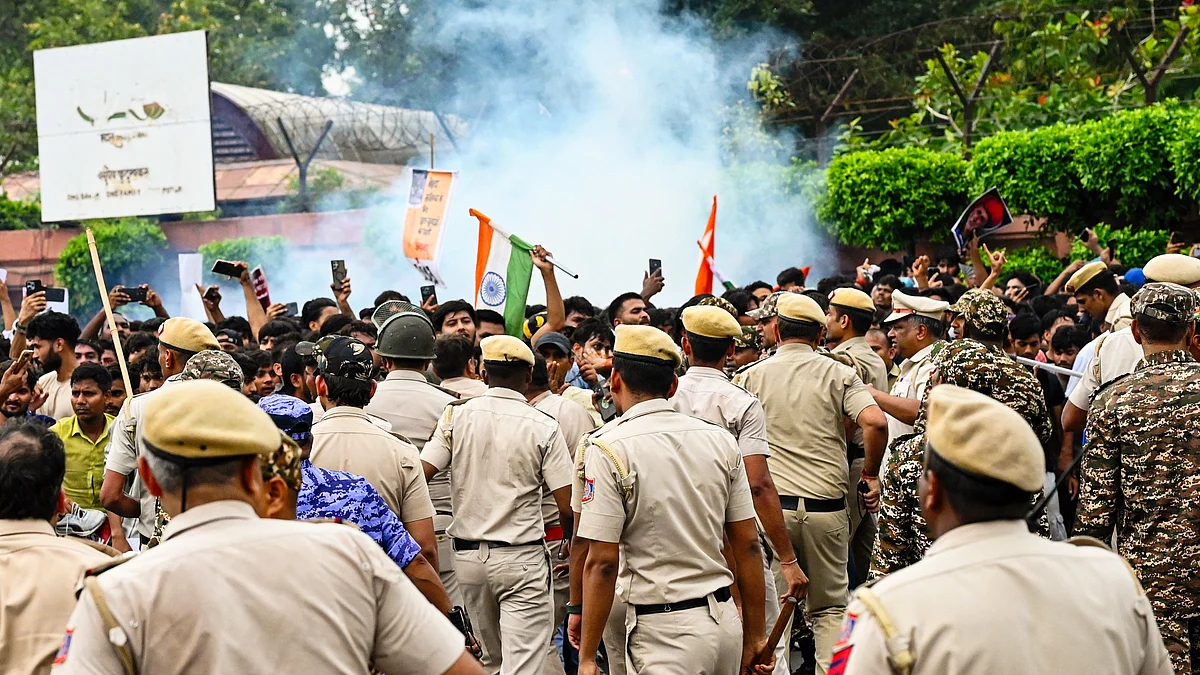
This is what has happened to the Indian police over the last decade or so, especially in some of the northern states. Encounter killings, custodial torture and even deaths, indiscriminate arrests, demolitions, forcible evictions, illegal deportations, voter suppression, selective prosecution, the patronage of criminals and excessive use of force (as witnessed during the July Jantar Mantar protests) — all these have become the norm. Jamia Millia, Kathua, Hathras and Lakhimpur Kheri no longer make news.
The Indian police had never really shed its khaki, colonial character, but its retrogression under the present governments, both at the Centre and in the states, has been rapid and alarming. There are three clear indicators of this.
One, the excessive use of force and the curbing of civil liberties and rights, often beyond the mandate of the law, without any accountability. Examples include the brutal use of force against protesting youth on 20 July this year in Delhi and Bihar; the large-scale registration of cases and arrests following the northeast Delhi riots in February 2020, most of which have subsequently failed to stand judicial scrutiny; and the physical persecution and prosecution of those protesting against environmentally destructive projects, such as bauxite mining in Niyamgiri in Odisha and the Siang hydropower project in Arunachal Pradesh.
Encounter killings have become the norm in some states. According to official NHRC data, there were 813 encounter deaths between 2016 and 2022, but not a single police official was convicted. Custodial deaths, both in judicial and police custody, also occur in frightening numbers. Once again, NHRC figures show 1,606 such deaths in 2021-22, while the minister of state for home affairs informed Parliament on 26 July 2022 that there had been 4,484 such deaths over the two-year period of 2021-22.
'Bulldozer justice', demolitions of religious structures and the homes of suspects and accused persons, arbitrary invocation of the NSA and UAPA, arrests over alleged 'conversions' and forcible deportations — all these have become a sickening daily reality, notwithstanding repeated warnings and strictures from the courts.
Also Read: A defence of the indefensible?
This brings us to the second indicator of the deterioration of police forces: contempt for judicial orders and judgments. The most recent example was the disregard for even Supreme Court orders during the Delhi protests. Despite clear directions from the court, the Delhi Police continued to detain lawyers and journalists, shut down Metro stations and roads, and obstruct peaceful protests. (The court is now hearing a contempt case in the matter, and both the Delhi Police commissioner and the Union home secretary have filed apology affidavits.)
The situation is even worse in some other states, where high courts have repeatedly passed strictures against the police. On 3 November this year, while allowing a habeas corpus petition, the Allahabad High Court observed in an order that 'Civil liberties situation in U.P. is shameful: Police have little regard for citizens' rights.' It went on to scathingly observe that 'the infringement of these rights seems to have become a matter of routine for the UP police'.
Similar observations have been made by other courts from time to time, but these have not deterred or restrained the police from continuing their lawless conduct. Regrettably, the reluctance of the courts to go beyond issuing strictures has only encouraged this growing tendency.
The third indicator, perhaps, provides the explanation for this flagrant disregard of orders and laws, and the misuse of authority and physical force. It is becoming increasingly evident that some sections of the police are now sympathetic to, and fully supportive of, the Hindutva ideology of the ruling dispensation and therefore harbour a personal animus towards those who do not subscribe to it.
This explains their brutal use of force against protesters, the deployment of pellet guns and AK-47s, the targeting of even women journalists, and the reported sexual molestation of young girls at Jantar Mantar. It also explains their willing targeting of members of a particular community in myriad cases.
It is difficult to believe that their superior officers would have ordered them to commit these selective excesses as part of their standard operating procedures, though I would not be surprised if that were indeed the case. (It may, however, not be fair to single out the police for this dubious distinction, considering that even higher echelons of the bureaucracy, the defence services, universities and judiciary seem to have embraced the ruling ideology.)
Further, let us admit it: the police as an institution is dominated by the upper castes. Although affirmative action by various governments has improved the representation of Other Backward Classes, Dalits and Scheduled Tribes, their combined share, at 51 per cent, remains far below their 67 per cent share of the general population.
The misogyny within our police forces is reflected in the fact that women account for only 10 per cent of personnel, against their 48 per cent share of the general population. Muslims account for just 4 per cent (excluding Jammu and Kashmir), though they constitute 14.2 per cent of the general population, according to the 2011 Census. These are precisely the sections of society for which the ruling ideology does not give a tinker's curse.
These figures go some way towards explaining why a particular ideology is gaining traction within the police and dictating its actions. India is a deeply divided society. Police personnel emerge from this society and carry its biases and prejudices with them. When these negative influences are allowed free rein, if not actively encouraged by the political executive, the result is what Allahabad High Court described in the observation quoted above. The cost is borne by the average Indian citizen and by society as a whole, in the form of deteriorating governance and a declining justice system.
The greater danger, however, lies in the future. The question is: when the good times return, along with the equitable rule of law, will the police shed this decomposition of values, this growing malfeasance and perversion of their mandate? Or have these tendencies become so deeply embedded in their psyche that they will be impossible to dislodge?
Even more disturbing is another question: will succeeding governments, even those of different persuasions and ideological leanings, be interested in reforming the police at all? For power is a communicable disease, and the virus needs little time to spread from one host to another.
Views are personal. More of the writer's works here
Avay Shukla is a retired IAS officer and author of The Last Sky — Countdown for an Endangered Planet and other works. He blogs at avayshukla.blogspot.com
Join our official telegram channel (@nationalherald) and stay updated with the latest headlines