


Indian Railways: Running late for 2047?
Delayed trains, chaotic stations and poor service expose the gap between railway branding and passenger experience


I've said it before and I'll say it again for the doubtful benefit of this hearing-impaired government — putting old wine in new bottles doesn't change the wine for the better. A prime example is the Indian Railways and its slew of hyped-up new trains — Vande Bharat, Tejas, Namo Bharat and others — along with the claim that they have transformed the way Indians travel. They haven't. They have just made travel more expensive.
Last month I had to go to my hometown, Kanpur, to revitalise my withering roots and decided to travel by the Delhi–Varanasi Vande Bharat, touted as the last word in luxury, speed and punctuality. It was my first time on a Vande Bharat. It turned out to be none of these.
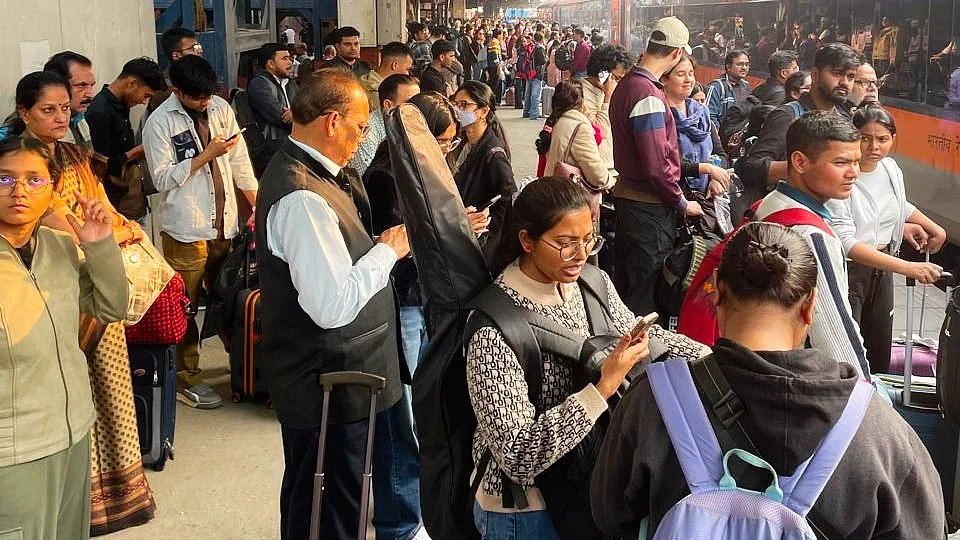
The fallacy began to unravel on platform 16 of New Delhi railway station itself, where I arrived at 2.30 pm for the 3.00 pm departure. The train arrived two hours late and finally left at 5.20 pm — two-and-a-half hours behind schedule. So much for punctuality.
Worse, there was almost no information shared with the hundreds of waiting passengers. Every now and then a bored announcement would inform us that the train "is delayed by 15 minutes". It was always 15 minutes — not a minute less or a minute more.
This instalment-style announcement of delays, copied from the airline industry, is inexplicable in this age of real-time information when a train's actual location can be tracked minute by minute. Why not share that information with the passengers who trusted the Railways' bloated hype? And isn't it ironic that the railway minister is also the IT minister, yet the Railways appear not to know where their own train is at any given moment?
The stranded passengers were treated like dirt in other ways too. They had to stand for two hours; there were barely half-a-dozen dirty benches on the platform for more than a thousand people. If there were elderly passengers, the sick or the disabled, that was just too bad — collateral damage on the country's journey to Vishwaguru status.
Also Read: The Vande Bharat paradox
The platform where India's supposedly most magnificent train was to arrive resembled a Sadar Bazaar trading yard. Every now and then, a policeman would come and shoo passengers away for causing overcrowding. Where exactly were they supposed to go?
It was no better inside the train when it finally arrived. The entrance foyer was jammed with food cartons, garbage bags and crates of bottled water. The toilets were awash like Niagara Falls.
The meals showed privatisation at its worst — packets of chura of uncertain origin, a soft drink, something described as tea and a mouldy piece of cake. We added up the printed MRPs of the items, which came to about Rs 50. IRCTC must have procured them at least 25 per cent cheaper through the lowest tender process. The passengers, however, paid Rs 80 each — another sign of how rapidly the Railways are moving towards the airline model.
The train's maximum speed, displayed on an LED screen above the doors, never exceeded 128 kmph, and that too only briefly. So much for the much-advertised top speed of 180 kmph.
The worst, however, came on the return journey when we got off the train at New Delhi railway station at around 11.00 pm.
Complete pandemonium prevailed at the Ajmeri Gate exit. There were no proper lanes for cars, no separate areas for taxis and no identified points for boarding or dropping passengers — facilities that are standard at railway stations in most developed countries. The result was chaos. Hundreds of passengers rushed around blocking traffic while trying to locate their booked Ola and Uber rides. Vehicles were parked randomly everywhere.
It took us more than 45 minutes — almost one-fifth of the train journey time from Kanpur — to locate our Ola and exit the station.
Also Read: Not just AQI, what we need is a BSI!
I shudder to think what the experience must have been for the elderly, the disabled, women travelling alone or foreign tourists who had swallowed the fable of 'atithi devo bhava'.
I longed wistfully for the Shatabdi days, when one simply went to the prepaid taxi or auto-rickshaw booths managed by the police, paid the fare and was allotted a vehicle without any fuss or the risk of being run over.
So here's the reality. Today's much-trumpeted trains are no better — perhaps even worse — than the earlier Shatabdis and Rajdhanis, which made no extravagant claims but delivered more than they promised.
All the hype about high-speed trains is just that — hype. We may have the technical capacity to build such trains, but we lack the administrative and policy-making ability to operate them properly.
The reasons are obvious: inadequate infrastructure — tracks, signalling and communication systems — poor staff training, weak catering systems, chaotic station management and little accountability.
The Railways' planning model itself appears inverted. Instead of introducing new trains first and hoping the system will cope, it should upgrade infrastructure to the standards of developed countries and only then introduce high-speed services.
Most importantly, the Railways must treat paying passengers with respect and consideration. Travel is not just about speed; it is a package of experiences. The Railways' responsibility does not end on the platform.
It must develop proper station infrastructure inside and outside stations, and create systems that allow passengers to enter and exit safely, conveniently and in an orderly manner.
Dial down the hype and dial up the delivery. It's a long way to 2047, Mr Minister — a much more difficult journey than the three-piece suit hop to Davos.
More of the writer's works can be read here
Avay Shukla is a retired IAS officer and author of Holy Cows and Loose Cannons — the Duffer Zone Chronicles and other works. He blogs at avayshukla.blogspot.com
Join our official telegram channel (@nationalherald) and stay updated with the latest headlines