


It’s advantage Stalin in Tamil Nadu
Tamil Nadu’s resistance to Hindutva politics remains its defining feature.
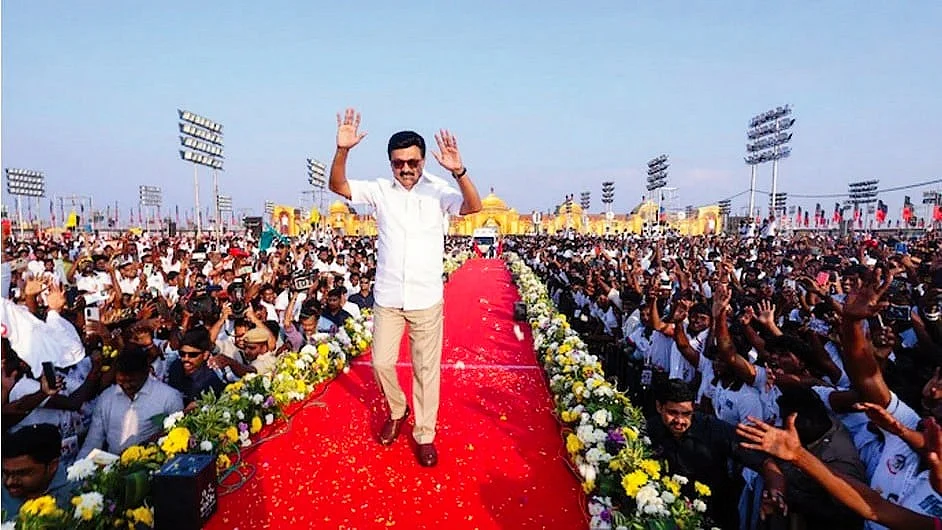


As Tamil Nadu approaches another assembly election, its political landscape reflects a paradox that has come to define the state. There is continuity in Dravidian dominance, welfare-driven governance and a political culture resistant to religious polarisation.
At the same time, there is churn within the opposition, among emerging players and in the subtle recalibration of alliances. When read together, these currents point less towards upheaval than towards consolidation, particularly for the ruling Dravida Munnetra Kazhagam (DMK) under chief minister M.K. Stalin.
Tamil Nadu’s resistance to Hindutva politics remains its defining feature. The ideological foundations laid by E.V. Ramasamy continue to shape politics here, privileging social justice, linguistic identity and rationalism over religious mobilisation. This living framework continues to inform voter expectations and political strategy. As Chennai-based academic C. Lakshmanan observes, elections in Tamil Nadu are not fought on identity alone but on dignity, welfare and rights.
It is within this framework that the BJP has struggled to find its feet. Despite expanding its organisational base and investing heavily in leadership projection, its strategies have often appeared misaligned with the state’s political sensibilities. Efforts to foreground religious identity have found limited traction, while attempts to cobble alliances together have been constrained by regional parties unwilling to cede space.
As journalist M. Satheesh Kumar puts it, the BJP’s problem in TN is not the lack of ambition but the lack of a political language that resonates.
Its dependence on alliances has tied the BJP into a complicated relationship with the All India Anna Dravida Munnetra Kazhagam (AIADMK), a party that is grappling with its own internal instability.
Since the death of J. Jayalalithaa, the AIADMK has struggled to reassert itself as a cohesive force. Leadership tussles have hardened into enduring factional divides. While Edappadi K. Palaniswami has brought a degree of organisational control, unity remains elusive. His consolidation has alienated factions aligned with O. Panneerselvam, even as the lingering shadow of V.K. Sasikala continues to cloud the party’s future.
Singai Ramachandran, a senior AIADMK leader from Coimbatore, admits the scale of the problem with unusual candour: the party is still negotiating leadership when it should be negotiating votes. Critics say that Palaniswami has succeeded in building authority but not consensus. This imbalance weakens the party’s ability to mount a credible challenge in an election that demands both.
The fragmentation extends beyond the AIADMK. The Pattali Makkal Katchi (PMK), with its strong Vanniyar base, remains influential but politically unsettled. Internal shifts, generational transitions and fluid alliance choices have made its positioning unpredictable. While it retains pockets of strength in northern Tamil Nadu, it lacks the coherence required to anchor a broader opposition narrative. As Lakshmanan points out, the PMK can mobilise votes, but it cannot unify them.
Onto this already crowded stage steps actor Vijay, whose political entry combines excitement and disruption. With cross-demographic mass appeal, Vijay represents a new political energy. His immediate impact is likely to be fragmentary. His support base overlaps significantly with segments of the anti-DMK electorate, raising the possibility of a split in anti-incumbency votes across constituencies.
As DMK spokesperson Salem Dharanidharan notes, even a modest vote share of 5 to 8 per cent for Vijay could alter outcomes in dozens of seats: he does not need a sweeping victory to make a dent. For now, analysts suggest that Vijay is less a threat to the DMK than a complication for its opponents.
The fragmentation within the opposition stands in sharp contrast to the relative cohesion of the ruling alliance. The DMK, along with the Congress and Left parties such as the CPI(M), has not only held its alliance together but strengthened it.
Early differences over seat-sharing between the DMK and Congress, often a flashpoint in coalition politics, were resolved through dialogue, with both sides recognising the value of unity over maximalist demands. The CPI(M) also navigated negotiations without public friction, reinforcing the image of a disciplined, coordinated front.
Congress leader Manickam Tagore acknowledges that differences existed, but also emphasises that there was a shared understanding that fragmentation would only benefit the opposition. The Left echoes this pragmatism, viewing seat-sharing as a process of accommodation anchored in a larger political objective.
The implications are clear. In a multi-cornered contest, a cohesive alliance can translate even a stable vote share into a comfortable victory if the opposition vote is divided. The DMK does not need dramatic expansion. It only needs to hold its ground while its opponents split the rest.
This brings the focus back to anti-incumbency. While there may be pockets of dissatisfaction with the government, the absence of a unified opposition prevents this sentiment from coalescing into a decisive electoral force. Instead, it is likely to disperse across multiple players including the AIADMK, BJP, PMK and Vijay’s political platform, each drawing from overlapping constituencies.
As one veteran observer puts it, discontent exists, but there is no agreement on who should benefit from it. That, more than anything else, is the DMK’s advantage.
As Tamil Nadu moves closer to the polls, the bigger picture is one of asymmetry. As political analyst S. Sundar Rajan succinctly observes, elections in Tamil Nadu are not only about strength but about cohesion. At present, only one side has that cohesion.
Unless there is a dramatic realignment within the AIADMK and the opposition ranks, or an unlikely consolidation around a new force, the DMK under M.K. Stalin appears well placed to retain power.
Join our official telegram channel (@nationalherald) and stay updated with the latest headlines