


Oh Calcutta! The city that defined the right to protest
As street protests mushroom around the country and the government cracks down on ‘dimagi Naxals’ who dare to defy, Jawhar Sircar takes a trip down memory lane
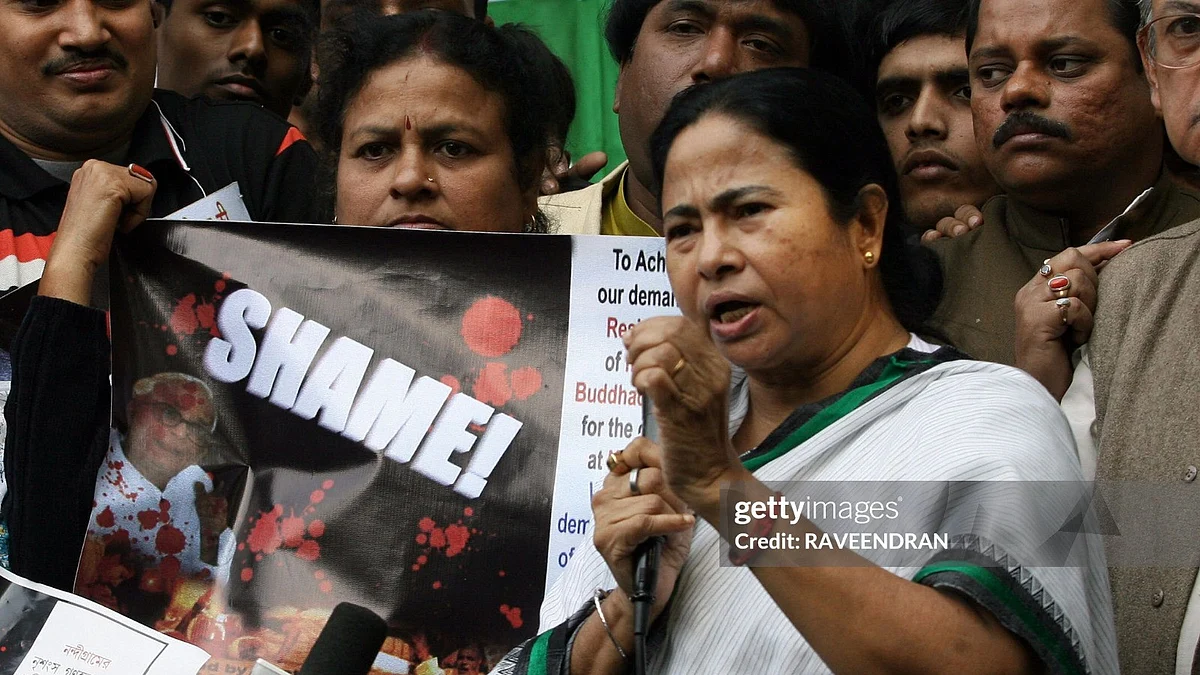


The 1960s were the decade of rage in Calcutta. Naxalite violence had reached the city. Not a day passed without multiple processions choking the streets. Army trucks with wary jawans behind mounted machine guns patrolled in slow motion. Intermittent slogans emerged from the lanes. Elected governments were being over-thrown every few weeks or, at the most, months.
One could say civic unrest was built into the DNA of the city. In the 19th century, Calcutta was not just the capital of British India, it was also the site of battle between Hindu orthodoxy and western education, between ancient beliefs and exciting new ideas like liberty, equality and fraternity. Printing presses mushroomed, churning out countless books, pamphlets and polemical tracts in English, Bengali, Hindi and other Indian languages that carried these ideas to the literate.
As early as in 1818, progressive leaders like Rammohan Roy challenged the status quo through newspapers, fighting both colonial apologists and the powerful Hindu orthodoxy. Christian missionaries condemned Hinduism for its obscurantist customs and the air was electric, taut with tension. Textbook societies, libraries, literary associations, reformist organisations and political associations sprang up. Educated Bengalis increasingly learned to challenge government policies through petitions, public meetings and journalism.
One of the earliest demonstrations of this new political culture erupted in 1905, with Viceroy Lord Curzon’s declaration of the ‘Partition of Bengal’. Outraged Bengalis took to the streets, including Rabindranath Tagore, with his stirring songs. On 7 August 1905, the Swadeshi movement was formally launched from the Calcutta Town Hall; in Banaras, the Indian National Congress gave its clarion call to boycott British cloth and goods.
Within weeks, Calcutta resounded with boycotts, picketing, public meetings and processions. A day of mourning was observed on 16 October (the date of the proposed partition). It became clear that the rallies were not just anti-British demonstrations, but a newly-crafted technique for weaving social unity through varied elements—politics, education, literature, culture, music, commerce and street mobilisation. This blend became characteristic of Bengali political life and agitations.
Also Read: The end is nigh, the bugle has been sounded
Interestingly, the area dedicated to roads in a city is among the lowest in what is now Kolkata. Decades of unplanned growth led to overcrowding, narrowing existing routes. This was not a handicap to the tradition of public demonstrations. Smaller processions converged on the city centre, the Esplanade, from different directions, stopping to listen to speeches and gather more participants as they proceeded. The open spaces around Shahid Minar in the Maidan, and the gigantic Brigade Parade Ground close by were the natural locations for some of the massive public protests we see framed in vintage photographs. Mounted police were often deployed to disperse unruly crowds.
Post-Independence, when tram fare was increased by just one paisa in July 1953, people poured into the streets against profiteering by the British-owned Calcutta Tramways Company. Protests continued for a month; and several tramcars were set on fire in response to police action. When the tram workers joined the movement, the government was compelled to review the fare hike.
Even today, bank and postal employees, teachers too, can be seen protesting quite regularly. For several decades, Left unions routinely called supporters to leave their offices and join street marches or micchil.
The year 1954 saw secondary school teachers on a 10-day strike. Police firing killed five and injured many more. Public pushback ultimately compelled the government to accept the teachers’ demands. In 1959, communists protested against rising food prices, with school and college students joining it. On 31 August, a massive demonstration in central Calcutta was fired upon—an estimated 50-100 people were shot dead. The Food Movement of 1966 was even more extensive, as mobilisation against the failures of the public distribution system spread to the districts and villages.
In 1967, the Left stormed into power but a section of Marxists fell out after the police opened fire on a farmers’ rally in a village in Naxalbari, near Siliguri, on 25 May. This triggered the armed revolt known as the Naxal uprising. While mainstream politics was already wedded to processions and public meetings, naxalism laid stress on the annihilation of class enemies. Violence and fatalities became endemic with Naxalites fighting both the Left and the Congress. Even as student politics became exceptionally important, the Left parties mainstreamed and institutionalised protest over its 34-year rule.
Also Read: What option do people have but to protest?
On 21 July 1993, the police opened fire on a protest march of Youth Congress workers led by Mamata Banerjee; 13 political activists were killed. Alleging that the Congress was not aggressive enough, Banerjee quit and formed the Trinamool Congress. For 16 years, she would remain a street-fighting woman. In July 2006, her party launched agitations against land acquisition for the Tata’s proposed car factory in Singur.
Mamata Banerjee’s 26-day hunger strike in December 2006 grabbed national attention. In Nandigram, at a protest against land acquisition, the police opened fire on 14 March 2007, killing 14 people. That is considered the moment that eventually led to the Trinamool Congress assuming power four years later.
The Singur-Nandigram movement—where intellectuals, writers and artists agitated alongside farmers, workers and students—demonstrated that Bengal’s protest culture had survived the Left Front era and could, in fact, challenge and topple the Left itself.
With the BJP gabbing power at the Centre in 2014, its Bengal state unit emerged as the most belligerent opposition with active Union government support. Even as central agencies went after the corrupt ministers and leaders of Mamata’s regime, it was the rape-and-murder of a young lady doctor at R.G. Kar Medical College in August 2022 that proved to be the last straw on the camel’s back.
All of Kolkata took to the streets: not just doctors and medical staff, but actors, musicians, football fans, rickshaw pullers, gig workers... Rage mobilisation may well have contributed to the BJP’s surprise victory in the assembly election
of 2026. Ironically, on 9 September 2026, the new BJP chief minister himself led a protest of saffron-party workers against Jadavpur University students for supporting Palestine and demanding Azaadi for Kashmir!
Protests and political violence are truly hardwired into the state’s historical-political culture. But Bengalis are not a people permanently on protest. Bengal enjoyed long spells of political stability, and much of Bengali protest culture remained electoral and institutional rather than revolutionary. It nurtured poets, writers, scientists, thinkers, economists, film and media personalities, and dissed those who distanced themselves from mass concerns. But then, as now, it remained on a short fuse when it came to converting social grievance into organised public expression.
JAWHAR SIRCAR is a former bureaucrat and Rajya Sabha MP