


Rule, not law: How the State is tightening the noose around NGOs
Unable to legislate, the government is increasingly achieving the same ends through executive rules
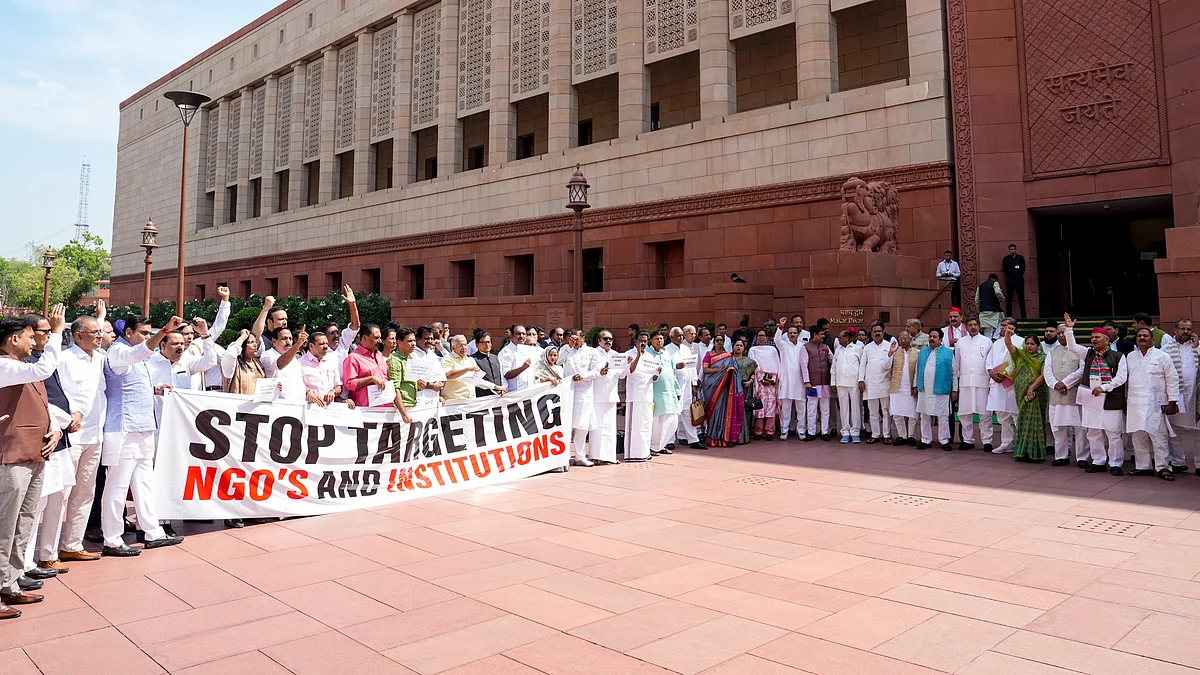


What cannot be passed in Parliament as law can be brought into effect through changes in the rules. The effect on the ground is often the same and the objective is achieved. This is not how democratic nations ought to function, but there is perhaps a reason why India is now, so many years after 1947, classified as 'partly free' rather than a full democracy.
This March, the government introduced a Bill to attack, yet again, non-government organisations. This is a sector to which, it must be clarified at the outset, the RSS does not belong because it is not a registered entity and does not, therefore, legally exist as one.
The Bill could not pass after the Opposition did what it should do more often: oppose. The prime minister, with his 240 MPs, took his Bill and went home. He then reintroduced much of its essence through changes to the rules under the existing law, something that does not require parliamentary approval.
Exactly like the introduction of the Special Intensive Revision, which did through rules what the National Register of Citizens could not achieve through legislation.
The current attack on NGOs continues the effort to shut the sector down. It is aimed at organisations receiving foreign funding, with the familiar tropes of national security, the 'foreign hand', and the rest once again being invoked. At the outset, it must also be clarified that PM CARES is not covered here because it is neither a government entity — and therefore falls outside the purview of the RTI Act — nor is it an NGO, and therefore cannot be held to the same standards. It is a mythical creature.
The new rules introduce a number of restrictions on NGO functioning. NGOs can conduct only those activities listed in a government-prescribed schedule. The government will also have greater control over where an NGO can operate. An NGO's 'chief functionary' is defined not merely as its chief executive but also its trustees and office-bearers, while foreign nationals are barred from serving in those roles.
NGOs must also declare their social media accounts and are prohibited from publishing material the government considers political. And so on and so forth.
Why are these rules not applied to the rest of the private sector, which is, after all, what 'non-government' means? That is difficult to explain. Corporates are free to bring in as much foreign investment as they wish and are applauded for doing so. They can hire foreign CEOs, while Indian CEOs leading companies abroad are celebrated as national successes.
There are other obvious hypocrisies. In January 2013, a public interest litigation was filed in Delhi High Court alleging that both the BJP and Congress had received donations from Vedanta/Sterlite in violation of the FCRA. On 28 March 2014, the court held that both parties had violated the Act and, in May that year, directed the Modi government and the Election Commission to take action against them.
By October 2015, however, the Modi government had found a way around the problem. It amended the law to define any company registered in India, irrespective of its ownership, as an Indian company. In effect, 'foreign' was redefined as 'Indian'. That amounted, critics argued, to a fraud on the Indian people, but because both major parties stood to benefit, the change passed without meaningful resistance.
For the rest of us, the rules are different.
In 2020, the government introduced another set of restrictions. First, the roughly 23,000 NGOs licensed to receive foreign contributions were required to receive all such funds through a single branch of the State Bank of India at Sansad Marg in New Delhi. Since only 1,488 of those NGOs were registered in Delhi, the rest had to travel to the capital simply to open an account. The branch, in turn, would report to the home ministry the details of every remittance, including its source and mode of receipt.
The second change reduced the amount NGOs could spend on administrative expenses from 50 per cent to 20 per cent of the foreign funds they received. Salaries, travel expenses, the cost of hiring personnel, electricity and water charges, telephone bills, postal and courier charges, office repairs, stationery and printing, transport, accounting and fund administration, vehicle maintenance, report writing, legal and professional fees, and rent were all classified as administrative expenses.
No more than 20 per cent of foreign funding could be spent on these essentials, even though no comparable restriction applies to any other sector in India. This disproportionately affected organisations engaged in research, advocacy and public policy work, which depend heavily on professionals such as lawyers, academics and researchers rather than brick-and-mortar projects like schools or hospitals.
Third, the law prohibited NGOs from transferring foreign funds to other NGOs, even when both organisations were fully FCRA-compliant. This struck at the way the sector functions. NGOs do not generally compete with one another in the way private companies do; they work through networks and partnerships. The change weakened those alliances, preventing larger organisations from supporting smaller grassroots groups that often lack the expertise or resources to raise funds independently.
And now come yet more rules in 2026, all of it accompanied by the astonishing slogan of 'minimum government, maximum governance'.
Views are personal. More of Aakar Patel’s writing here
Join our official telegram channel (@nationalherald) and stay updated with the latest headlines