


The wonder that is India
How Hindutva has reshaped India’s politics, institutions and society — and why the future looks increasingly dark


A foreign outlet interviewed me this week and at the end of it, after we had wrapped up, the interviewer said he was surprised. He said he did not know this was the position India was in, and I find this to be quite a common reaction. Other than the academics who study India and foreign correspondents posted here, few realise how much India has changed from the image they had of it.
I will recap what was asked of me in that interview and how I replied so you can get a picture of what the interviewer grasped. You can also compare it to your own assessment of where India stands today.
He first wanted to look at Hindutva — its origins, ideological foundations and how it differs from Hinduism as a religion. I told him Hindutva combined the word Hindu and the suffix 'tva', meaning Hindu-ness. The word was used in Savarkar's book a century ago, in which he wrote that India and Hindu come from the same root as Indus and Sindhu. He felt that one could only be Hindu — and by extension Indian — if one's holy sites were in India and not in Jerusalem or Mecca or elsewhere.
To the second part, I said Hinduism was a religion concerned with personal belief: gods, prayers, fasts, festivals. Hindutva was concerned about the other person's belief and what they could not eat, where they could not pray, who they could not love and where they could not stay.
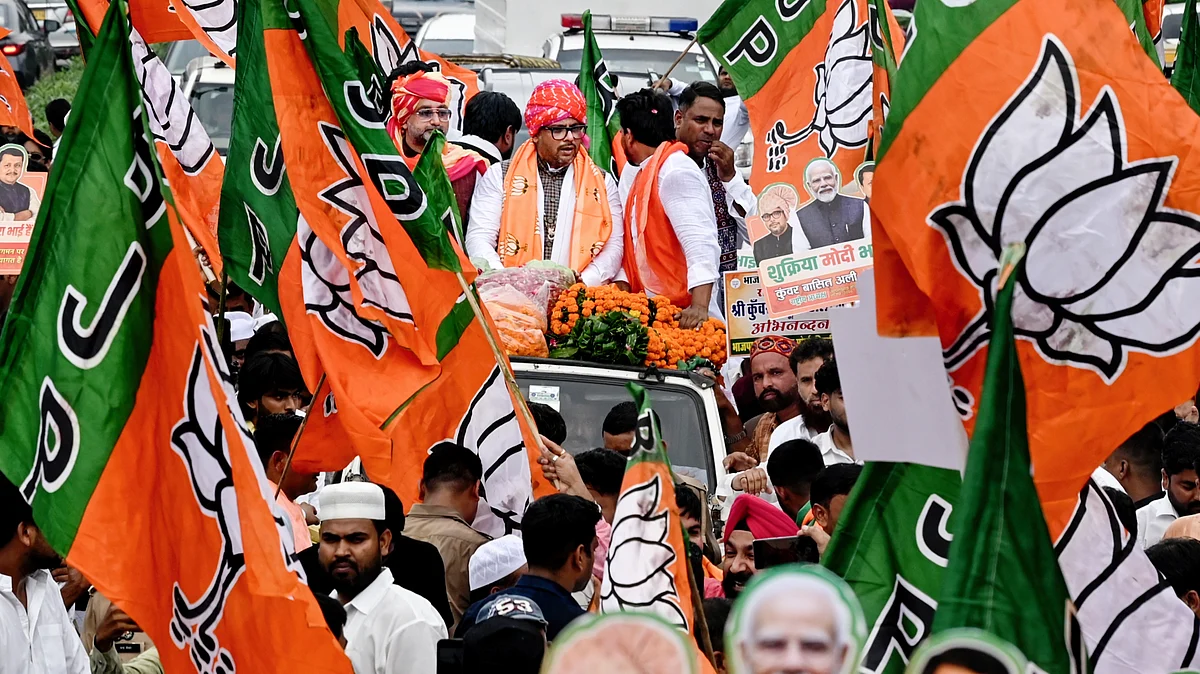
He then asked how Hindutva became increasingly influential in Indian politics, particularly through the rise of the BJP. I said though it was formed in 1951, for four decades, the BJP/BJS had only a single-digit vote share nationally and did not win a single state without alliances until 1990. The party did not know which issue to mobilise through all those years.
What made it popular, and doubled its vote share to 18 per cent, was the demolition of the Babri Masjid in Ayodhya. Some 3,000 Indians were killed in the violence that made the BJP ascendant. Two other demands — stripping Muslims of their constitutional autonomy in Kashmir and taking away their personal law — kept the pot simmering.
He then wanted to discuss how Hindutva has affected India’s political institutions and the wider political environment, including the treatment of religious minorities. Here there was nothing to do other than recite the numbers which show us the total exclusion our ruling party practices as revealed by its ministers, Lok Sabha and Rajya Sabha members and its state legislators.
The laws criminalising possession of beef appeared in 2015, triggering beef lynchings, and laws criminalising interfaith marriage in 2018. He was aghast to learn about the reversal of burden of proof and the presumption of guilt. How can you call yourself a democracy with all this around you, he asked. I shrugged.
He then asked about the prime minister's role in the normalisation of Hindutva politics, and why this political project has remained electorally successful. I said Narendra Modi was more open and honest about his championing of Hindutva than the BJP leaders before him. This made him popular with his votaries and had taken the BJP nationally to a vote share of 38 per cent, where it has remained.
The BJP was also, I said, enthusiastic about permanent polarisation through law and policy (I referred to the bulldozers and absence of due process and he was dumbstruck).
He then asked how Hindutva has affected India’s Muslims and other minorities, and whether the rise of majoritarian politics is changing how minorities understand their place within the Indian state. I answered as best I could. The main point was that India has more minorities than the entire population of western Europe.
Asked about Hindutva beyond India’s borders, I told him Israel puts us on display as its trusted friend and ally when asked to justify its actions against Palestinians.
I said our ambition since 2014 had moved from global to regional, and our obsession was getting the better of our neighbours. We had stopped competing with China and I gave him the numbers on the economy and the position since 1991.
He asked: Do BJP leaders not see the damage they are doing? I said in my experience, they genuinely believed in their ideology. To them, it is not a means to an end but an end in itself, and for this reason, what is happening by way of exclusion and persecution will continue no matter the fallout.
Finally, he asked me to look ahead and discuss India’s future — whether the country can move away from majoritarian politics, what role the Opposition and India’s democratic institutions may play, and whether India’s pluralist tradition can withstand the growing influence of Hindutva.
I said our natural state was pluralist and that broadly, society did not reflect the ideology of our government. However, so many years of it being imposed on us top-down has meant the ideology has seeped into institutions and society in general, and this will remain even if the party goes from power.
As far as the future is concerned, it is dark because we have no ideas on how to transition half-a-billion people out of poverty, where they will remain. More importantly, we no longer discuss this with any urgency, nor is it the primary basis of politics in our country. We will remain poor and irrelevant but content in the knowledge that our minorities are worse off than us.
Views are personal. More of Aakar Patel’s writing here
Join our official telegram channel (@nationalherald) and stay updated with the latest headlines