


Guess who isn’t calling the shots?
Ashok Swain on the message from the Xi–Putin summit for Trump’s America and the rest of the world
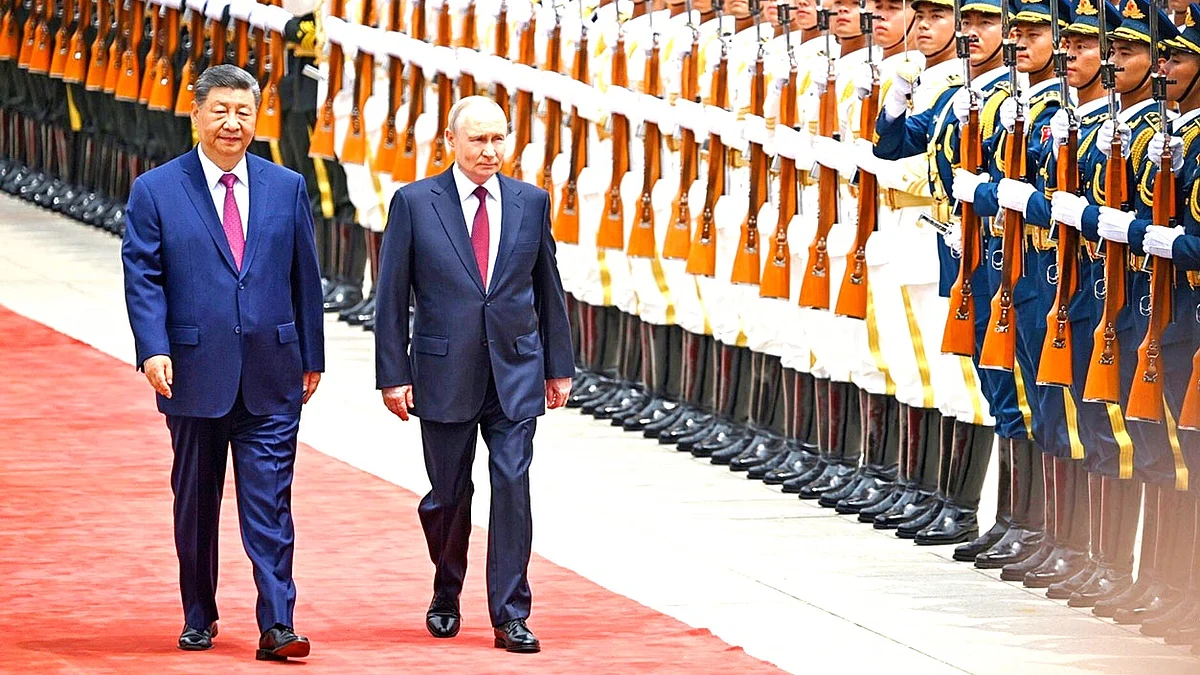


When Vladimir Putin arrived in Beijing days after Donald Trump had left, Xi Jinping did not merely host another summit. He staged a geopolitical statement. Trump had come to China believing that personal diplomacy if not transactional pressure could still bend the world to Washington’s will. Xi answered by standing beside Putin, as if to declare that the age of unquestioned American dominance is nearing the end.
The Xi-Putin summit was a calculated performance. By signing a declaration on a multipolar world, China and Russia were mounting a direct challenge to the central assumption of Trump’s foreign policy that the US can still define the global order, decide which wars are legitimate, determine who is to be punished and expect others to fall in line.
Trump’s worldview has chronically overestimated US leverage. He has banked on America’s ability to coerce other nations — China, Russia, India, Iran, even NATO allies — to cooperate or pay a price. Sanctions, tariffs, military strikes, theatrical summits and Truth Social ultimatums have become US strategy. But where some powers like India have capitulated in the face of bullying, China and Russia and more recently Iran have pushed back and successfully called his bluff.
These countries and their leadership read Trump’s vulnerabilities. Xi has never confronted Trump with reckless gestures. Instead, he steadily accumulates leverage. He receives Trump with courtesy, keeps economic channels open, avoids unnecessary rupture, and then immediately hosts Putin to show that China will not be trapped inside a Washington-designed international order. This is the essence of Xi’s challenge, careful in tone, forceful in substance.
The condemnation of US and Israeli military strikes on Iran gave the summit its sharpest edge. By framing these strikes as violations of international law and basic norms of international relations, Xi and Putin placed Washington in the dock, not Tehran. This was not only about Iran. It was about the wider claim that no power, however strong, has the right to bomb, sanction or destabilise another state outside the authority of the United Nations.
Also Read: China holds the aces in Trump–Xi meet
Trump may unpredictably talk peace and even covet the Nobel Peace Prize, but overestimated US leverage. He has banked on America’s ability to coerce other nations — China, Russia, India, Iran, even NATO allies — to cooperate or pay a price. Sanctions, tariffs, military strikes, theatrical summits and Truth Social ultimatums have become US strategy. But where some powers like India have capitulated in the face of bullying, China and Russia and more recently Iran have pushed back and successfully called his bluff.
These countries and their leadership read Trump’s vulnerabilities. Xi has never confronted Trump with reckless gestures. Instead, he steadily accumulates leverage. He receives Trump with courtesy, keeps economic channels open, avoids unnecessary rupture, and then immediately hosts Putin to show that China will not be trapped inside a Washington-designed international order. This is the essence of Xi’s challenge, careful in tone, forceful in substance.
The condemnation of US and Israeli military strikes on Iran gave the summit its sharpest edge. By framing these strikes as violations of international law and basic norms of international relations, Xi and Putin placed Washington in the dock, not Tehran. This was not only about Iran. It was about the wider claim that no power, however strong, has the right to bomb, sanction or destabilise another state outside the authority of the United Nations.
Trump may unpredictably talk peace and even covet the Nobel Peace Prize, but his administration spouts the doctrine of ‘peace through strength’, an euphemism for flexing muscle to achieve desired outcomes. He attacks multilateral institutions, then complains when others build alternatives. He invokes sovereignty when it suits America but violates the principle flagrantly, as evidenced by US actions in Venezuela and Iran and US support for Israel’s wars. Xi has seized on this contradiction and turned it into a diplomatic weapon.
China’s message is simple: the UN, not Washington, must remain central to international legitimacy.
Of course, Beijing’s own record is not spotless. Its positions on Taiwan, the South China Sea and its human rights record invite criticism. Likewise, Russia’s invasion of Ukraine makes Moscow’s position untenable in any discussion of sovereignty. Yet the power of Xi’s move lies not in its moral framing but in political timing. Trump’s unilateralism and the unreliability of his word and actions has made it easier for China to present itself as a defender of rules, restraint and global balance.
The more Trump attacks the international order in the name of American greatness, the more space he creates for Xi to claim global responsibility. The more Washington behaves like a hegemon, the more convincing Beijing’s language of multipolarity sounds to many countries in Asia, Africa, Latin America and West Asia.
Xi is not asking the world to choose Russia over America. He is asking the world to question why America should remain the final arbiter of every other nation’s conduct. That is a far more sophisticated challenge. It appeals not only to authoritarian states but also to governments tired of the West’s double standards.
The Beijing summit also showed that Russia needs China more than China needs Russia. Putin requires markets, technology, diplomatic cover and energy buyers. Xi requires Russia as a strategic counterweight, but he is careful not to become dependent on Moscow. The failure to finalise key energy decisions, including long-delayed pipeline plans, reveals the limits of the partnership.
Xi is mindful of these limits. So, he engages with Putin without yielding to him. He engages with Trump without trusting him. He talks about the centrality of the United Nations in the international order even while expanding China’s influence through trade, infrastructure, technology and diplomacy. This is statecraft.
Trump, by contrast, treats foreign policy as spectacle. His visits produce headlines, handshakes and declarations, but not durable order. Xi’s summits are designed differently. They are meant to place China at the centre of every conversation. Trump comes to Beijing seeking a deal. Putin comes seeking reassurance. Others come seeking access. Xi receives them all, and the image is unmistakable — the world is no longer kowtowing to Washington.
The call for a multipolar world is not an abstract slogan. For China, multipolarity weakens US primacy and gives Beijing time to expand its own influence without triggering a direct confrontation. For Russia, it offers protection from isolation. For many states in the Global South, it offers bargaining space. For Trump’s America, though, it’s a rude reminder that its military might does not automatically translate into leverage or legitimacy.
****
The call for ‘multipolarity’ is really a push towards competing spheres of influence. Big powers may invoke sovereignty but violate it when convenient. Russia has done exactly that in Ukraine and China has made low-key assertions in its own neighbourhood.
The Xi-Putin summit should, therefore, be read as a diplomatic counterstrike. It told Trump that China will not yield to US pressure. It told the world that Beijing has partners, platforms and an alternative vision of international order.
Xi Jinping is challenging the US carefully yet forcefully — carefully because China still needs stability and forcefully because he believes history is moving in China’s direction. Trump’s policy missteps and hegemonic misadventures are no small help.
Ashok Swain is a professor of peace and conflict research at Uppsala University, Sweden. More by the author here
Join our official telegram channel (@nationalherald) and stay updated with the latest headlines