


Why the SIR is Narendra Modi’s chosen weapon to crush democracy
The term “special” suggests routine electoral roll updates have been inadequate and require periodic intensive reviews


At a press conference she held at her Kalighat residence immediately after the West Bengal assembly election results were announced on May 4, former West Bengal chief minister, Mamata Banerjee, whose Trinamool Congress had suffered its first defeat in 15 years, had adamantly declared, “There is no question of me resigning; we were defeated not by public mandate but by conspiracy.” She accused the Election Commission and the central security forces of colluding with the Bharatiya Janata Party (BJP) to “loot” the election. “I have not lost, so I will not go to Raj Bhavan. I will not tender my resignation,” she said.
In closed-door meetings she held later with her newly elected MLAs, she reportedly added, “Let them impose President’s Rule if they want. Let them dismiss me if they want. Let this day go down on the record as a black day for democracy.”
Her reason for taking that step was perhaps her realisation that she and her political party, the Trinamool Congress, were not going to be the only, but the first, victims of Prime Minister Narendra Modi’s determination to crush the last remnant of India’s democracy – its so far irreproachable election system – and turn India into a fascist ‘Hindu state’.
The weapon Modi has chosen is a Special Intensive Review of the electoral rolls. The word ‘special’ suggests that the normal annual updating of electoral rolls has been a lackadaisical affair, and needs backstopping every few years with an intensive review of the voters’ lists. Two of these were held in Bihar and West Bengal last year, because of the imminence of the state assembly elections, and were followed by decisive victories of the BJP in West Bengal and the BJP and allied political parties in Bihar. The SIRs have now been completed in the 11 most populous of India’s 28 states, that account for two-thirds of its population and three of its eight Union territories that are ruled directly by the Union government. A pattern is emerging that fully vindicates the Bengal former chief minister’s warning that these so-called SIRs are designed only to allow the Modi government to steal election after election until its grip on the country is complete.
Why is Modi doing this only now, when he has already been the prime minister of India for the past 11 years? The answer is that he needs to – after the jolt he got from the 2024 Lok Sabha election results – because he knows he can get away with it thanks to the Election Commission whose pliant nature he has reinforced.
An attempt was made by transparency activists to ensure the government did not fully control the selection of election commissioners and a five-judge bench of the court ruled in March 2023 that the Modi government needed to enact a law that would create a proper, independent, and transparent process for the appointment of the chief election commissioner and other election commissioners. But it held that until that law was passed it should appoint the commissioners through a committee consisting of the prime minister, the leader of opposition in the Lok Sabha and the Chief Justice of India.
This was the loophole that Modi was looking for. So he lost no time in passing that law, but with a single change that reversed its entire intent: This was to replace ‘the Chief Justice of India’ in the election committee with ‘a Cabinet Minister nominated by the Prime Minister’. Since the BJP and its allies were in power, and none of the latter saw the trap he was dragging them into, they gave their assent. That law has given the ruling party a permanent majority in the choice of election commissioners and the BJP has sought to use this ‘court-approved’ power to steal the vote election after election in order to stay in power for the foreseeable future.
Modi began to use his complete control over the ECI within months to the enactment. The law he passed in response to the Supreme Court’s directive shows such utter contempt that it has been challenged by many civil rights organisations in the country and numerous individuals ranging from members of former and current members of Parliament to eminent citizens who fear that India’s democracy is at its last gasp. Chief among the appellants are the four most respected civil rights organisations in the country, The Association for Democratic Rights, the Peoples’ Union for Civil Liberties, Common Cause and the Centre for Public Interest Litigation.
The Supreme Court has bunched all of these petitions together and as is its wont, took its time in getting to hear them. The matter is being considered only now – three years after it should have been. Admittedly, justice hastened can lead to justice denied, but on this issue, justice delayed is giving the Modi government all the time it needs to complete the dismantling of India’s democracy and its conversion into a one-party quasi-fascist state.
Modi unveiled the principal weapon that he wished to deploy to achieve his goal on June 24, 2025. This was to hold an SIR of the electoral rolls. In its various submissions and FAQs, the Election Commission explained the need for the SIR by saying that as follows the last full Special Intensive Revision was conducted in 2002–2004 and that there had been a massive demographic change in the country since then, and that it was likely that a large number of deceased persons, permanently shifted voters, and duplicate entries remain on the rolls. And that since only summary revisions (i.e. annual routine updates) had been carried out over the past two decades, these were not sufficient to remove accumulated errors.
The ECI’s explanations were intended to fool a gullible electorate into believing that the Modi government is belatedly making up for the laxity and irresponsibility of the work by earlier commissioners appointed by its predecessors. But even a superficial examination of the changes in the lists of registered voters over the past 70 years shows that this is nothing more than a pretext for tearing up the present voters’ lists and creating new ones that will increase its chance of staying in power for the foreseeable future. For there have been 18 elections to the Lok Sabha and 345 elections to state assemblies in the past 75 years, and in not one has the performance and independence of the Election Commission even been questioned, let alone impugned.
After Independence, the ECI engaged in the ground-breaking task from 1948 till 1952 of generating an electoral roll that could give effect to the principle of universal adult franchise. The task took four years because there was no way then for identifying and enumerating the largest electorate in the world, other than through a house-to-house, hut-to-hut count of every living soul in India’s half a million cities, towns and villages.
This basic survey was updated, once every five years till 1967, and then twice every five years from 1971 onwards, after Prime Minister Indira Gandhi separated the Central from state assembly elections. This doubled the ECI’s workload, but made it even more necessary for it to maintain accurate data on the electorate. It was only able to cope with this doubling of its workload because of India’s decennial censuses. The introduction of digital data storage progressively eased its workload as well.
Twenty years later its task became even easier when Electronic Voting Machines and record keeping were introduced, first in selected states in 1998, and then nationwide in 2004. That finalisation of the switch to electronic voting and record-keeping enabled the ECI to conduct its first Special Intensive Review from 2002-2004, generating a basic electoral roll which has become the reference point for all elections held in the country since then, including the one launched by the Modi government in 2025. The table below gives its results:
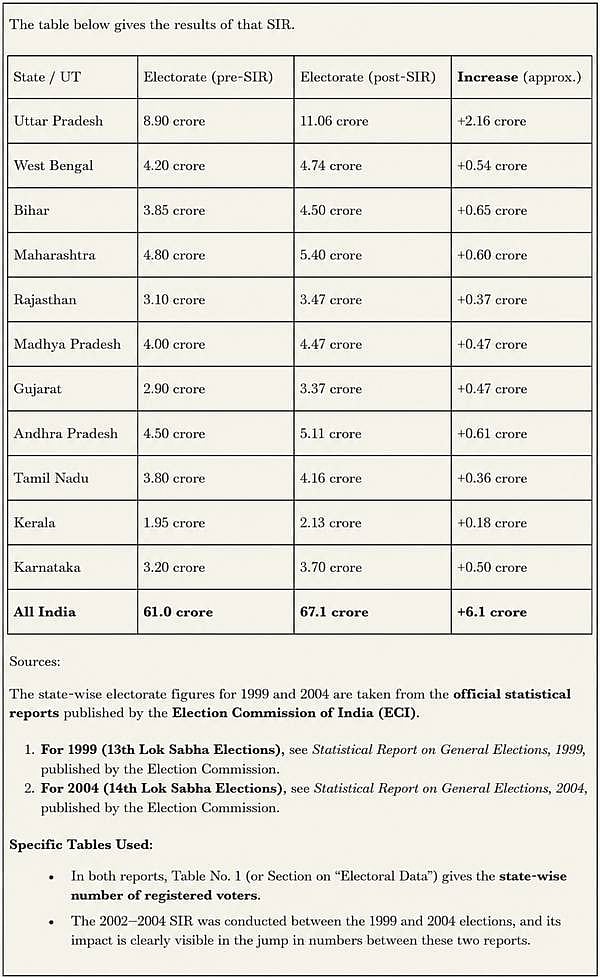
In sum, between 1951 and 2004 the Election Commission’s growing experience, and progressively better methods of registration and record- keeping, increased the size of the electorate. But, in the sharpest possible contrast, as the table issued by the Election Commission itself, which is reproduced below, shows, the 2025-26 SIR has done the exact opposite, and reduced the size of the electorate by almost the same proportion.

Which of these two diametrically opposite trends – where the 2002-2004 SIR led to an increase in the size of the electorate while the 2025 one led to a sharp decrease – should the Indian public trust? The answer can be found by comparing both sets of data with a third: That is the change in the size of the population of India between 2004 and 2024. This grew from 113.6 crores in 2004, to 144.2 crores in 2024.
Moreover, as the table below shows, this increase was fully reflected in the increase in the number of registered voters in the Lok Sabha elections of this period:
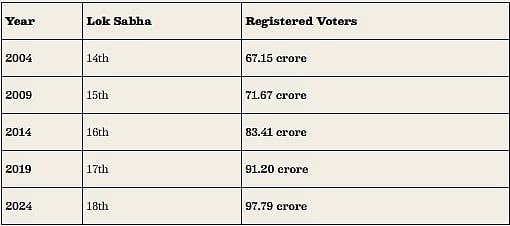
This is an increase of 30.64 crores in 20 years, an annual increase of almost 1.5 crores a year. These voters’ rolls were prepared during the tenure of Manmohan Singh and Narendra Modi both. All of this data, compiled by AI from EC reports, reflect the same rate of growth of the electorate, of about 1.56% a year, which is identical to the growth of the +18 population of the country during this period. So the possibility of double-counting of voters because of mass migration, non-registration of change of residence, or death – all the plausible reasons that CEC Gyanesh Kumar has given – at the scale suggested seems improbable.
There are only two possible answers: the first is that the Election Commission has deliberately made it so difficult, and so expensive, for those who are not on the so-called “legacy electoral rolls” of 2004, created a full 20 years ago, to return to their original homes now to collect, or get re-issued, the documents of domicile that will enable them to qualify as voters, that huge numbers have simply given up trying. The second, which is Modi’s favourite, is the need to prove that they are truly Indian citizens and not illegal immigrants from Bangladesh, Myanmar, or any other place. Although the Supreme Court has asked the Election Commission to consider the Aadhaar card, every other proof of identity that a migrant worker needs has to be obtained from home.
The 10% drop in the electorate shows how vast is the number that have given up even trying to vote. That, of course is what Modi and the BJP want, for these are the poorest people in the country who are most prone to voting as a bloc, and have tended to vote, as the Aam Aadmi Party’s repeated victories in Delhi and more recently in Punjab show, for those who can give them a smidgen of hope for the future.
As many surveys have shown, a disproportionate proportion of the poorest in the country are also Muslims. So, Modi has all but succeeded in ensuring that only the relatively privileged will find it easy to cast their votes.
Mamata Banerjee is therefore right. The election in Bengal was, in all probability, ‘stolen’ through a conjunction of these factors. But what happened in Bengal will now happen in the rest of India.
Prem Shankar Jha is a veteran journalist, writer and economist. Read more from him here
Join our official telegram channel (@nationalherald) and stay updated with the latest headlines