


Congress bats away Somnath charge, as BJP dusts off Nehru yet again
Opposition calls out “lies and half-truths”; ruling party returns to a well-worn script
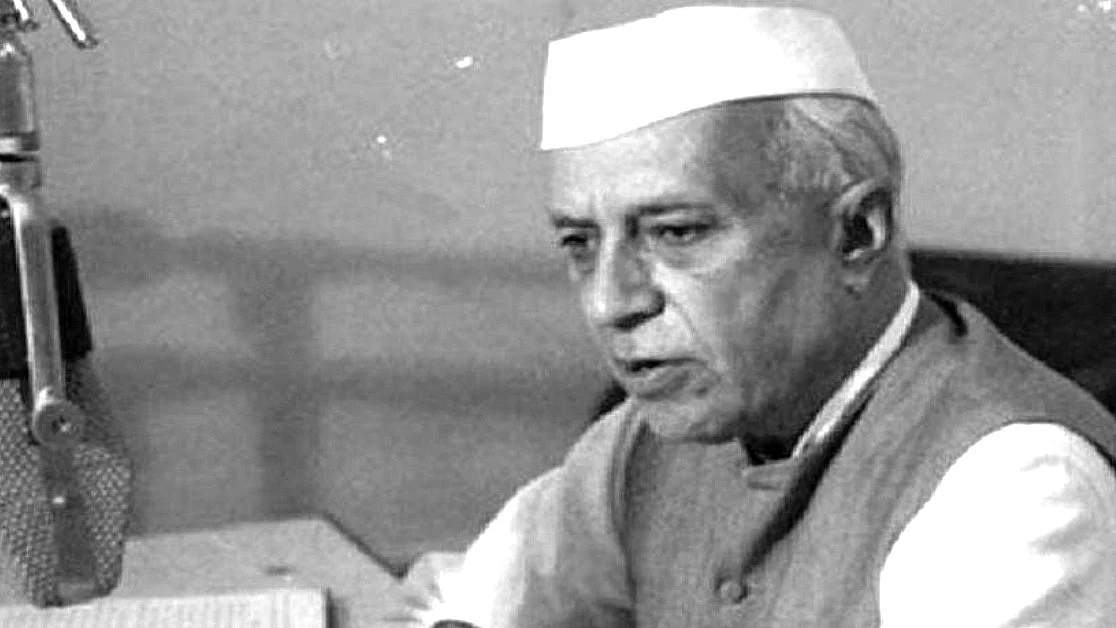


The BJP on Wednesday launched a fresh attack on India’s first prime minister Jawaharlal Nehru, with national spokesperson Sudhanshu Trivedi accusing him of “blind appeasement politics” and claiming he opposed the rebuilding of the Somnath temple after Independence, a charge the BJP has been at pains to establish.
In a series of social media posts followed by a press conference, Trivedi alleged that Nehru “hated” Lord Somnath, glorified Mughal invaders, and even “surrendered” to Pakistan by writing a diplomatic letter to its then prime minister Liaqat Ali Khan in 1951. Casting Nehru as a civilisational antagonist rather than a constitutional head of government, Trivedi argued that the former prime minister’s “mindset” continues to shape the Congress today.
The Congress hit back sharply, accusing the BJP of recycling long-debunked claims by selectively quoting Nehru’s correspondence while ignoring both historical context and inconvenient facts. Congress leader Piyush Babele said the BJP was “serving lies and half-truths as truth”, lifting isolated sentences from Nehru’s letters without acknowledging those written before and after, which made clear that his objection was not to the temple’s reconstruction but to the use of government funds for a religious project.
Babele pointed out that the principle Nehru was defending was neither novel nor personal. At a prayer meeting on 28 November 1947, Mahatma Gandhi had explicitly opposed the use of public money from the state treasury to rebuild the Somnath temple.
According to Babele, Gandhi had sought clarity from Sardar Vallabhbhai Patel, who assured him that “not a single paisa” from government coffers would be used and that Hindu society could build the temple through donations.
That consensus was later tested when the Saurashtra government contributed Rs 5 lakh towards the construction — an act Babele said ran contrary to the views of Gandhi, Patel and the constitutional separation between religion and State.
Nehru’s letters, he argued, reflected precisely this concern. In correspondence with then President Rajendra Prasad on 2 March 1951, Nehru stated that his objection was limited to state involvement; if Prasad had already agreed to attend the inauguration in a personal capacity, Nehru wrote, he would not stop him.
Babele said Nehru reiterated the same position in subsequent letters to C. Rajagopalachari and K.M. Munshi, stressing that the issue was constitutional propriety, not faith. Those letters, he noted, are conspicuously absent from the BJP’s retellings.
The Congress also turned the BJP’s argument on its head by questioning its selective outrage over presidential participation. If the presence of a head of State at a temple event is now being treated as proof of ideological virtue, Babele asked, why was President Droupadi Murmu not invited to the Ram temple inauguration in Ayodhya? And why was former President Ram Nath Kovind excluded from the foundation-stone ceremony during the Modi government’s tenure?
Babele went further, alleging that the BJP and the RSS have a consistent record of sidelining Dalit and Adivasi figures while claiming civilisational ownership of religious symbols. His remarks were amplified by Congress MP and communications chief Jairam Ramesh, who reposted the rebuttal on X.
For critics, Trivedi’s offensive fits a familiar BJP pattern: resurrect Nehru, flatten historical nuance, inflate motive, repeat. Over the years, Trivedi and other party spokespersons have variously claimed that Nehru blocked the Somnath reconstruction, barred the President from attending the inauguration, believed India was “never a nation”, or sought to erase Hindu civilisational memory — assertions that historians and archival records have repeatedly challenged.
Yet the routine endures. Trivedi insisted the BJP’s opposition to Nehru was “ideological, not personal”, even as he described Nehru’s ideas as “terrifying”, accused the Congress of inheriting a “Muslim League mindset”, and argued that India must be freed from a “Macaulay mindset”.
For the Congress, the takeaway is simpler: when present-day questions get uncomfortable, the BJP reaches for the past. Nehru, nearly six decades after his death, remains the ruling party’s most reliable foil — permanently on trial, endlessly accused, and conveniently unable to answer back.
Conspicuously missing from the BJP’s otherwise omnipresent spokesperson brigade, however, has been any comment on US President Donald Trump’s recent boast that Prime Minister Narendra Modi “wants to make me happy” — a statement that, in less forgiving times, might have warranted at least a clarification, if not a press conference.
Instead, while party spokespersons remain tirelessly animated about deciphering Jawaharlal Nehru’s correspondence from 1951, they appear to have misplaced their curiosity when faced with a live, contemporary claim carrying obvious diplomatic overtones. For a party that prides itself on muscular nationalism, the preference for shadowboxing with a long-dead prime minister over addressing an awkward remark about the sitting one has been strikingly, and perhaps conveniently, consistent.
With PTI inputs
Join our official telegram channel (@nationalherald) and stay updated with the latest headlines