


Congress-led UDF raring to make a comeback
With a clear political message of social harmony, the possibility of a return seems real
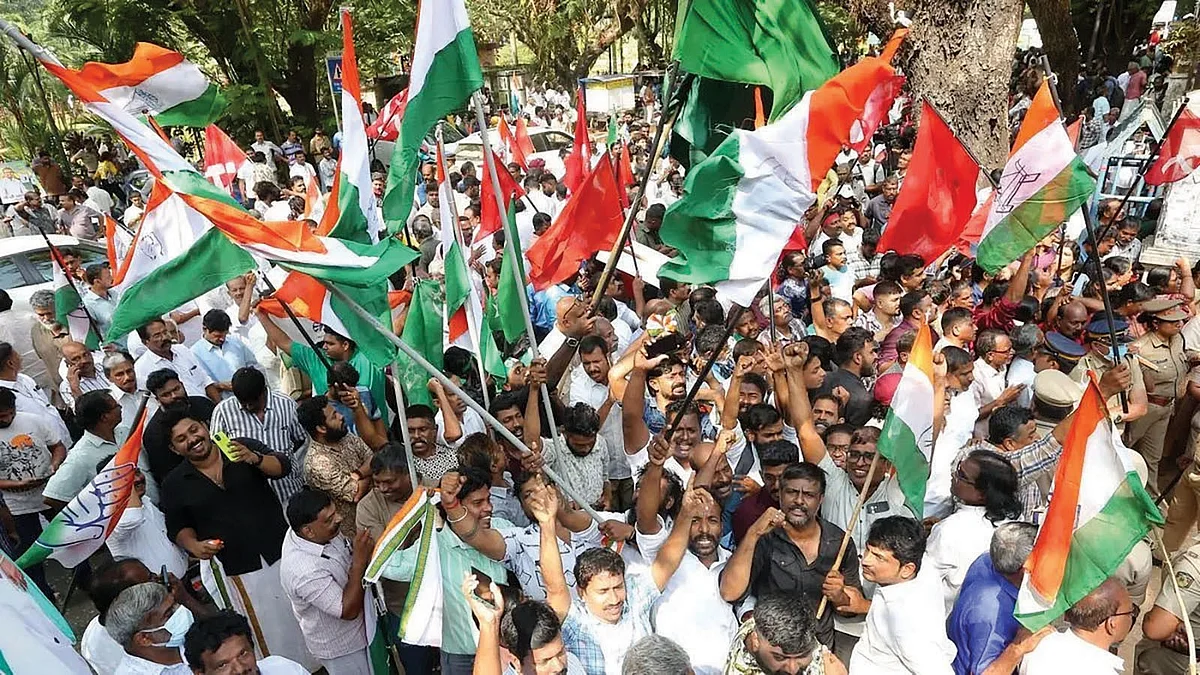


Kerala does not change governments in a hurry. Its political shifts are rarely dramatic. They grow quietly, through fragments of doubt, conversations that question, loyalties that begin to fray at the edges. As the state heads into a high-stakes Assembly election, that quiet churn is unmistakable.
The CPI(M)-led Left Democratic Front (LDF), which made history in 2021 by breaking Kerala’s four-decade pattern of alternating governments, now finds itself confronting not just anti-incumbency but a deeper erosion of political authority. The Congress-led United Democratic Front (UDF), on the other hand, is no longer waiting for the Left to falter. It is actively building a case for return, with a clarity and discipline that has eluded it for years.
Leader of Opposition V.D. Satheesan has emerged as a sharp and consistent campaigner. Speaking to National Herald, Satheesan said, “This is not just about misgovernance. We are witnessing a situation where the CPI(M) is indirectly benefiting from the BJP’s presence. That is the real political question before Kerala.”
He went further, accusing the LDF of drifting away from its ideological moorings. “Today, the Congress reflects the concerns of real Leftists as well. Many of them feel alienated by what the CPI(M) has become.”
This charge goes to the heart of the Left’s identity. In a state where the CPI(M) has long wielded ideological clarity against the BJP, any suggestion of political accommodation carries serious implications. The Congress has reframed the contest, not merely as a choice between two alliances but as a question of political integrity.
Rahul Gandhi has reinforced this line, and his exchanges with chief minister Pinarayi Vijayan have given the campaign an unconventional directness. Political commentator Joseph C. Mathew captures the shift clearly. “For a long time, the Congress was reactive in Kerala. Now it is setting the agenda. By raising the question of a CPI(M)-BJP equation, it is forcing the Left to defend its ideological position, not just its governance record.”
The Congress has also recalibrated its strategy on the ground. Over the past year, the party has organised a series of thematic conclaves and consultations across Kerala, focusing on health, education, employment and the future of the state’s economy. These were not symbolic exercises, they were designed to project a governing vision that goes beyond criticism of the LDF.
On health, the Congress has promised to strengthen primary care networks while addressing emerging gaps in infrastructure and staffing. On education, it has emphasised quality, employability and global competitiveness, seeking to align Kerala’s strong base with changing economic realities. On jobs, the focus has been on decentralised industrial growth, support for small enterprises and creating opportunities that reduce the compulsion for migration.
This imagining and articulation of policy has been accompanied by a clear political message: the Congress as custodian of Kerala’s social harmony. At a time when national politics is marked by polarisation, the UDF is emphasising the protection of minority rights, constitutional values and social justice.
The party has repeatedly underlined its commitment to safeguarding Kerala’s plural fabric, arguing that development cannot be separated from inclusiveness. This emphasis is not incidental. It is central to the Congress’s attempt to rebuild a broad social coalition that cuts across communities.
Equally significant has been the Congress’s management of its own internal contradictions. Potential friction over candidate selection, including the ambitions of senior leaders and MPs such as K. Sudhakaran, has been handled with relative discipline. The party has avoided public ruptures, signalling a level of organisational maturity that was previously missing. This has strengthened its credibility as a stable alternative.
In contrast, the LDF finds itself on complex and uncomfortable terrain. Pinarayi Vijayan remains the most powerful political figure in Kerala, but the nature of that power is under scrutiny. His leadership style, once seen as decisive and reassuring, is now increasingly described as centralised and distant. The space for dissent appears limited.
There are allegations that the LDF has invested heavily in projecting Vijayan through elaborate public relations, creating what opponents describe as a ‘personality cult’ that is, as the Congress points out, a departure from the collective ethos that once defined the Left.
These perceptions are echoed, cautiously but clearly, within sections of the Left itself. Veteran leader G. Sudhakaran, who walked out of the CPI(M) after four decades of public life that included stints as MLA and minister, has now entered the electoral fray in Ambalapuzha with UDF support. His departure has become a political marker of the unease within the party. “The party must return to its collective functioning,” he said. “Centralisation cannot become the norm. That is not how the Left has worked.”
At the grassroots, there are signs of drift. Local leaders, cooperative figures and community intermediaries who once formed the backbone of the Left’s political machinery are no longer uniformly aligned. Some have withdrawn into silence. Others are quietly recalibrating their positions.
Writer and critic M.N. Karassery situates this within a broader cultural context. “The Left still has a strong base and ideological appeal,” he says. “But elections are not won on legacy alone. They require renewal. The question is whether the LDF has been able to renew itself.”
The memory of Sabarimala continues to cast a shadow over the political landscape. For many believers, the issue was not merely about a court verdict but about the state’s response. The perception that the government acted with inflexibility, without adequate sensitivity to faith, has not entirely faded.
Karassery says, “Many felt the state was not listening. That sentiment still lingers.” The BJP attempted to convert this sentiment into electoral gains but failed to sustain momentum. The Congress handled it by positioning itself as respectful of faith while remaining within a constitutional framework. This measured approach resonated particularly in central Kerala.
The LDF continues to defend its record with confidence. Senior leader K.K. Shailaja, contesting from Peravoor in Kannur, has dismissed the Opposition’s claims. “The LDF government has delivered in health, welfare and social security in ways that are nationally recognised,” she said. “People will judge us on our work, not on allegations.”
The electorate, though, is more sceptical. Welfare schemes continue, but they no longer generate the same political enthusiasm. Younger voters, shaped by migration and changing aspirations, are looking beyond welfare. Job creation within the state has not kept pace with expectations. Educated youth continue to look outside Kerala for better prospects. Fiscal pressures limit the scope for expanding welfare.
These concerns do not always translate into immediate electoral shifts, but they shape the mood in ways that are politically consequential. Despite sustained efforts, the BJP’s organisational expansion has not translated into electoral success. Kerala resists easy polarisation and attempts to consolidate votes along religious lines have faced structural limits.
What emerges is the kind of open contest not seen in years. The LDF’s strengths are significant: its cadre base is disciplined, its ideological appeal remains relevant, Pinarayi Vijayan continues to command respect across sections. But the Congress has altered the terms of engagement. Organised, assertive and politically engaged, it is offering a framework for governance built around jobs, public services, social justice and communal harmony. For the first time in a decade, the possibility of a Congress-led return is real.
Join our official telegram channel (@nationalherald) and stay updated with the latest headlines