


Dipankar attacks Centre over labour codes as Bharat Bandh sees mixed response
CPI(ML) leader says policies threaten workers and farmers amid nationwide protests
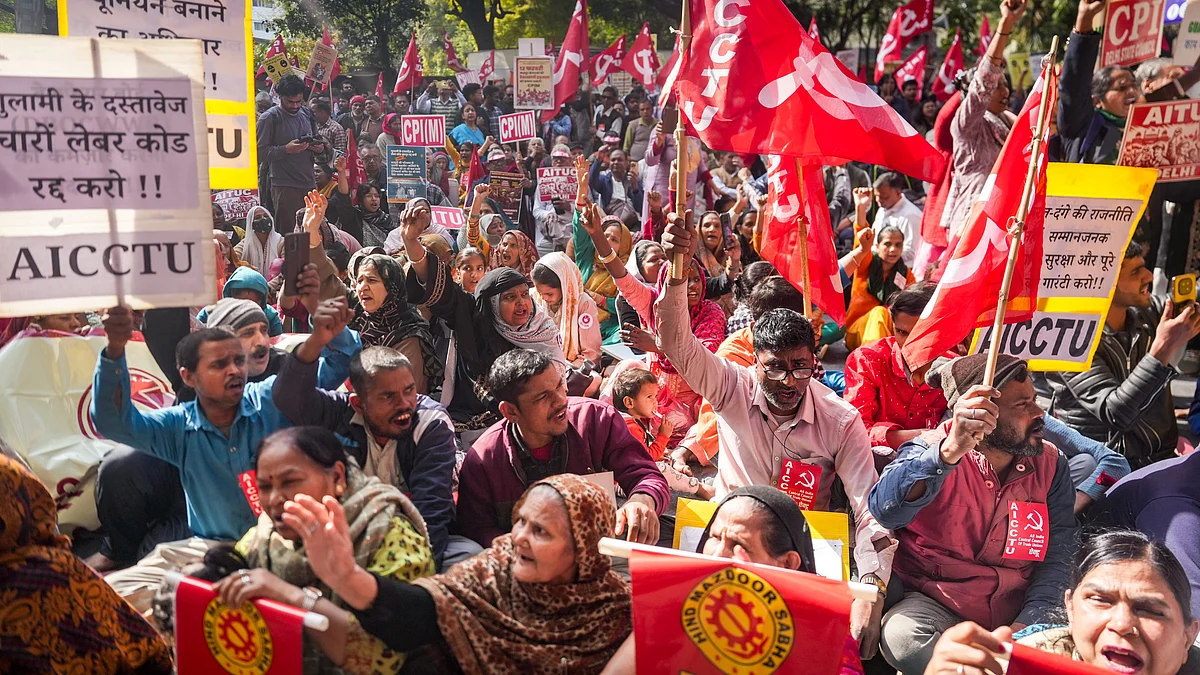


CPI(ML)-Liberation general-secretary Dipankar Bhattacharya on Thursday mounted a sharp attack on the Narendra Modi government, accusing it of undermining workers’ rights and farmers’ interests through labour reforms, welfare changes and trade policy, as trade unions and farmers’ organisations staged a nationwide strike.
Speaking on the sidelines of a demonstration organised by his party in Patna, Bhattacharya criticised the introduction of new labour codes, the replacement of MGNREGA with the VB-GRAMG scheme, and the proposed trade deal with the United States.
"The Opposition is rightly calling the proposed trade deal with the US a trap deal. It will jeopardise the interests of the country's farmers. So far, our farmers have been fighting Ambani and Adani, but now they will also be pitted against America," Bhattacharya alleged. "Never before have the interests of our farmers been compromised while striking a trade deal with another country. Prime Minister Narendra Modi has, in effect, given up on his earlier slogans of 'Make in India' and 'Viksit Bharat'."
Bhattacharya also claimed that the recently introduced labour codes will "force workers to become slaves of the owners of business enterprises where they offer their labour" and the VB-GRAMG will "deprive the rural population of the right to livelihood that had been guaranteed through MGNREGA".
Bhattacharya further alleged that the BJP-led NDA’s electoral success in Bihar had translated into governance that people were beginning to perceive as burdensome. He pointed to what he described as “bulldozer-style” administration and expressed concern that revisions to electoral rolls could be manipulated for political gain.
The strike itself drew varied responses across states. In Bihar’s Katihar district — a CPI(ML) stronghold — trade unions, farmers’ organisations and student groups blocked a national highway, disrupting traffic on NH-31 for several hours before movement resumed. Processions were also held in other areas in support of the bandh.
In Kerala — traditionally a stronghold of Left politics and trade union mobilisation — the shutdown had a far wider impact, disrupting daily life across the state. Attendance at government offices remained low despite the administration declaring a dies non for employees who stayed away, warning that unauthorised absence would result in salary deductions and limited leave exceptions.
Public transport services were largely paralysed as state-run and private buses stayed off the roads and auto-rickshaw unions joined the strike, leaving travellers stranded. Passengers arriving by train reported long waits for onward connections, with police arranging limited transport support at some stations. Special bus services were nevertheless operated for pilgrims travelling to Sabarimala, while metro rail and app-based taxis offered partial relief in urban centres.
Commercial activity also slowed sharply, with many shops closed and financial institutions that initially opened later shutting under protest pressure. All educational institutions remained closed. Trade unions organised rallies and meetings across districts, where leaders accused corporates of exploiting labour and criticised labour law changes they said would extend working hours and weaken safeguards.
Despite heavy police deployment, only isolated incidents were reported, including a minor scuffle at a school in Kozhikode when protesters attempted to enforce closure. Industrial parks, IT hubs and the Kochi Special Economic Zone continued operating with skeletal staff using special transport arrangements, highlighting the uneven but substantial reach of the strike.
In Maharashtra, protests were organised in several locations but without major disruption. Trade union leaders demanded withdrawal of the labour codes, an end to privatisation, filling of vacancies and a minimum wage of Rs 30,000 per month. Demonstrations were held outside the state labour commissioner’s office in Mumbai, with support from opposition political figures and participation reported in parts of Palghar district.
The nationwide strike was called to oppose what unions described as anti-worker and anti-farmer policies of the Union government. While participation levels varied, Bhattacharya’s criticism underscored the broader political narrative emerging from the protests — that labour reforms and economic policy remain a central flashpoint between the Centre and sections of organised labour and Opposition groups.
With PTI inputs
Join our official telegram channel (@nationalherald) and stay updated with the latest headlines