


Lok Sabha passes SHANTI nuclear energy Bill amid Opposition walk-out
Opposition members warn of safety risks, diluted liability and demand deeper scrutiny of private entry
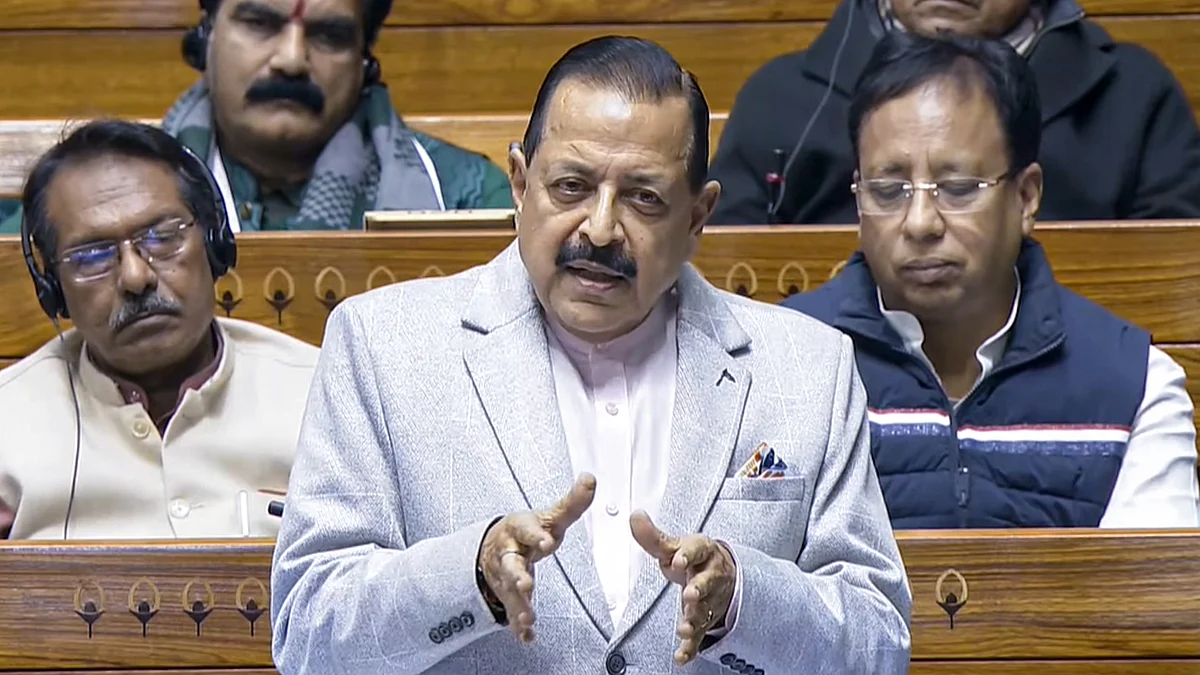


Amid a walkout by Opposition parties, the Lok Sabha on Wednesday passed the Sustainable Harnessing and Advancement of Nuclear Energy for Transforming India (SHANTI) Bill, clearing the way for private participation in India’s civilian nuclear energy sector even as critics across parties warned that the legislation weakens safety, accountability and public oversight.
The Bill was passed by a voice vote, with Union minister of state for the departments of space and atomic energy Jitendra Singh hailing it as a “milestone legislation” that would help India meet its target of generating 100 gigawatts of nuclear power by 2047. Singh argued that nuclear energy was central to India’s clean energy transition and its global ambitions.
“India’s role in geopolitics is increasing. If we have to be a global player, we have to follow global benchmarks and global strategies,” Singh told the House. “The world is moving towards clean energy. We too have set a target of 100 GW of nuclear energy capacity by 2047.”
The government has maintained that opening the sector to private players will unlock investment, accelerate capacity addition and reduce reliance on fossil fuels. Opposition parties, however, accused the Centre of rushing through a far-reaching reform without adequately addressing long-standing concerns over nuclear safety, liability and regulation.
Congress MP Shashi Tharoor mounted a detailed critique of the Bill, objecting to its description of nuclear power as a “clean and abundant” source of energy. He said the language was “dangerously misleading” as it ignored “serious, massive and irreversible risks from radioactive leaks and long-lived nuclear waste that remains hazardous for millennia”, as well as the possibility of catastrophic accidents.
Tharoor also warned that the Bill effectively throws open the entire nuclear sector to private actors. Under its provisions, any company or individual explicitly permitted by the central government would be eligible to apply for a licence to set up and operate nuclear facilities.
“This effectively amounts to a blanket opening up of the entire nuclear energy sector,” he said, cautioning that it could allow entities with “indeterminable and indeterminate qualifications” into a domain traditionally governed by strict state control.
On liability, Tharoor argued that the Bill shifts financial risk from private operators to the public. He pointed out that the Central government would become liable once damages exceeded the operator’s liability cap. “In effect, public funds — taxpayers’ money — will compensate for all the damages caused by private facilities,” he said, adding that the provision “does nothing but further dilute corporate accountability for systemic failures, occupational safety and health”.
He also criticised the limitation periods prescribed for compensation claims — three years for filing applications, with rights extinguished after 10 years for property damage and 20 years for personal injury. Given the long latency of radiation-related illnesses, Tharoor called the limits “frankly, shamefully restrictive”, noting that cancers can emerge decades after exposure and that genetic impacts can span generations.
Congress MP Manish Tiwari echoed these concerns, accusing the government of stripping the law of supplier liability altogether. “I did not find a single clause or a single word which says anything about supplier liability. The supplier liability has been completely removed,” Tiwari said, arguing that if India were to depend on foreign suppliers, they must be held accountable in the event of a nuclear incident.
Tiwari also questioned the independence of the Atomic Energy Regulatory Board, asking whether it functioned as an autonomous regulator or merely as an extension of the department of atomic energy. Without a genuinely independent regulator, he warned, private participation could create serious safety risks. He further flagged the absence of a robust statutory framework for radioactive waste disposal, arguing that such critical issues could not be left to delegated legislation.
Adding to the chorus of Opposition voices, Samajwadi Party MP Dimple Yadav said the Bill had drawn resistance across party lines due to multiple flaws that raised concerns about public safety. “All parties have strongly opposed it because several flaws have been observed that raise concerns about the safety of our country’s citizens,” she said. “We believe the government should refer it to a JPC if its intentions are genuine.”
Despite the objections and demands for the Bill to be sent to a joint parliamentary committee for closer scrutiny, the government pressed ahead. Opposition MPs staged a walkout before the vote, allowing the legislation to be passed by voice vote.
The passage of the SHANTI Bill marks one of the most significant shifts in India’s nuclear energy policy in decades and is expected to intensify debate outside Parliament over private participation, foreign investment, regulatory independence and whether India’s push for clean energy has come at the cost of long-established safeguards on nuclear safety and liability.
With PTI inputs
Join our official telegram channel (@nationalherald) and stay updated with the latest headlines