


Nitish gave up CM's post on his own, BJP didn't ask him to do so: Samrat
Bihar CM credits Nitish with reciprocating Vajpayee’s 2000 gesture, invokes BJP’s role in Lalu Prasad’s rise
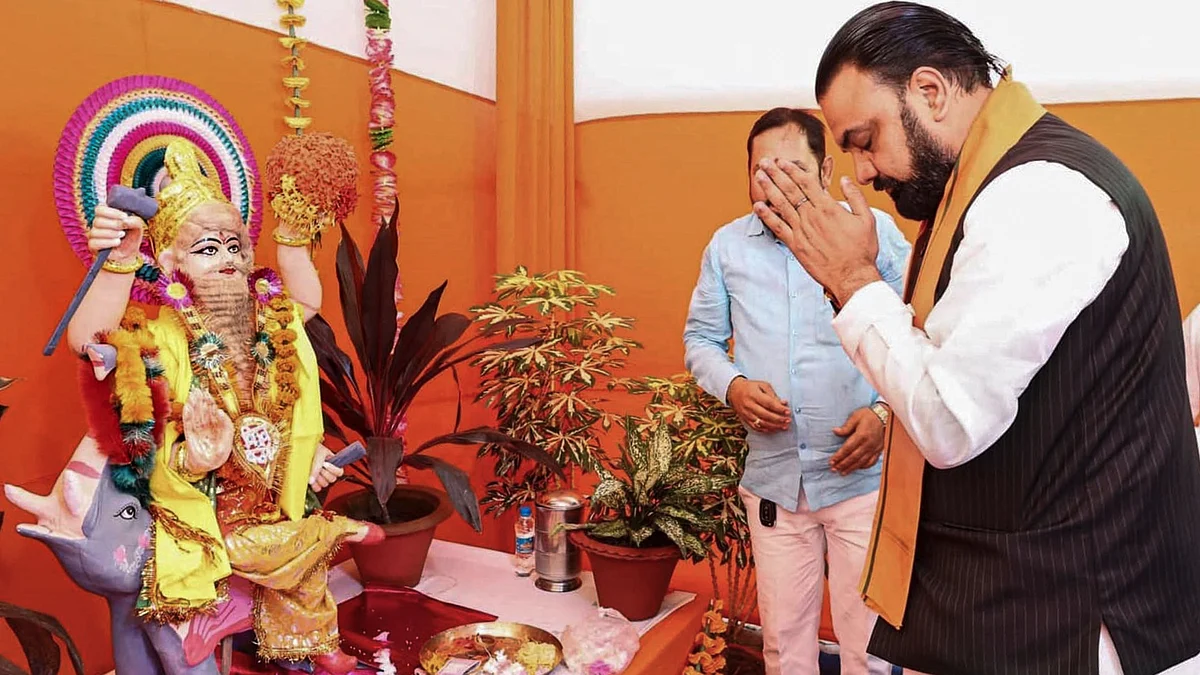


Samrat Choudhary says Nitish Kumar stepped down voluntarily and remains the NDA’s “undisputed leader” in Bihar.
Choudhary invokes BJP’s past support for Nitish and Lalu Prasad, while trading barbs with Tejashwi Yadav over his own elevation as chief minister.
Asked about staying in office until 2030, Choudhary sidesteps question, says he owes his position to Narendra Modi and Nitish Kumar.
Bihar chief minister Samrat Choudhary on Friday, 18 September offered a rather generous account of the change of guard in the state, insisting that his predecessor and JD(U) president Nitish Kumar had stepped down voluntarily and had not been elbowed out by the BJP.
Choudhary, the first BJP leader to head the Bihar government, also stressed that Kumar, now a Rajya Sabha MP, "remains the NDA's undisputed leader in Bihar" — even as he explained how the outgoing chief minister had apparently decided to make way for him.
"Nitish Kumar stepped down of his own accord. We had not asked him to do so. Of course, he did acknowledge the fact that Atal Bihari Vajpayee had let him become the chief minister for the first time when BJP had more MLAs than his party and that he now wanted to reciprocate the gesture," Choudhary said at an event organised by a media group in Patna.
The reference was to 2000, when a hung Assembly election saw Kumar, whose party was then known as the Samata Party, take oath as chief minister. He resigned within a week after the NDA failed to cobble together a majority.
While underlining the "support" the BJP had extended to Kumar, Choudhary also reached further back into Bihar's political history, pointing out that RJD president Lalu Prasad too owed his rise to the "benediction" of the BJP.
"Lalu ji became chief minister of Bihar thanks to the benediction of the BJP. Of course, those who witnessed that era would also recall that in doing so he snatched away the rightful claim of Dalit leader Ram Sundar Das," he said.
Prasad was then with the Janata Dal, which formed the government in Bihar in 1990 with outside support from the BJP. Das, who had served briefly as chief minister in the 1970s, was also in the race and was believed to have the backing of then Prime Minister V.P. Singh.
In the election for leader of the legislative party, however, Das lost to Prasad by a narrow margin. Political analysts have attributed the outcome partly to a division in the upper-caste vote after another Janata Dal leader, Raghunath Jha, entered the contest.
Choudhary, who himself began his ministerial career in the government headed by Rabri Devi, Lalu Prasad's wife and successor as chief minister, also bristled at Tejashwi Yadav's description of him as a "selected, and not elected" leader.
Without naming Yadav — RJD's working president and leader of Opposition in the Assembly — Choudhary said, "He should remember that his mother too was not elected by the people when she first became CM. And his party had not announced beforehand that it would back him for the deputy CM's post."
Choudhary, whose elevation to the chief minister's post less than a decade after joining the BJP is understood to have caused some heartburn within the party, sidestepped a question on whether he expected to remain in office until the next Assembly elections in 2030.
"I am a small leader who owes his standing to the blessings of Prime Minister Narendra Modi and Nitish Kumar, the NDA's undisputed leader in Bihar. The party has given me a lot. I was made state president, became Deputy CM twice and, for the first time, got the Home portfolio, which earlier remained with the CM. I am focused on doing my job," he said.
Choudhary said his priorities were law and order, education and improving revenue generation through industrialisation.
He also claimed that his government was effectively handling the ongoing floods with assistance from the Centre, while the state was pursuing longer-term measures, including the inter-linking of rivers.