


Suvendu’s Durga immersion diktat draws fire over religious exclusion
Opposition questions Bengal CM's religious restriction, flags its implications for Muslim labourers
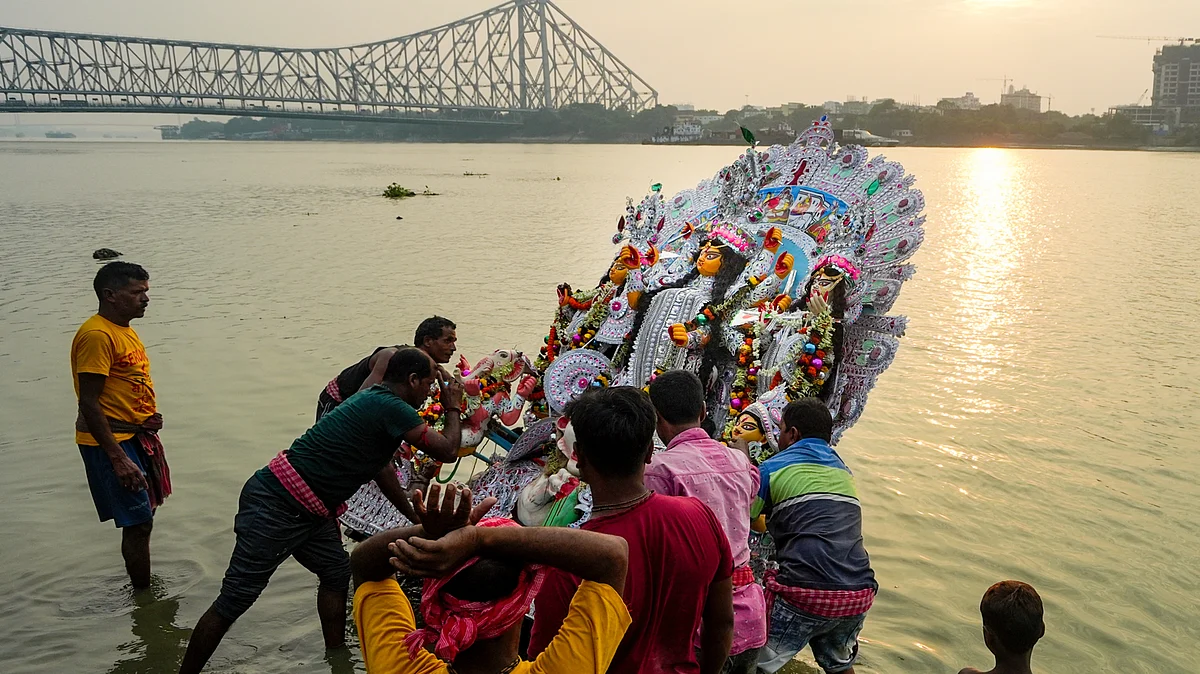


Suvendu Adhikari says only followers of Sanatan Dharma can touch Durga idols during immersion.
Opposition leaders question the directive’s religious exclusion and implications for Muslim labourers.
CPI(M), Congress and TMC leaders challenge how the restriction would be defined and enforced.
West Bengal chief minister Suvendu Adhikari’s declaration that only followers of Sanatan Dharma will be allowed to touch Durga idols during immersion has drawn criticism from Opposition leaders, who have questioned its constitutional implications and the religious exclusion it entails.
Reviewing immersion arrangements at Babughat in Kolkata on Wednesday, 21 October, Adhikari said he had instructed Kolkata Police commissioner Ajay Kumar Nand to identify those involved in carrying idols into the Hooghly river.
Adhikari defended the proposed restriction as a matter of religious tradition and ritual purity, insisting that it was not communal. But his explanation does not resolve the central issue: the proposed distinction is explicitly based on religious identity.
By making the handling of Durga idols during immersion conditional on adherence to Sanatan Dharma, the directive raises questions about who gets to participate in a public religious celebration and who may be excluded. The implications are particularly pertinent for Muslim labourers, many of whom are involved in transporting and handling idols during Durga Puja.
CPI(M) leader Bikash Ranjan Bhattacharya accused Adhikari of acting against the Constitution and promoting Hindu fundamentalism. He questioned how the chief minister intended to determine who qualified as a follower of Sanatan Dharma.
Bhattacharya also challenged the premise of the restriction, asking whether Adhikari had a list of those who qualified as Sanatanis and those who did not.
Congress spokesperson Suman Roy Chowdhury condemned the announcement, arguing that a person holding constitutional office should not make remarks that undermine India's pluralistic framework. He accused Adhikari of encouraging the social boycott of non-Hindus and alleged that the move was politically motivated.
Trinamool Congress leader Baishwanar Chatterjee questioned Adhikari’s understanding of Hinduism’s inclusive traditions and raised a practical concern: what would the proposed restriction mean for non-Hindu workers who handle idols as part of their jobs?
The question is especially relevant in West Bengal, where Muslim labourers are among those involved in the transportation and handling of Durga idols. If the restriction is enforced as announced, would these workers be prevented from carrying idols into the river because of their faith?
The issue goes beyond ritual practice. A directive that makes the handling of idols contingent on religious identity risks turning a question of religious observance into one of exclusion from work. It also leaves unanswered how religious eligibility would be established, who would enforce the restriction and whether workers could lose access to employment on the basis of their faith.
Adhikari has maintained that the measure is intended to preserve religious traditions and the sanctity of immersion rituals. He has also stressed that Durga Puja is primarily a religious observance.
But invoking tradition does not, in itself, answer the criticism that the proposed restriction draws a religious boundary around participation in a festival celebrated across communities. Nor does a denial of communal intent erase the exclusionary implications of a rule that explicitly distinguishes between people on religious grounds.
The political dispute is therefore not simply about ritual practice. It concerns the implications of a chief minister publicly directing that access to an immersion ceremony be determined by religious identity — and the message such a distinction sends in a state whose cultural life has long been shaped by participation across communities.
Join our official telegram channel (@nationalherald) and stay updated with the latest headlines