


‘Vote chori’ biggest anti-national act: Rahul in fiery Lok Sabha address
LoP asks three questions, proposes four reform measures including machine-readable voter lists and independent access to EVMs
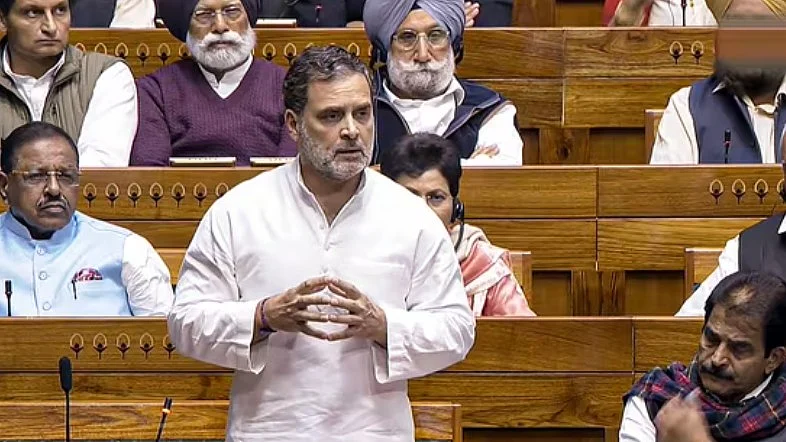


In one of his sharpest interventions during the ongoing winter session of Parliament, Lok Sabha Leader of Opposition Rahul Gandhi on Tuesday turned a Lok Sabha debate on electoral reforms into a sweeping indictment of the BJP-RSS, accusing them of systematically “capturing institutions” and “stealing elections” to subvert India’s democratic architecture.
Casting the moment as a constitutional crisis, Gandhi warned that the ruling regime was eroding the integrity of the vote — the foundation on which the republic rests.
“India is not only the biggest but the greatest democracy in the world,” Gandhi said. “Today, the BJP and the Election Commission are colluding to destroy that democracy and rob people of their voice.” Vote chori (theft), he argued, was not merely malpractice but the “biggest anti-national act”, because it destroys “the fabric of this country, modern India, the idea of India”.
Gandhi cited examples from Haryana — including a Brazilian woman allegedly appearing 22 times on the voter list, and another voter’s name appearing over 200 times — as evidence of what he described as a widening pattern. “The election was stolen,” he said, adding that the recent Assembly polls in Madhya Pradesh, Chhattisgarh and Maharashtra “did not reflect the will of the people” because the ecosystem meant to safeguard elections had been compromised.
He also flagged the 1.2 lakh duplicate images detected even after the Special Intensive Revision (SIR) of electoral rolls in Bihar. “If you’ve cleaned up the voting list, why are there still 1.2 lakh duplicates?” he asked, arguing that the Election Commission of India had no satisfactory answer.
Gandhi structured his attack around three pointed questions for the government, which he said “make it absolutely clear that the BJP is directing and using the Election Commission”:
1. Why was the CJI removed from the EC selection panel?
He questioned the government’s decision to alter the constitution of the committee that selects election commissioners, replacing the Chief Justice of India with a cabinet minister. “What motivation could there be to remove the CJI?” he asked. As the LoP on the committee, he said he had “no voice” against Prime Minister Narendra Modi and home minister Amit Shah. “What they decide is what happens.”
2. Why grant sweeping immunity to election commissioners?
Referring to amendments passed in December 2023, Gandhi asked why election commissioners were given blanket protection from legal scrutiny. “Why would the prime minister and the home minister give this unprecedented gift of immunity?” he asked, insisting such safeguards serve one purpose only — shielding wrongdoing.
3. Why weaken CCTV safeguards during polling?
Gandhi criticised the provision allowing CCTV footage from polling stations to be destroyed after 45 days. Rejecting the government’s explanation that it was a storage issue, he said: “This is not about data; it is about stealing elections.”
Gandhi laid out four reforms he said were essential for electoral credibility:
Machine-readable voter lists for all parties one month before voting.
Withdrawal of the law allowing destruction of CCTV footage after 45 days.
Full disclosure of EVM architecture and independent examination of the machines.
Reversal of immunity provisions shielding election commissioners.
He delivered a blunt warning to the EC: “We are going to change the law — and that too retroactively. And we will come and find you.”
Broadening the scope of his speech, Gandhi argued that the alleged manipulation of electoral processes was part of a larger ideological project. Citing Mahatma Gandhi’s assassination by Nathuram Godse, he said: “That is not where the project ended. Everything, all the institutions, have emerged from the vote. So it is obvious the RSS has to capture all the institutions that have emerged from the vote.”
He accused the BJP–RSS network of executing a “wholesale capture” of India’s institutional framework — from investigating agencies to regulatory bodies — with the Election Commission at its centre.
Responding to Gandhi, BJP MP Nishikant Dubey dismissed the allegations as baseless, arguing that the Congress had itself pioneered EVM usage.
“All opposition parties spoke about EVMs,” Dubey said. “But EVMs were first introduced by the Congress. Rajiv Gandhi tested them in 1987, and Narasimha Rao expanded them in 1991.”
Dubey also pointed to historical precedent, noting that select committees in 1961 and 1971 had recommended SIRs of electoral rolls and had even suggested electronic voting as a tool to prevent rigging. The BJP, he said, was simply following long-established institutional recommendations.
The clash underscored the polarised political atmosphere ahead of the next general election, with the Opposition portraying electoral reform as central to preserving India’s democratic identity and the government framing accusations as attempts to pre-emptively undermine EC credibility.
For Gandhi and the Opposition, the integrity of the vote is now the battleground on which the political future will be contested; for the BJP, resurrecting Congress’s own history with EVMs is a way to turn the charge of institutional capture back onto its accusers.
Either way, Tuesday’s debate made clear that electoral legitimacy — once a shared foundation — has now become one of the most fiercely fought political issues in Parliament.
Join our official telegram channel (@nationalherald) and stay updated with the latest headlines