


Why the delay? Priyanka questions govt’s changing stand on women’s quota Bill
Congress MP raises issue of quota within quota. The 2011 Census raises questions, particularly as it does not capture the OBC population
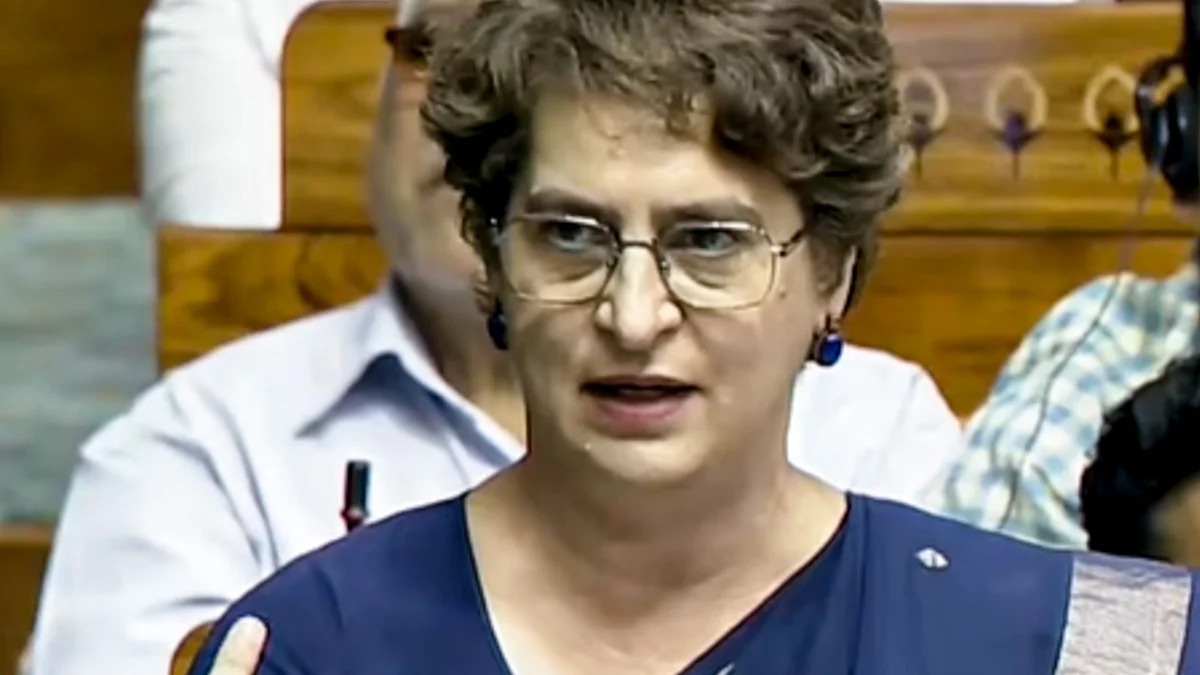


With a blend of history lesson and a sharp political critique, Congress MP and general-secretary Priyanka Gandhi Vadra on Thursday questioned the Centre’s shifting stance on the implementation of the women’s reservation law, taking aim at Prime Minister Narendra Modi during the special Parliament session on the Nari Shakti Vandan Adhiniyam.
Intervening in the debate, Priyanka raised concerns over the government’s decision to link the rollout of women’s reservation to a future delimitation exercise.
She asked why the quota could not be implemented immediately without waiting for an increase in the number of seats. “The Bill passed in 2023 clearly stated that a Census and delimitation would precede the implementation of women’s reservation. Has the government now changed its mind? Why does it want to move ahead on the basis of outdated data?” she asked.
Linking representation to population realities, the Wayanad MP argued that a caste-based census was essential for ensuring equitable political participation. “Fair representation cannot be ensured without updated data. The government’s reliance on the 2011 Census raises questions, particularly as it does not capture the OBC population,” she said.
"Is the Prime Minister intimidated by a caste-based census, fearing that when the real numbers come out, it will be revealed just how large and strong the OBC category is, and no one will be able to deny it then? By using the 2011 census as the basis for delimitation, PM Narendra Modi wants to snatch away the rights of the OBC category, but the Congress party will never allow that to happen," she said.
Invoking history, Priyanka Gandhi countered the Prime Minister’s attempt to portray the Opposition as anti-women. She recalled that in 1928, when Motilal Nehru presented the Nehru Report, it laid down the principle of universal franchise — “one vote, one citizen, one value.”
“Because of this principle, women in India secured voting rights from the very first day of Independence, unlike countries such as the United States, where women had to wait for decades,” she said.
She also recalled that the Rajiv Gandhi government had sought to introduce 33 per cent reservation for women in panchayats and local bodies, but the bill failed to pass at the time due to opposition from the BJP.
In a pointed swipe at the government’s political messaging, she remarked that even Chanakya would be surprised by the present approach.
Challenging Modi’s assertion that no one fears losing their position, Priyanka Gandhi said there should be no hesitation in implementing the reservation without delay. The continued linkage to delimitation, she argued, casts doubt on the government’s intent despite its stated support for the legislation.
Her remarks came amid a charged debate in the Lok Sabha, with sharp exchanges between the Treasury benches and the Opposition over the timing, scope and intent of the proposed changes.
Join our official telegram channel (@nationalherald) and stay updated with the latest headlines