


You have sold India: Rahul Gandhi to govt during discussion on Union Budget
Lok Sabha LoP links US trade deal criticism to global instability, data control and risks to farmers
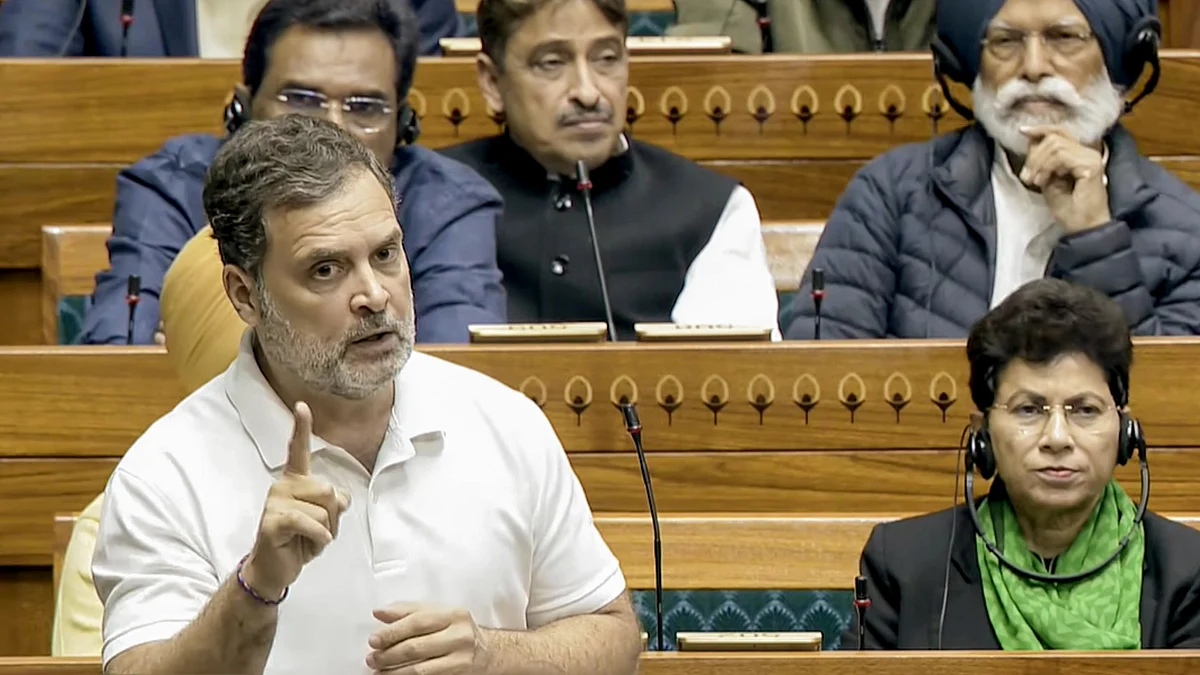


Lok Sabha Leader of Opposition Rahul Gandhi on Wednesday sharpened his criticism of the government over the interim India–US trade agreement, portraying it as a surrender of national leverage and situating his charge within a wider warning about geopolitical volatility, technological disruption and strategic vulnerability.
Participating in the Lok Sabha debate on the Union Budget, Gandhi argued that the arrangement compromised India’s interests in energy, agriculture and digital governance, while contending that policymakers were ignoring the realities of an unstable international environment.
Drawing on the Economic Survey, he said the world was confronting intensifying geopolitical rivalry and the growing weaponisation of energy and finance, signalling a shift “from a world of stability to a world of instability”.
He said this global trajectory contradicted earlier official assertions that large-scale conflict was receding. “The prime minister has stated, and shockingly the NSA has also stated, that the era of war is over,” Gandhi said. “In fact, we are moving into an era of war.” He maintained that such turbulence demanded stronger protection of national strengths.
Returning to the trade pact, Gandhi reiterated his central accusation that the government had conceded excessive ground in negotiations. “You have sold India. Are you not ashamed of selling India? You have sold our mother, Bharat Mata,” he said.
He argued that the deal undermined autonomy in energy procurement and exposed farmers to intensified competition, warning of a “storm” as American agricultural products entered domestic markets. He also alleged that industrial sectors such as textiles faced severe disruption.
At one point, Gandhi used a martial-arts metaphor to suggest the prime minister appeared constrained by external pressure. “When a chokehold is applied in martial arts, you can see fear in the eyes of the person being choked. In the same way, you can see fear in Narendra Modi’s eyes.”
He went on to argue that policy decisions should instead be guided by recognition of India’s intrinsic strengths, identifying population, food security and energy capacity as foundational assets. The country’s “1.4 billion people — brilliant, energetic, and dynamic” represented its central strength, he said, adding that in the digital era citizens generate vast quantities of data that function as the “petrol for AI”.
He warned that artificial intelligence could disrupt employment patterns within the IT sector developed over decades, potentially replacing large numbers of software professionals, while emphasising that farmers and labourers remained the backbone of food production and economic resilience.
According to Gandhi, though the Budget acknowledged geopolitical conflict and financial weaponisation, it did not outline credible responses to these pressures. He said this gap was compounded by the trade agreement, which he alleged diluted India’s digital bargaining power by relaxing localisation controls, permitting cross-border data flows and offering concessions to multinational technology companies.
He maintained that an INDIA bloc government would have negotiated from parity, foregrounding India’s data, energy security and agricultural interests and ensuring discussions occurred “between equals, not as masters and servants”.
Closing his remarks, Gandhi again criticised the agricultural implications of the pact, arguing that small farmers would struggle to compete with industrial-scale imports.
“You yourself say the era of one superpower is over… and yet you have allowed the Americans to weaponise our finance and our energy against us,” he said, before asking: “How can you come to this House and defend this? Are you not ashamed of what you are giving away?”
Join our official telegram channel (@nationalherald) and stay updated with the latest headlines