


Brazil Senate passes Bill that may reduce Bolsonaro's 27-year prison term
Former Brazilian President Jair Bolsonaro is serving a 27-year sentence for his role in a failed coup
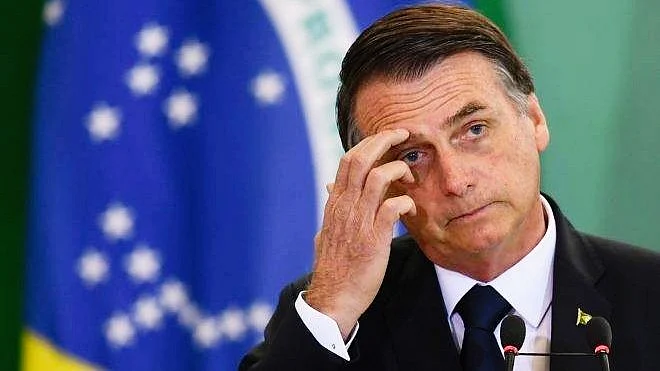


Brazil’s Senate has approved legislation that could sharply reduce the prison terms of those convicted over the January 2023 attempt to overturn the country’s democratic order — a move that may significantly benefit former president Jair Bolsonaro, who is serving a 27-year sentence for his role in the failed coup.
The Bill had earlier cleared the lower house, the Chamber of Deputies, and will now be sent to President Luiz Inácio Lula da Silva for assent. The government, however, has made it clear that the legislation is unlikely to survive in its current form. Lula is expected to veto the Bill, setting the stage for a fresh institutional confrontation between Congress, the executive and the judiciary.
Gleisi Hoffmann, Lula’s minister of institutional relations, said on Wednesday evening that the president would reject the legislation, describing it as a direct challenge to the Supreme Court’s rulings. “Those convicted of attacking democracy must pay for their crimes,” Hoffmann said in a post on X, calling the bill “a sign of disrespect for the Supreme Court and a serious setback to laws that protect democracy”.
Legal experts have also indicated that even if Congress were to override a presidential veto, the law would almost certainly face constitutional challenges before the Supreme Court, which has taken a central role in prosecuting those involved in the 8 January 2023 insurrection in Brasília.
The proposed legislation revises sentencing rules for defendants convicted on multiple charges arising from the same criminal episode — a change that would apply directly to Bolsonaro. The former president was convicted of attempting to abolish the democratic rule of law and leading a coup attempt after supporters stormed Congress, the Supreme Court and the presidential palace days after Lula’s inauguration.
Bolsonaro’s legal team has consistently argued that the cumulative sentence imposed by the court was excessive, maintaining that the charges stemmed from a single set of actions and should not have resulted in stacked penalties. His lawyers have appealed the conviction and sentence, claiming that the punishment was disproportionate and politically motivated.
The Bill would alter how sentences are calculated in such cases, reducing the final prison terms for defendants convicted under multiple overlapping offences. It would also accelerate the progression from stricter prison regimes to more lenient ones, such as semi-open or open custody.
Under current law, Bolsonaro would be eligible to move to a less restrictive prison regime after serving roughly seven years, provided he met behavioural and legal criteria while incarcerated. Paulinho da Força, the Bill’s rapporteur in the Chamber of Deputies, has said under the proposed changes, that period could be cut to just over two years — a reduction that critics argue would effectively hollow out the original sentence.
The legislation also introduces sweeping sentence reductions for crimes committed “in a crowd”, a provision that would benefit hundreds of people convicted for participating in the storming of government buildings during the January 2023 unrest. Defendants who neither financed nor led the actions could see their sentences reduced by between one-third and two-thirds.
Supporters of the Bill frame it as a correction to what they describe as judicial excesses and overly harsh penalties. Opponents, however, see it as a thinly veiled amnesty that undermines accountability for one of the most serious attacks on Brazil’s democratic institutions since the end of military rule.
Senator Flávio Bolsonaro, the former president’s eldest son and a leading figure in the Liberal Party, welcomed the Senate’s approval of the bill, calling it a “first step”. He went further, arguing that the convictions themselves should be annulled. “There shouldn’t even be a debate about amnesty, but about annulling the farce that the entire process was,” he said.
Flávio Bolsonaro is widely expected to be a key challenger to Lula in the 2026 presidential election, as the Liberal Party seeks to keep the Bolsonaro political project alive despite the former president’s legal troubles and political ban.
The Bill’s passage has already triggered a public backlash. On Sunday, tens of thousands of Brazilians took to the streets in Brasília and other major cities, including São Paulo, Florianópolis, Salvador and Recife, protesting what they see as an attempt to rewrite accountability for an assault on democracy.
The controversy underscores Brazil’s deep political polarisation, more than two years after the violent scenes that shocked the country and the world. With the executive vowing a veto, the judiciary poised to intervene and Congress divided, the fate of the legislation — and its implications for Bolsonaro — is likely to be decided not by lawmakers alone, but by Brazil’s highest court.
With AP/PTI inputs
Join our official telegram channel (@nationalherald) and stay updated with the latest headlines