


Israel: West Bank attacks surge amid explosive claims by Netanyahu ex-aide
Approval of 19 new settlements and explosive claims by a former aide put government under mounting scrutiny
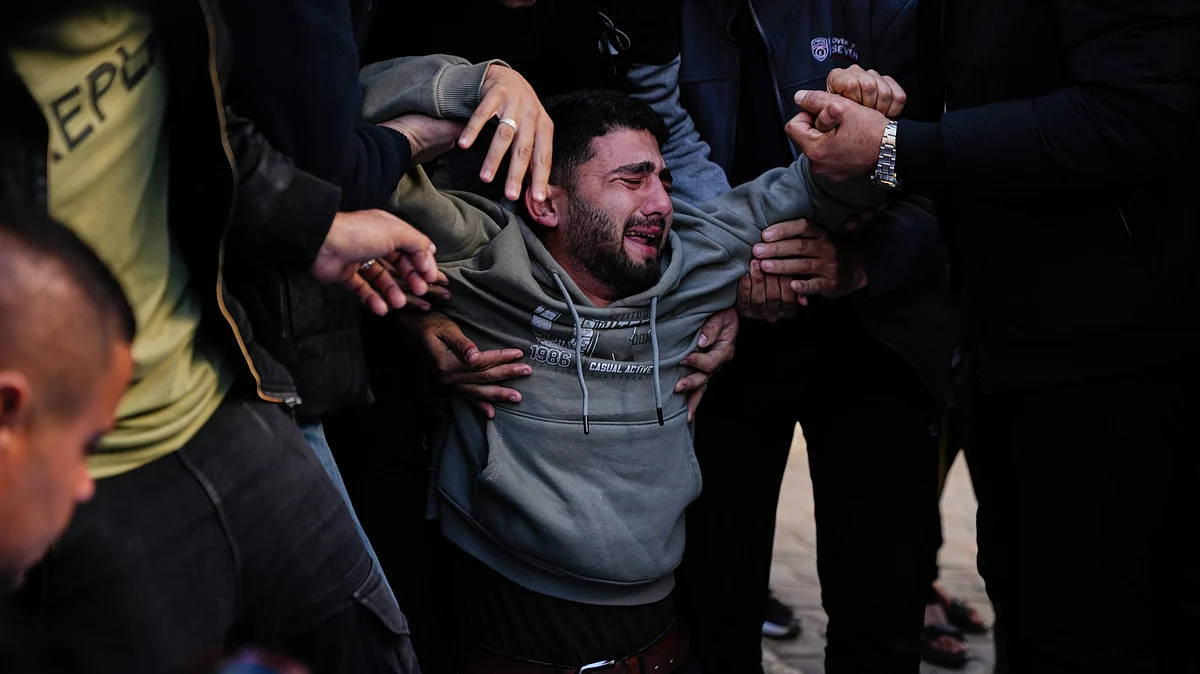


A brutal overnight attack by Israeli settlers on a Palestinian family in the occupied West Bank has once again highlighted the sharp rise in violence against Palestinians — even as Israel’s government faces fresh political pressure at home over allegations that Prime Minister Benjamin Netanyahu sought to deflect responsibility in the aftermath of the 7 October Hamas attack.
Late on Monday night, settlers stormed a Palestinian home in the town of As Samu’, south of Hebron, smashing doors and windows, killing livestock and firing chemical irritants inside the house, according to Palestinian officials. Three children under the age of four were taken to hospital, while several sheep were killed or injured in the attack.
Israeli police said five settlers had been arrested on suspicion of trespassing, vandalism and deploying pepper spray, though they disputed Palestinian claims that tear gas was used. An investigation is ongoing.
Amir Dawood, who heads an office documenting settler attacks within the Palestinian Authority’s Wall and Settlement Resistance Commission, said the assailants were masked and armed with batons. CCTV footage released by the commission shows five figures entering the property as sounds of smashing and animal distress are heard. Subsequent images show bloodied sheep lying dead, smashed vehicles and a ransacked home.
Dawood said the family had been attacked once before in the past two months, calling the assault part of a “systematic and ongoing pattern of settler violence” carried out with impunity. “This is not an isolated incident,” he said. “It is about targeting civilians, their property and their livelihoods.”
The attack comes against the backdrop of a renewed settlement push by Israel. Earlier this month, Israeli authorities approved plans for 19 new settlements in the occupied West Bank — a move welcomed by settler leaders but condemned by Palestinians, the United Nations and most of the international community as illegal under international law.
According to UN data, settler violence has surged alongside settlement expansion. During the October olive harvest alone, settlers carried out an average of eight attacks per day, the highest level since the UN Office for the Coordination of Humanitarian Affairs (OCHA) began systematic tracking in 2006. By 24 November, at least 136 settler attacks had already been recorded that month.
OCHA data also shows that more than 1,200 Palestinians were displaced in the West Bank in 2024 due to settler violence and related access restrictions — the highest annual figure since records began. Rights groups argue that settlement approvals and weak law enforcement have created a permissive environment in which settlers increasingly act as de facto enforcers of Israeli control.
Israel captured the West Bank, east Jerusalem and Gaza in the 1967 war. Today, more than 500,000 Israeli settlers live in the West Bank, alongside over 200,000 in east Jerusalem, territories Palestinians claim for a future state.
European governments and the UN have warned that the latest settlement approvals further erode the viability of a two-state solution. The United States has repeatedly said settlement expansion is “unhelpful” and destabilising, even as it stops short of imposing penalties.
Against this backdrop, Israel’s defence minister briefly inflamed tensions further. Speaking at a conference in a West Bank settlement on Tuesday, Israel Katz said Israel would, “with God’s help”, re-establish Jewish settlements in northern Gaza, two decades after Israel’s withdrawal from the enclave.
“We will do this in the right way, at the appropriate time,” Katz said, echoing long-standing demands from far-right members of Israel’s governing coalition.
Hours later, after video of the remarks circulated widely, Katz’s office issued a clarification, insisting his comments were made “in a security context” and reiterating that Israel “has no intention to establish settlements in the Gaza Strip”.
A US official, speaking on condition of anonymity, appeared to rebuke the initial remarks, warning that inflammatory rhetoric undermines regional diplomacy. “The more Israel provokes, the less the Arab countries will want to work with them,” the official said, adding that Washington expects all parties to adhere to commitments under the US-brokered Gaza ceasefire, which calls for a near-total Israeli military withdrawal and makes no mention of settlement reconstruction.
As violence escalates on the ground, political pressure is mounting at the top. In a televised interview with Israel’s Kan public broadcaster, Eli Feldstein — a former close aide and spokesperson to Netanyahu — alleged that the prime minister’s immediate response to the October 7, 2023 Hamas attack was focused on avoiding blame rather than accountability.
Feldstein said that in the hours after the assault, Netanyahu asked him to gauge whether the media was discussing responsibility for the intelligence failure — and to find ways to counter that narrative. “He asked me, ‘Are they still talking about responsibility?’” Feldstein said. “He wanted something that could be said to offset the storm.”
Feldstein described Netanyahu as “panicked” and claimed he was later instructed by people close to the prime minister to avoid using the word “responsibility” in official statements.
On 7 October, Hamas-led militants killed around 1,200 people in southern Israel and abducted 251 hostages, triggering Israel’s war in Gaza. Since then, nearly 71,000 Palestinians have been killed, according to Gaza’s Health Ministry, which says roughly half the dead are women and children.
Netanyahu has consistently resisted calls for an independent state inquiry into the failures surrounding 7 October, arguing that investigations should wait until the war ends. Critics say the refusal reflects a broader effort to avoid political accountability.
Netanyahu’s office dismissed Feldstein’s claims as “mendacious and recycled allegations” by someone acting out of personal interest.
Feldstein is currently facing trial for allegedly leaking classified military information to a German newspaper in an attempt to improve Netanyahu’s image following the killing of six Israeli hostages in Gaza last year. He is also a suspect in the so-called 'Qatargate' scandal, involving allegations that aides close to Netanyahu received money from Qatar while working for the prime minister.
Taken together, the settler violence in the West Bank, the approval of new settlements, incendiary rhetoric about Gaza and allegations of internal damage control at the highest level underscore what critics describe as a widening credibility crisis for Israel.
Rights groups say unchecked settler attacks and continued settlement expansion are entrenching occupation and eroding the rule of law. Politically, Netanyahu — already under strain from corruption trials and public anger over 7 October — faces renewed scrutiny over whether his government is capable of accountability at home while claiming legitimacy abroad.
As the war grinds on and violence spills across multiple fronts, the gap between Israel’s stated security objectives and the realities on the ground appears increasingly hard to ignore — both for its allies and for Israelis themselves.
With AP/PTI inputs
Join our official telegram channel (@nationalherald) and stay updated with the latest headlines